Cardiovascular Division at Guy's and St Thomas and King's College Hospitals, King's College London, London, United Kingdom.
PLoS One. 2011;6(5):e20317. doi: 10.1371/journal.pone.0020317. Epub 2011 May 31.
Subjects with Polycystic ovarian syndrome (PCOS) are at increased risk of Type 2 diabetes mellitus (T2DM). The mechanism of this enhanced risk is unclear. Circulating vascular progenitor cells (VPC) are immature bone marrow derived cells capable of differentiating into mature endothelial cells. VPC number/function and central arterial stiffness predict cardio-metabolic disease in at-risk populations.
We studied VPC and arterial stiffness measures in non-obese PCOS subjects as compared to age and body mass index (BMI) matched healthy controls in a cross-sectional study.
Fourteen subjects with PCOS and 12 controls of similar age, BMI (all <30 kg/m(2)) and metabolic profile were studied. VPC number and in vitro function were studied by flow cytometry and tube formation assays respectively. Augmentation index (AIx), a measure of central arterial stiffness, and central (aortic) blood pressures (BP) were measured by applanation tonometry.
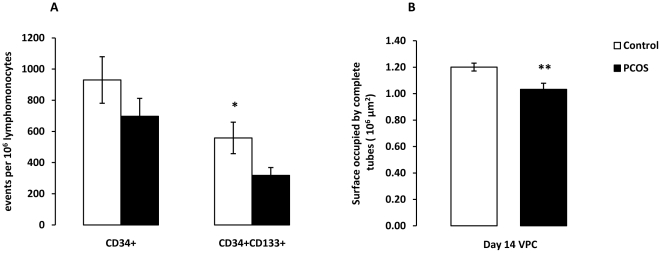
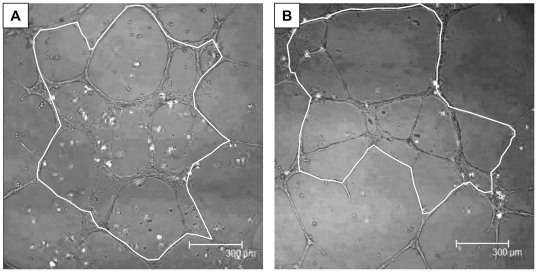
Subjects with PCOS had a reduced number, mean±SEM, of circulating CD34(+)133(+) VPCs (317.5±51.0 vs. 558.3±101.2, p = 0.03) and impaired in vitro tube formation (completed tube area 1.0±0.06 vs. 1.2±0.05×10(6) µm(2) p = 0.02). PCOS subjects had significantly higher AIx (18.4±1.9% vs. 4.9±2.0%) and this difference remained significant even after adjustments for age, BMI and smoking (p = 0.003) in multivariate analyses. Central systolic and pulse pressure were higher in PCOS subjects but these differences were not statistically significant after adjustment for age. Brachial systolic and pulse pressures were similar. VPC number/function and arterial stiffness or BP measures were not correlated.
Non-obese PCOS is characterized by a reduced VPC number, impaired VPC function and increased central arterial stiffness. These changes in novel vascular risk markers may explain the enhanced risk of T2DM and CVD in PCOS.
多囊卵巢综合征(PCOS)患者患 2 型糖尿病(T2DM)的风险增加。其风险增加的机制尚不清楚。循环血管祖细胞(VPC)是一种不成熟的骨髓来源细胞,能够分化为成熟的内皮细胞。VPC 数量/功能和中心动脉僵硬度可预测高危人群的心血管代谢疾病。
我们在一项横断面研究中比较了非肥胖 PCOS 患者与年龄和体重指数(BMI)匹配的健康对照者的 VPC 和动脉僵硬度指标。
研究了 14 例 PCOS 患者和 12 例年龄、BMI(均<30 kg/m2)和代谢特征相似的对照者。通过流式细胞术和管形成测定分别研究 VPC 数量和体外功能。通过平板测压法测量增强指数(AIx),一种中心动脉僵硬度的测量指标,以及中心(主动脉)血压(BP)。
PCOS 患者的循环 CD34+133+ VPC 数量减少,平均值±SEM(317.5±51.0 与 558.3±101.2,p=0.03),体外管形成受损(完成管面积 1.0±0.06 与 1.2±0.05×106μm2,p=0.02)。PCOS 患者的 AIx 显著升高(18.4±1.9%与 4.9±2.0%),即使在多元分析中调整年龄、BMI 和吸烟因素后,这一差异仍有统计学意义(p=0.003)。PCOS 患者的中心收缩压和脉压较高,但调整年龄后差异无统计学意义。肱动脉收缩压和脉压相似。VPC 数量/功能与动脉僵硬度或 BP 测量值之间无相关性。
非肥胖型 PCOS 的特点是 VPC 数量减少、VPC 功能受损和中心动脉僵硬度增加。这些新的血管风险标志物的变化可能解释了 PCOS 中 T2DM 和 CVD 风险增加的原因。