Communicable Diseases Centre, Tan Tock Seng Hospital, Singapore, Singapore.
PLoS Negl Trop Dis. 2011;5(5):e1191. doi: 10.1371/journal.pntd.0001191. Epub 2011 May 31.
The emergence of dengue throughout the tropical world is affecting an increasing proportion of adult cases. The clinical features of dengue in different age groups have not been well examined, especially in the context of early clinical diagnosis.
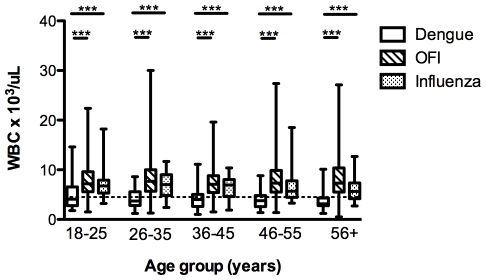
METHODOLOGY/PRINCIPAL FINDINGS: We structured a prospective study of adults (≥ 18 years of age) presenting with acute febrile illness within 72 hours from illness onset upon informed consent. Patients were followed up over a 3-4 week period to determine the clinical outcome. A total of 2,129 adults were enrolled in the study, of which 250 (11.7%) had dengue. Differences in the rates of dengue-associated symptoms resulted in high sensitivities when the WHO 1997 or 2009 classification schemes for probable dengue fever were applied to the cohort. However, when the cases were stratified into age groups, fewer older adults reported symptoms such as myalgia, arthralgia, retro-orbital pain and mucosal bleeding, resulting in reduced sensitivity of the WHO classification schemes. On the other hand, the risks of severe dengue and hospitalization were not diminished in older adults, indicating that this group of patients can benefit from early diagnosis, especially when an antiviral drug becomes available. Our data also suggests that older adults who present with fever and leukopenia should be tested for dengue, even in the absence of other symptoms.
Early clinical diagnosis based on previously defined symptoms that are associated with dengue, even when used in the schematics of both the WHO 1997 and 2009 classifications, is difficult in older adults.
登革热在整个热带地区的出现,正在影响越来越多的成年病例。不同年龄组的登革热的临床特征尚未得到很好的研究,尤其是在早期临床诊断方面。
方法/主要发现:我们对 2129 名成年患者(年龄≥18 岁)进行了前瞻性研究,这些患者在发病后 72 小时内出现急性发热性疾病,并在知情同意的情况下进行了随访。总共 2129 名成年人参加了这项研究,其中 250 名(11.7%)患有登革热。由于登革热相关症状的发生率不同,当应用世界卫生组织(WHO)1997 年或 2009 年的可能登革热分类方案时,敏感性较高。然而,当病例按年龄组分层时,较少的老年患者报告了肌痛、关节痛、眼眶后疼痛和粘膜出血等症状,从而降低了 WHO 分类方案的敏感性。另一方面,老年患者患重症登革热和住院的风险并没有降低,这表明这组患者可以从早期诊断中受益,特别是在抗病毒药物可用的情况下。我们的数据还表明,即使没有其他症状,出现发热和白细胞减少的老年患者也应进行登革热检测。
基于以前与登革热相关的症状进行早期临床诊断,即使在使用世界卫生组织(WHO)1997 年和 2009 年分类方案时,也很难在老年患者中进行。