College of Public Health, University of Nebraska Medical Center, Omaha, NE, USA.
Matern Child Health J. 2011 Dec;15 Suppl 1(Suppl 1):S96-105. doi: 10.1007/s10995-011-0825-6.
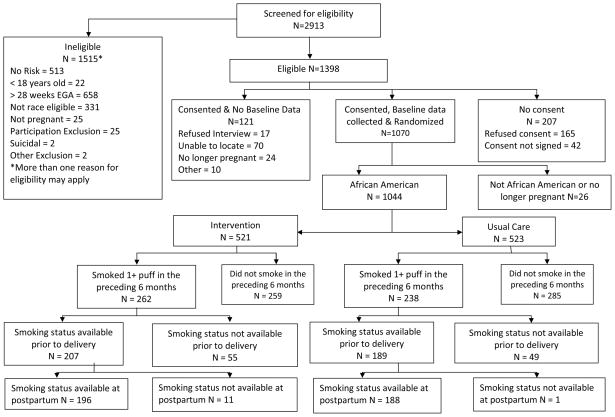
Smoking is the single most preventable cause of perinatal morbidity. This study examines smoking behaviors during pregnancy in a high risk population of African Americans. The study also examines risk factors associated with smoking behaviors and cessation in response to a cognitive behavioral therapy (CBT) intervention. This study is a secondary analysis of data from a randomized controlled trial addressing multiple risks during pregnancy. Five hundred African-American Washington, DC residents who reported smoking in the 6 months preceding pregnancy were randomized to a CBT intervention. Psycho-social and behavioral data were collected. Self-reported smoking and salivary cotinine levels were measured prenatally and postpartum to assess changes in smoking behavior. Comparisons were made between active smokers and those abstaining at baseline and follow-up in pregnancy and postpartum. Sixty percent of participants reported quitting spontaneously during pregnancy. In regression models, smoking at baseline was associated with older age, <a high school education and illicit drug use. At follow-up closest to delivery, smoking was associated with lower education, smoking and cotinine level at baseline and depression. At postpartum, there was a relapse of 34%. Smokers postpartum were significantly more likely to smoke at baseline and use illicit drugs in pregnancy. Mothers in the CBT intervention were less likely to relapse. African-American women had a high spontaneous quit rate and no response to a CBT intervention during pregnancy. Postpartum mothers' resolve to maintain a quit status seems to wane despite their prolonged period of cessation. CBT reduced postpartum relapse rates.
吸烟是围产期发病的最可预防的原因。本研究在高危的非裔美国人人群中检查了妊娠期间的吸烟行为。该研究还检查了与吸烟行为和戒烟相关的风险因素,以应对认知行为疗法(CBT)干预。本研究是对一项针对妊娠期间多种风险的随机对照试验数据的二次分析。500 名报告在妊娠前 6 个月吸烟的非裔华盛顿特区居民被随机分配到 CBT 干预组。收集了心理社会和行为数据。在产前和产后测量自我报告的吸烟和唾液可替宁水平,以评估吸烟行为的变化。在基线和妊娠及产后随访时,将主动吸烟者与不吸烟者进行比较。60%的参与者报告在妊娠期间自发戒烟。在回归模型中,基线时吸烟与年龄较大、<高中教育程度和非法药物使用有关。在最接近分娩的随访中,吸烟与较低的教育程度、基线时的吸烟和可替宁水平以及抑郁有关。在产后,有 34%的人复吸。产后吸烟的人在基线时更有可能吸烟,并且在妊娠期间使用非法药物。接受 CBT 干预的母亲较少复发。非裔美国女性自发戒烟率很高,并且在妊娠期间对 CBT 干预没有反应。尽管产后母亲的戒烟时间延长,但她们保持戒烟状态的决心似乎减弱了。CBT 降低了产后复发率。