Rockhill Karilynn M, Tong Van T, England Lucinda J, D'Angelo Denise V
Division of Reproductive Health, Centers for Disease Control and Prevention, Atlanta, GA.
Oak Ridge Institute for Science and Education, Oak Ridge, TN.
Nicotine Tob Res. 2017 Jul 1;19(7):810-816. doi: 10.1093/ntr/ntw237.
This study aimed to calculate the prevalence of pre-pregnancy nondaily smoking (<1 cigarette/day), risk factors, and report of prenatal provider smoking education; and assess the likelihood of prenatal cessation and postpartum relapse for nondaily smokers.
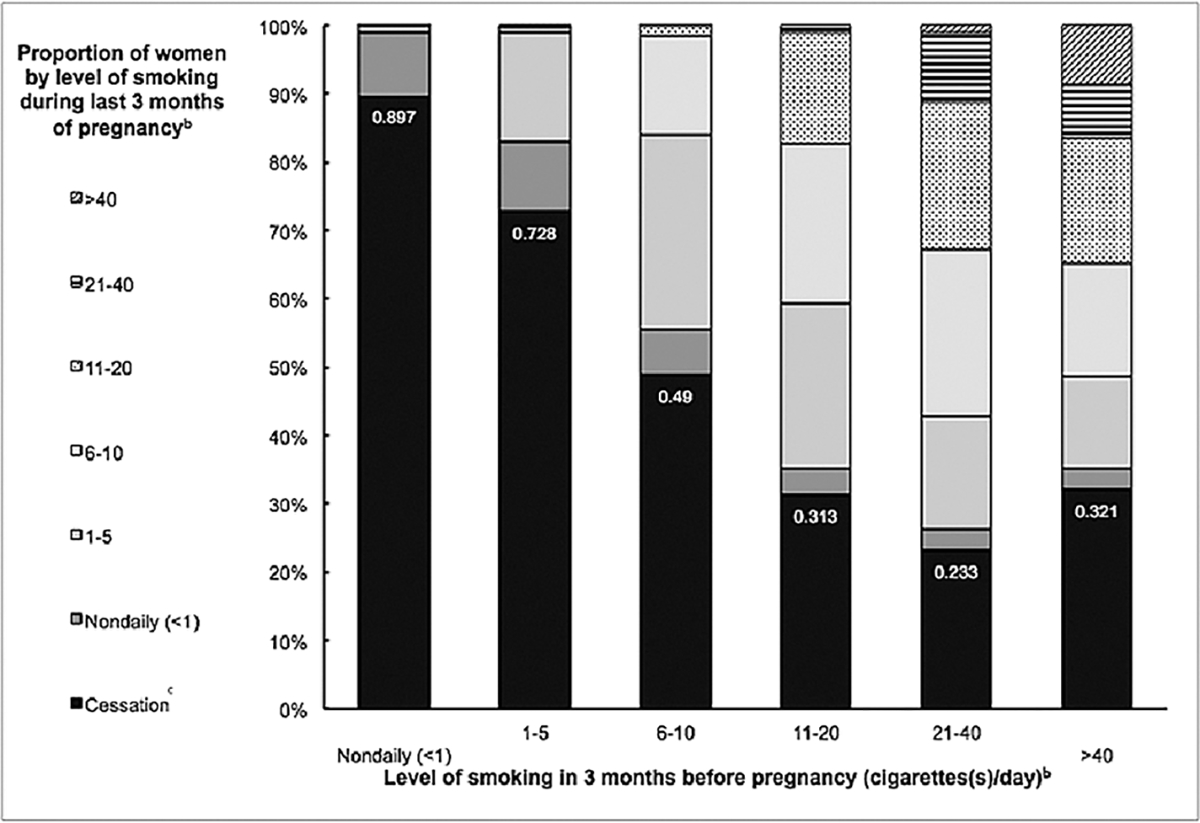
We analyzed data from 2009 to 2011 among women with live-born infants participating in the Pregnancy Risk Assessment Monitoring System. We compared characteristics of pre-pregnancy daily smokers (≥1 cigarette/day), nondaily smokers, and nonsmokers (chi-square adjusted p < .025). Between nondaily and daily smokers, we compared proportions of prenatal cessation, postpartum relapse (average 4 months postpartum), and reported provider education. Multivariable logistic regression calculated adjusted prevalence ratios (APR) for prenatal cessation among pre-pregnancy smokers (n = 27 360) and postpartum relapse among quitters (n = 13 577).
Nondaily smokers (11% of smokers) were more similar to nonsmokers and differed from daily smokers on characteristics examined (p ≤ .001 for all). Fewer nondaily smokers reported provider education than daily smokers (71.1%, 86.3%; p < .001). A higher proportion of nondaily compared to daily smokers quit during pregnancy (89.7%, 49.0%; p < .001), and a lower proportion relapsed postpartum (22.2%, 48.6%; p < .001). After adjustment, nondaily compared to daily smokers were more likely to quit (APR: 1.65; 95% confidence interval [CI]: 1.58-1.71) and less likely to relapse postpartum (APR: 0.55; 95% CI: 0.48-0.62).
Nondaily smokers were more likely to quit smoking during pregnancy, less likely to relapse postpartum, and less likely to report provider education than daily smokers. Providers should educate all women, regardless of frequency of use, about the harms of tobacco during pregnancy, provide effective cessation interventions, and encourage women to be tobacco free postpartum and beyond.
Nondaily smoking (<1 cigarette/day) is increasing among US smokers and carries a significant risk of disease. However, smoking patterns surrounding pregnancy among nondaily smokers are unknown. Using 2009-2011 data from the Pregnancy Risk Assessment Monitoring System, we found pre-pregnancy nondaily smokers compared to daily smokers were 65% more likely to quit smoking during pregnancy and almost half as likely to relapse postpartum. Providers should educate all women, regardless of frequency of use, about the harms of tobacco during pregnancy, provide effective cessation interventions, and encourage women to be tobacco free postpartum and beyond.
本研究旨在计算孕前非每日吸烟(<1支/天)的患病率、风险因素以及产前保健人员吸烟教育报告情况;并评估非每日吸烟者孕期戒烟及产后复吸的可能性。
我们分析了2009年至2011年参与妊娠风险评估监测系统的活产婴儿母亲的数据。我们比较了孕前每日吸烟者(≥1支/天)、非每日吸烟者和非吸烟者的特征(卡方检验校正p<0.025)。在非每日吸烟者和每日吸烟者之间,我们比较了孕期戒烟、产后复吸(产后平均4个月)的比例以及报告的保健人员教育情况。多变量逻辑回归计算了孕前吸烟者(n = 27360)孕期戒烟的校正患病率比(APR)以及戒烟者(n = 13577)产后复吸的校正患病率比。
非每日吸烟者(占吸烟者的11%)与非吸烟者更为相似,在所检查的特征方面与每日吸烟者不同(所有p≤0.001)。报告接受保健人员教育的非每日吸烟者少于每日吸烟者(71.1%,86.3%;p<0.001)。与每日吸烟者相比,非每日吸烟者孕期戒烟的比例更高(89.7%,49.0%;p<0.001),产后复吸的比例更低(22.2%,48.6%;p<0.001)。调整后,与每日吸烟者相比,非每日吸烟者更有可能戒烟(APR:1.65;95%置信区间[CI]:1.58 - 1.71),产后复吸的可能性更小(APR:0.55;95%CI:0.48 - 0.62)。
与每日吸烟者相比,非每日吸烟者在孕期更有可能戒烟,产后复吸的可能性更小,且报告接受保健人员教育的可能性更小。保健人员应教育所有女性,无论吸烟频率如何,告知其孕期吸烟的危害,提供有效的戒烟干预措施,并鼓励女性产后及产后之后都不要吸烟。
在美国吸烟者中,非每日吸烟(<1支/天)的情况正在增加,且存在重大疾病风险。然而,非每日吸烟者孕期的吸烟模式尚不清楚。利用妊娠风险评估监测系统2009 - 2011年的数据,我们发现与每日吸烟者相比,孕前非每日吸烟者孕期戒烟的可能性高65%,产后复吸的可能性几乎减半。保健人员应教育所有女性,无论吸烟频率如何,告知其孕期吸烟的危害,提供有效的戒烟干预措施,并鼓励女性产后及产后之后都不要吸烟。