Tanaka Takuji, Tanaka Mayu, Tanaka Takahiro
Director TCI-CaRP, 5-1-2 Minami-Uzura, Gifu City, Gifu 500-8285, Japan.
Patholog Res Int. 2011;2011:431246. doi: 10.4061/2011/431246. Epub 2011 May 22.
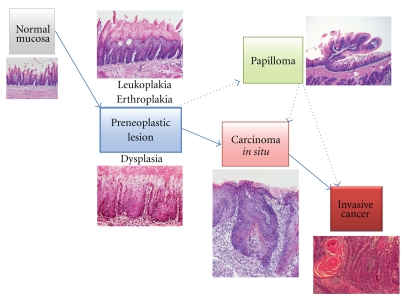
Oral cancer is one of the major global threats to public health. The development of oral cancer is a tobacco-related multistep and multifocal process involving field cancerization and carcinogenesis. The rationale for molecular-targeted prevention of oral cancer is promising. Biomarkers of genomic instability, including aneuploidy and allelic imbalance, are possible to measure the cancer risk of oral premalignancies. Understanding of the biology of oral carcinogenesis will yield important advances for detecting high-risk patients, monitoring preventive interventions, and assessing cancer risk and pharmacogenomics. In addition, novel chemopreventive agents based on molecular mechanisms and targets against oral cancers will be derived from studies using appropriate animal carcinogenesis models. New approaches, such as molecular-targeted agents and agent combinations in high-risk oral individuals, are undoubtedly needed to reduce the devastating worldwide consequences of oral malignancy.
口腔癌是全球对公众健康的主要威胁之一。口腔癌的发展是一个与烟草相关的多步骤、多灶性过程,涉及场癌化和致癌作用。口腔癌分子靶向预防的理论依据很有前景。基因组不稳定的生物标志物,包括非整倍体和等位基因失衡,有可能用于衡量口腔癌前病变的癌症风险。对口腔致癌生物学的理解将在检测高危患者、监测预防干预措施以及评估癌症风险和药物基因组学方面取得重要进展。此外,基于分子机制和针对口腔癌靶点的新型化学预防剂将来自于使用适当动物致癌模型的研究。无疑需要新的方法,如针对高危口腔个体的分子靶向药物和药物组合,以减少口腔恶性肿瘤在全球范围内造成的毁灭性后果。