Sheri-Kashmir Institute of Medical Sciences, Srinagar, Jammu and Kashmir, India.
Influenza Other Respir Viruses. 2011 Nov;5(6):e521-7. doi: 10.1111/j.1750-2659.2011.00261.x. Epub 2011 May 16.
With the emergence of pandemic influenza A (2009A/H1N1) virus in India, we sought to determine the prevalence and clinical presentations of seasonal and pandemic influenza viruses among acute respiratory illness (ARI) patients from Srinagar, a temperate climate area in northern India, during the peak winter season.
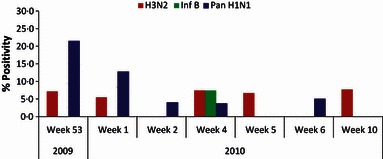
Combined throat and nasal swabs, obtained from 194 (108 male) presenting with ARI from January to March 2010 (Week 53-week 10), were tested by RT-PCR for influenza A and B, including 2009A/H1N1 viruses. HA1 gene of selected 2009A/H1N1-positive samples was sequenced, and phylogenetic analysis was carried out.
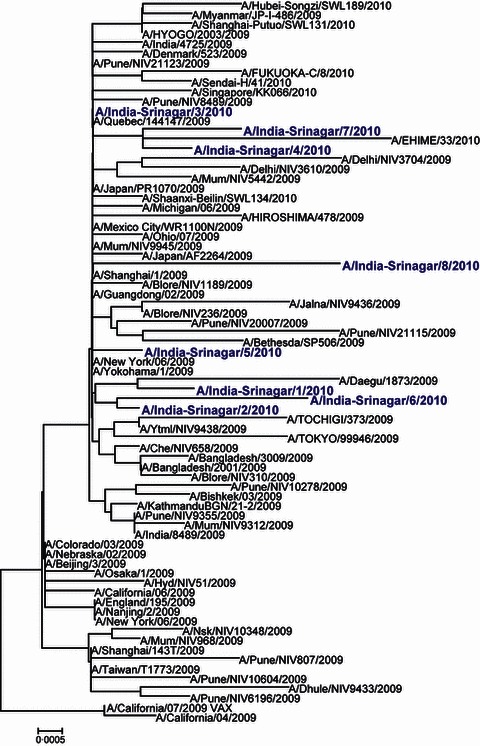
Twenty-one (10·8%, age 15-80 years, median age 40 years) patients tested positive for influenza viruses: 13 (62%) for 2009A/H1N1 virus, 6 (28·5%) for seasonal influenza A (H3N2), and 2 (9·5%) for influenza B. Twelve of the 13 patients with 2009A/H1N1 presented with febrile ARI, and eight had associated comorbidities. All of the patients recovered. Phylogenetic analysis of HA gene (n = 8) revealed that all strains from Srinagar clustered in 2009A/H1N1 clade seven along with the other 2009A/H1N1 strains from India. Amino acid substitutions in the HA protein defining clade seven (P83S, S203T, and I321V) were found in almost all isolates from Srinagar.
Both seasonal and 2009A/H1N1 viruses appear to be associated with ARI in Srinagar. The 2009A/H1N1 in Srinagar is genetically similar to globally circulating clade 7 strains, with unique signature sequences in the HA gene. Further investigations into ascertain the role of these mutations in possible alteration of the virulence and transmissibility of the virus are needed.
在印度出现大流行性流感 A(2009A/H1N1)病毒后,我们试图确定在印度北部温带地区斯利那加的急性呼吸道疾病(ARI)患者中,季节性流感病毒和大流行性流感病毒的流行情况和临床表现。
2010 年 1 月至 3 月(第 53 周至第 10 周),从出现 ARI 的 194 名(108 名男性)患者中采集咽拭子和鼻拭子,采用 RT-PCR 检测流感 A 和 B,包括 2009A/H1N1 病毒。对选定的 2009A/H1N1 阳性样本的 HA1 基因进行测序,并进行系统进化分析。
21 名(10.8%,年龄 15-80 岁,中位年龄 40 岁)患者的流感病毒检测结果为阳性:13 名(62%)为 2009A/H1N1 病毒,6 名(28.5%)为季节性流感 A(H3N2),2 名(9.5%)为乙型流感。13 名 2009A/H1N1 患者中有 12 名出现发热性 ARI,其中 8 名患者有合并症。所有患者均康复。对 8 名患者的 HA 基因(n=8)进行系统进化分析发现,来自斯利那加的所有菌株均与印度的其他 2009A/H1N1 菌株一起聚类于 2009A/H1N1 七组。在斯利那加分离株中几乎都发现了定义七组的 HA 蛋白氨基酸替换(P83S、S203T 和 I321V)。
季节性流感病毒和 2009A/H1N1 病毒似乎都与斯利那加的 ARI 有关。斯利那加的 2009A/H1N1 在基因上与全球流行的七组病毒相似,HA 基因中有独特的特征序列。需要进一步研究这些突变在病毒毒力和传染性可能改变中的作用。