School of Immunity and Infection, MRC Centre for Immune Regulation, Institute for Biomedical Research, University of Birmingham, Birmingham, England, United Kingdom.
PLoS One. 2011;6(6):e20731. doi: 10.1371/journal.pone.0020731. Epub 2011 Jun 3.
Although in vitro IL-4 directs CD4 T cells to produce T helper 2 (Th2)-cytokines, these cytokines can be induced in vivo in the absence of IL-4-signalling. Thus, mechanism(s), different from the in vitro pathway for Th2-induction, contribute to in vivo Th2-differentiation. The pathway for in vivo IL-4-independent Th2-differentiation has yet to be characterized.
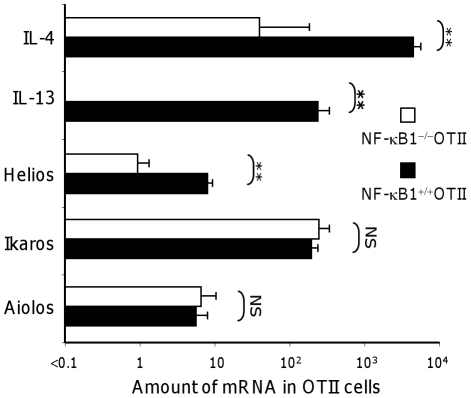
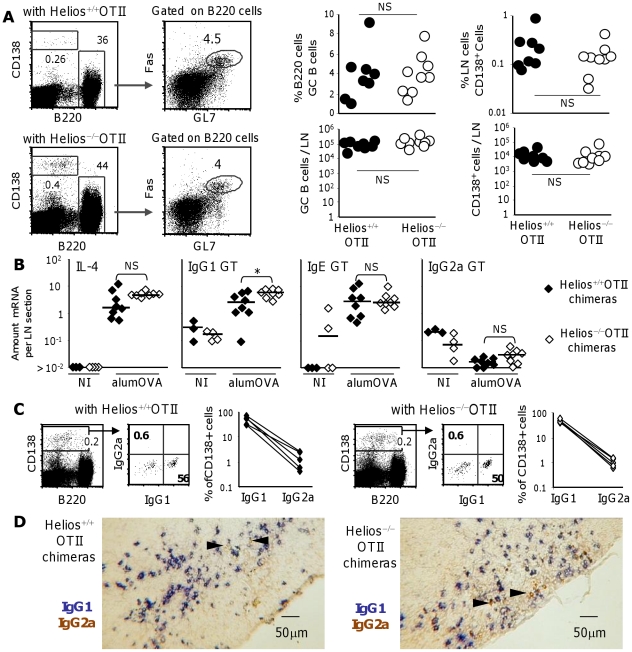
Helios (ikzf2), a member of the Ikaros transcription regulator family, is expressed in thymocytes and some antigen-matured T cells as well as in regulatory T cells. It has been proposed that Helios is a specific marker for thymus-derived regulatory T cells. Here, we show that mouse ovalbumin-specific CD4 (OTII) cells responding to alum-precipitated ovalbumin (alumOVA) upregulate Th2 features - GATA-3 and IL-4 - as well as Helios mRNA and protein. Helios is also upregulated in follicular helper T (TFh) cells in this response. By contrast, OTII cells responding to the Th1 antigen - live attenuated ovalbumin-expressing Salmonella - upregulate Th1 features - T-bet and IFN-γ - but not Helios. In addition, CD4 T cells induced to produce Th2 cytokines in vitro do not express Helios. The kinetics of Helios mRNA and protein induction mirrors that of GATA-3. The induction of IL-4, IL-13 and CXCR5 by alumOVA requires NF-κB1 and this is also needed for Helios upregulation. Importantly, Helios is induced in Th2 and TFh cells without parallel upregulation of Foxp3. These findings suggested a key role for Helios in Th2 and TFh development in response to alum-protein vaccines. We tested this possibility using Helios-deficient OTII cells and found this deficiency had no discernable impact on Th2 and TFh differentiation in response to alumOVA.
Helios is selectively upregulated in CD4 T cells during Th2 and TFh responses to alum-protein vaccines in vivo, but the functional significance of this upregulation remains uncertain.
尽管体外白细胞介素 4(IL-4)指导 CD4 T 细胞产生辅助性 T 细胞 2(Th2)-细胞因子,但这些细胞因子可在没有 IL-4 信号的情况下在体内诱导。因此,不同于体外 Th2 诱导途径的机制有助于体内 Th2 分化。体内 IL-4 非依赖性 Th2 分化的途径尚未得到描述。
Helios(ikzf2)是 Ikaros 转录调节因子家族的成员,在胸腺细胞和一些抗原成熟的 T 细胞以及调节性 T 细胞中表达。有人提出 Helios 是胸腺来源的调节性 T 细胞的特异性标志物。在这里,我们显示对明矾沉淀卵清蛋白(alumOVA)作出反应的小鼠卵清蛋白特异性 CD4(OTII)细胞上调 Th2 特征 - GATA-3 和 IL-4 - 以及 Helios mRNA 和蛋白。在该反应中,滤泡辅助 T(TFh)细胞中也上调 Helios。相比之下,对 Th1 抗原 - 活减毒卵清蛋白表达的沙门氏菌 - 作出反应的 OTII 细胞上调 Th1 特征 - T-bet 和 IFN-γ - 但不上调 Helios。此外,体外诱导产生 Th2 细胞因子的 CD4 T 细胞不表达 Helios。Helios mRNA 和蛋白诱导的动力学与 GATA-3 的动力学相吻合。NF-κB1 对 alumOVA 诱导的 IL-4、IL-13 和 CXCR5 也需要这种诱导,这也是 Helios 上调所必需的。重要的是,在 Th2 和 TFh 细胞中诱导 Helios 而不平行上调 Foxp3。这些发现表明 Helios 在对明矾蛋白疫苗的 Th2 和 TFh 发育中起关键作用。我们使用 Helios 缺陷型 OTII 细胞测试了这种可能性,发现这种缺陷对 alumOVA 反应中 Th2 和 TFh 分化没有明显影响。
Helios 在体内对明矾蛋白疫苗的 Th2 和 TFh 反应中,CD4 T 细胞中选择性地上调,但这种上调的功能意义尚不确定。