Department of Human Genetics, David Geffen School of Medicine, University of California, Los Angeles, 695 Charles Young Drive South, Los Angeles, CA 90095, USA.
Hum Genet. 2011 Aug;130(2):217-22. doi: 10.1007/s00439-011-1038-1. Epub 2011 Jun 16.
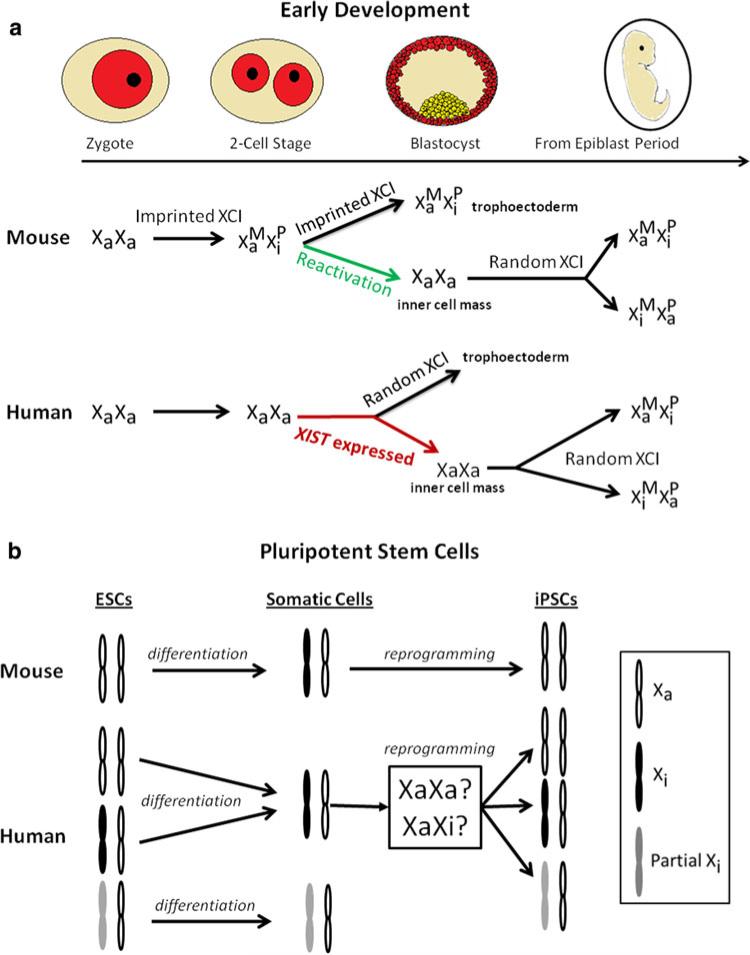
Since the groundbreaking hypothesis of X chromosome inactivation (XCI) proposed by Mary Lyon over 50 years ago, a great amount of knowledge has been gained regarding this essential dosage compensation mechanism in female cells. For the mammalian system, most of the mechanistic studies of XCI have so far been investigated in the mouse model system, but recently, a number of interesting XCI studies have been extended to human pluripotent stem cells, including both embryonic stem cells (ESCs) and induced pluripotent stem cells (iPSCs). Emerging data indicate that XCI in hESCs and hiPSCs is much more complicated than that of their mouse counterparts. XCI in human pluripotent stem cells is not as stable and is subject to environmental influences and epigenetic regulation in vitro. This mini-review highlights the key differences in XCI between mouse and human stem cells with a greater emphasis placed on the understanding of the epigenetic regulation of XCI in human stem cells.
自玛丽·莱昂(Mary Lyon) 50 多年前提出开创性的 X 染色体失活(XCI)假说以来,人们已经获得了大量关于女性细胞中这种基本剂量补偿机制的知识。对于哺乳动物系统,迄今为止,XCI 的大多数机制研究都在小鼠模型系统中进行,但最近,一些有趣的 XCI 研究已经扩展到人类多能干细胞,包括胚胎干细胞(ESCs)和诱导多能干细胞(iPSCs)。新出现的数据表明,hESCs 和 hiPSCs 中的 XCI 比其小鼠对应物复杂得多。人多能干细胞中的 XCI 不如小鼠的稳定,并且易受到体外环境影响和表观遗传调控的影响。本综述重点介绍了小鼠和人类干细胞中 XCI 的关键差异,并更加注重理解人类干细胞中 XCI 的表观遗传调控。