School of Kinesiology and Health Science-Muscle Health Research Center, York University, Toronto, ON, Canada.
Lipids Health Dis. 2011 Jun 16;10:99. doi: 10.1186/1476-511X-10-99.
High-fat (HF) diet has been extensively used as a model to study metabolic disorders of human obesity in rodents. However, the adaptive whole-body metabolic responses that drive the development of obesity with chronically feeding a HF diet are not fully understood. Therefore, this study investigated the physiological mechanisms by which whole-body energy balance and substrate partitioning are adjusted in the course of HF diet-induced obesity.
Male Wistar rats were fed ad libitum either a standard or a HF diet for 8 weeks. Food intake (FI) and body weight were monitored daily, while oxygen consumption, respiratory exchange ratio, physical activity, and energy expenditure (EE) were assessed weekly. At week 8, fat mass and lean body mass (LBM), fatty acid oxidation and uncoupling protein-1 (UCP-1) content in brown adipose tissue (BAT), as well as acetyl-CoA carboxylase (ACC) content in liver and epidydimal fat were measured.
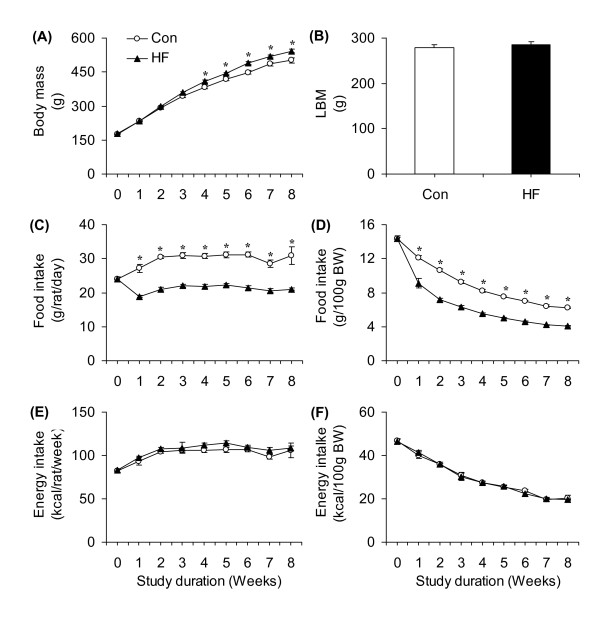
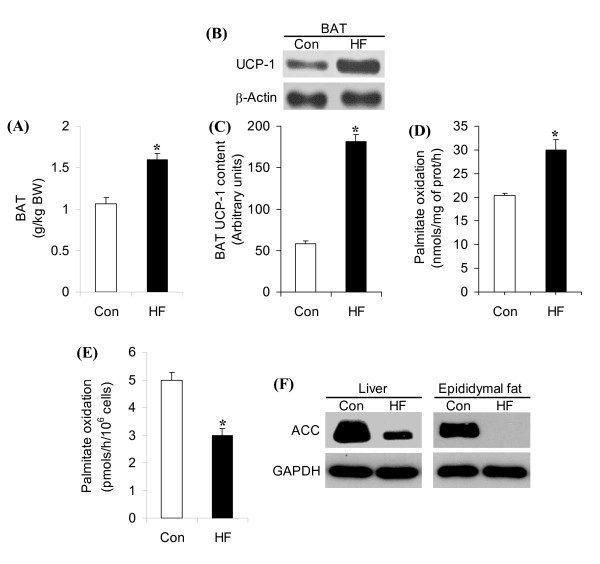
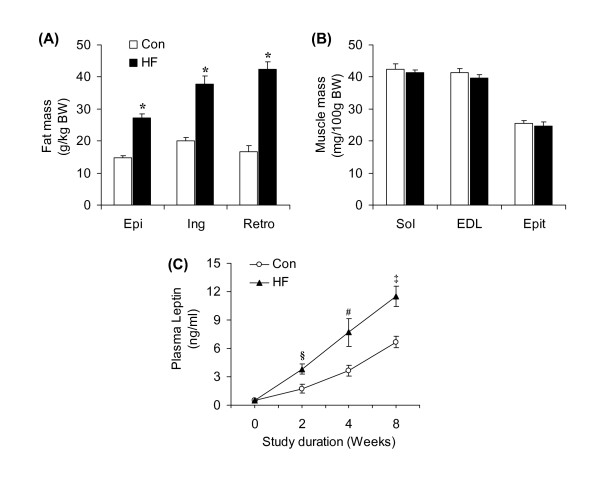
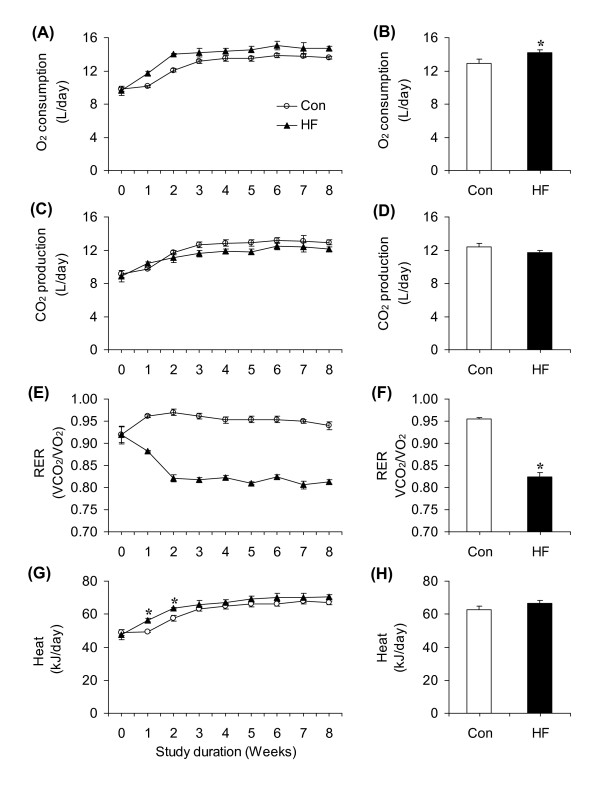
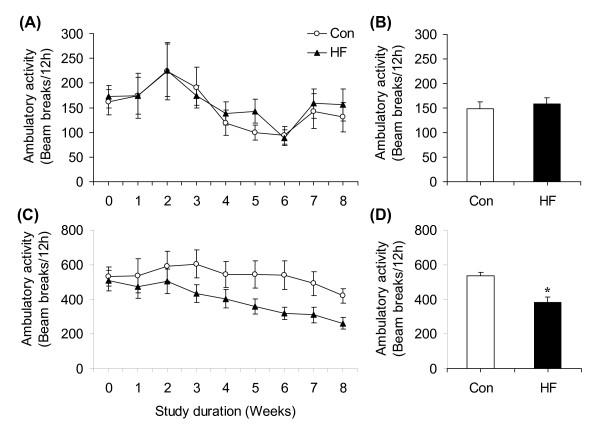
Within 1 week of ad libitum HF diet, rats were able to spontaneously reduce FI to precisely match energy intake of control rats, indicating that alterations in dietary energy density were rapidly detected and FI was self-regulated accordingly. Oxygen consumption was higher in HF than controls throughout the study as whole-body fat oxidation also progressively increased. In HF rats, EE initially increased, but then reduced as dark cycle ambulatory activity reached values ~38% lower than controls. No differences in LBM were detected; however, epidydimal, inguinal, and retroperitoneal fat pads were 1.85-, 1.89-, and 2.54-fold larger in HF-fed than control rats, respectively. Plasma leptin was higher in HF rats than controls throughout the study, indicating the induction of leptin resistance by HF diet. At week 8, UCP-1 content and palmitate oxidation in BAT were 3.1- and 1.5-fold higher in HF rats than controls, respectively, while ACC content in liver and epididymal fat was markedly reduced.
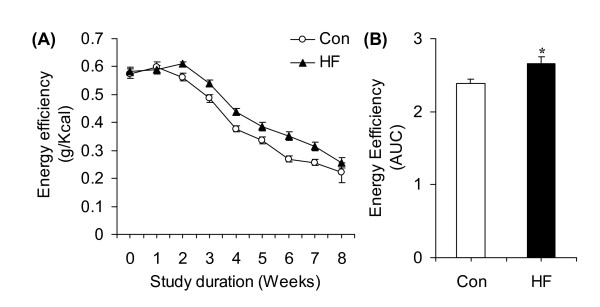
The thermogenic response induced by the HF diet was offset by increased energy efficiency and time-dependent reduction in physical activity, favoring fat accumulation. These adaptations were mainly driven by the nutrient composition of the diet, since control and HF animals spontaneously elicited isoenergetic intake.
高脂肪(HF)饮食已被广泛用于研究啮齿动物人类肥胖的代谢紊乱。然而,长期喂养高脂肪饮食导致肥胖的全身代谢适应反应尚不完全清楚。因此,本研究旨在探讨全身能量平衡和底物分配在高脂肪饮食诱导肥胖过程中的生理机制。
雄性 Wistar 大鼠自由摄取标准或高脂肪饮食 8 周。每日监测食物摄入量(FI)和体重,每周评估耗氧量、呼吸交换比、体力活动和能量消耗(EE)。第 8 周时,测量脂肪量和瘦体重(LBM)、棕色脂肪组织(BAT)中的脂肪酸氧化和解偶联蛋白 1(UCP-1)含量,以及肝脏和附睾脂肪中的乙酰辅酶 A 羧化酶(ACC)含量。
在自由摄取高脂肪饮食的 1 周内,大鼠能够自发地减少 FI,以精确匹配对照大鼠的能量摄入,表明饮食能量密度的变化被迅速检测到,并相应地自我调节 FI。整个研究过程中,HF 组的耗氧量高于对照组,全身脂肪氧化也逐渐增加。HF 组的 EE 最初增加,但随着暗周期活动量降至对照的 38%以下而降低。LBM 无差异;然而,附睾、腹股沟和腹膜后脂肪垫在 HF 喂养大鼠中分别比对照组大鼠大 1.85、1.89 和 2.54 倍。整个研究过程中,HF 组大鼠的血浆瘦素水平高于对照组,表明 HF 饮食引起了瘦素抵抗。第 8 周时,BAT 中的 UCP-1 含量和棕榈酸氧化分别比对照组大鼠高 3.1 倍和 1.5 倍,而肝脏和附睾脂肪中的 ACC 含量明显降低。
高脂肪饮食引起的产热反应被能量效率的提高和随时间推移的体力活动减少所抵消,有利于脂肪积累。这些适应主要由饮食的营养成分驱动,因为对照和 HF 动物自发地产生等能量摄入。