Department of Family Medicine, Academic Medical Center, University of Amsterdam, Amsterdam, The Netherlands.
Health Qual Life Outcomes. 2011 Jun 16;9:44. doi: 10.1186/1477-7525-9-44.
Dizziness is a common and often disabling symptom, but diagnosis often remains unclear; especially in older persons where dizziness tends to be multicausal. Research on dizziness-related impairment might provide options for a functional oriented approach, with less focus on finding diagnoses. We therefore studied dizziness-related impairment in older primary care patients and aimed to identify indicators related to this impairment.
In a cross-sectional study we included 417 consecutive patients of 65 years and older presenting with dizziness to 45 general practitioners in the Netherlands from July 2006 to January 2008. We performed tests, including patient history, and physical and additional examination, previously selected by an international expert panel and based on an earlier systematic review. Our primary outcome was impact of dizziness on everyday life measured with the Dutch validated version of the Dizziness Handicap Inventory (DHI). After a bootstrap procedure (1500x) we investigated predictability of DHI-scores with stepwise backward multiple linear and logistic regressions.
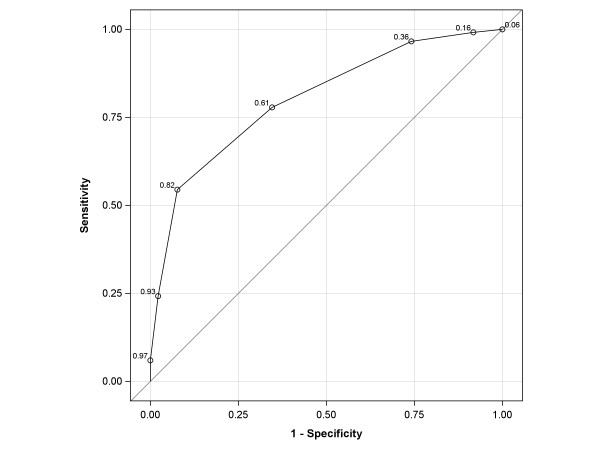
DHI-scores varied from 0 to 88 (maximum score: 100) and 60% of patients experienced moderate or severe impact on everyday life due to dizziness. Indicators for dizziness-related impairment were: onset of dizziness 6 months ago or more (OR 2.8, 95% CI 1.7-4.7), frequency of dizziness at least daily (OR 3.3, 95% CI 2.0-5.4), duration of dizziness episode one minute or less (OR 2.4, 95% CI 1.5-3.9), presence of anxiety and/or depressive disorder (OR 4.4, 95% CI 2.2-8.8), use of sedative drugs (OR 2.3, 95% CI 1.3-3.8) , and impaired functional mobility (OR 2.6, 95% CI 1.7-4.2). For this model with only 6 indicators the AUC was .80 (95% CI .76-.84).
Dizziness-related impairment in older primary care patients is considerable (60%). With six simple indicators it is possible to identify which patients suffer the most from their dizziness without exactly knowing the cause(s) of their dizziness. Influencing these indicators, if possible, may lead to functional improvement and this might be effective in patients with moderate or severe impact of dizziness on their daily lives.
头晕是一种常见且常使人丧失能力的症状,但诊断往往仍不明确;尤其是在老年人中,头晕往往是多因素的。对与头晕相关的障碍的研究可能为功能导向的方法提供选择,而不那么关注寻找诊断。因此,我们研究了老年初级保健患者中与头晕相关的障碍,并旨在确定与这种障碍相关的指标。
在一项横断面研究中,我们纳入了 2006 年 7 月至 2008 年 1 月期间,荷兰 45 名全科医生接诊的 417 名 65 岁及以上的头晕患者。我们进行了测试,包括病史、体格检查和额外的检查,这些测试是由一个国际专家小组预先选择的,并基于早期的系统评价。我们的主要结局是使用荷兰验证的头晕障碍量表(DHI)评估头晕对日常生活的影响。经过 bootstrap 程序(1500 次)后,我们使用逐步向后多元线性和逻辑回归分析来研究 DHI 评分的可预测性。
DHI 评分从 0 到 88 分(满分 100 分),60%的患者因头晕而对日常生活有中度或重度影响。与头晕相关的障碍指标包括:头晕发作时间为 6 个月或以上(OR 2.8,95% CI 1.7-4.7)、头晕频率至少每天一次(OR 3.3,95% CI 2.0-5.4)、头晕发作持续时间为 1 分钟或更短(OR 2.4,95% CI 1.5-3.9)、存在焦虑和/或抑郁障碍(OR 4.4,95% CI 2.2-8.8)、使用镇静药物(OR 2.3,95% CI 1.3-3.8)和功能移动能力受损(OR 2.6,95% CI 1.7-4.2)。对于这个只有 6 个指标的模型,AUC 为 0.80(95% CI 0.76-0.84)。
老年初级保健患者中与头晕相关的障碍相当严重(60%)。通过 6 个简单的指标,可以识别出哪些患者因头晕而受影响最大,而无需确切了解他们头晕的原因。如果可能的话,影响这些指标可能会导致功能改善,这可能对头晕对日常生活有中度或重度影响的患者有效。