Medical Research Council Cognition and Brain Sciences Unit, Cambridge, UK.
Behav Res Ther. 2011 Aug;49(8):498-504. doi: 10.1016/j.brat.2011.05.007. Epub 2011 May 27.
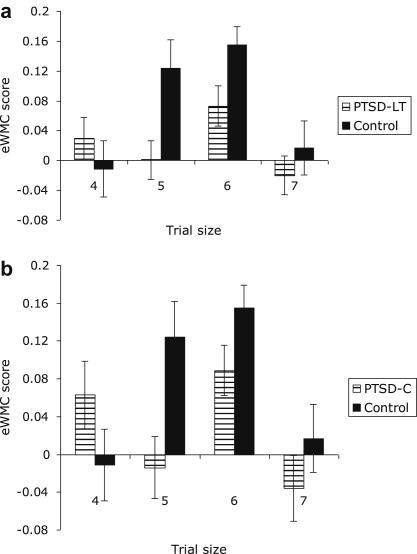
Participants with a lifetime history of posttraumatic stress disorder (PTSD) and trauma-exposed controls with no PTSD history completed an emotional working memory capacity (eWMC) task. The task required them to remember lists of neutral words over short intervals while simultaneously processing sentences describing dysfunctional trauma-related thoughts (relative to neutral control sentences). The task was designed to operationalise an everyday cognitive challenge for those with mental health problems such as PTSD; namely, the ability to carry out simple, routine tasks with emotionally benign material, while at the same time tackling emotional laden intrusive thoughts and feelings. eWMC performance, indexed as the ability to remember the word lists in the context of trauma sentences, relative to neutral sentences, was poorer overall in the PTSD group compared with controls, suggestive of a particular difficulty employing working memory in emotion-related contexts in those with a history of PTSD. The possible implications for developing affective working memory training as an adjunctive treatment for PTSD are explored.
参与者中患有创伤后应激障碍(PTSD)病史的人和没有 PTSD 病史的创伤暴露对照组完成了一项情绪工作记忆容量(eWMC)任务。该任务要求他们在短时间内记住中性单词列表,同时处理描述功能失调的创伤相关思想的句子(相对于中性对照句子)。该任务旨在为 PTSD 等心理健康问题患者设计一种日常认知挑战;即能够使用情绪良性材料执行简单、常规的任务,同时处理情绪负荷的侵入性思想和感觉。与对照组相比,PTSD 组在创伤句子背景下记住单词列表的能力(相对于中性句子)整体上较差,表明在 PTSD 病史的人群中,在情绪相关背景下使用工作记忆存在特定困难。探讨了将情感工作记忆训练作为 PTSD 的辅助治疗方法的可能影响。