Bogomazova Alexandra N, Lagarkova Maria A, Tskhovrebova Leyla V, Shutova Maria V, Kiselev Sergey L
Stem Cell Laboratory, Vavilov Institute of General Genetics RAS, Moscow, 119991, Russia.
Aging (Albany NY). 2011 Jun;3(6):584-96. doi: 10.18632/aging.100336.
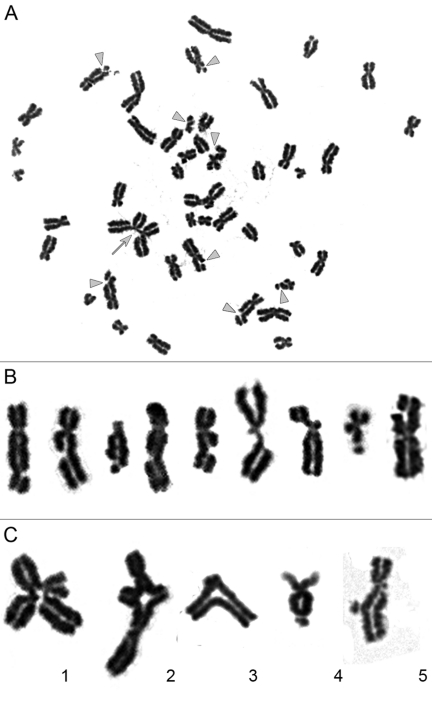
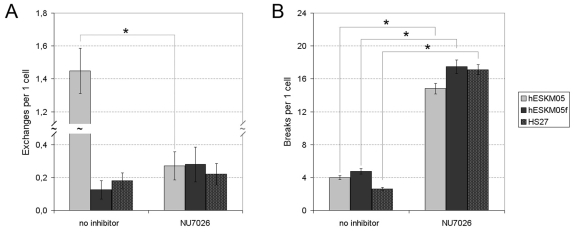
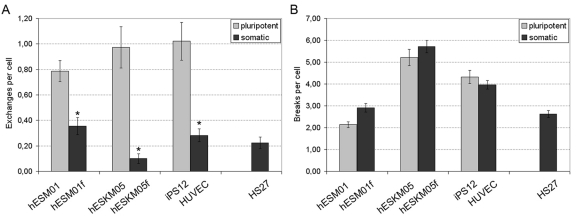
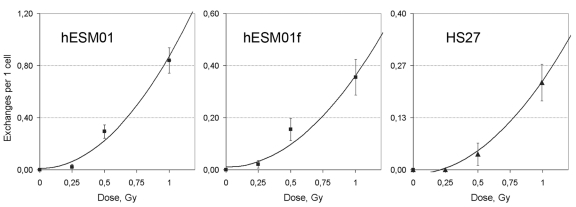
Genome stability of human embryonic stem cells (hESC) is an important issue because even minor genetic alterations can negatively impact cell functionality and safety. The incorrect repair of DNA double-stranded breaks (DSBs) is the ultimate cause of the formation of chromosomal aberrations. Using G2 radiosensitivity assay, we analyzed chromosomal aberrations in pluripotent stem cells and somatic cells. The chromatid exchange aberration rates in hESCs increased manifold 2 hours after irradiation as compared with their differentiated derivatives, but the frequency of radiation-induced chromatid breaks was similar. The rate of radiation-induced chromatid exchanges in hESCs and differentiated cells exhibited a quadratic dose response, revealing two-hit mechanism of exchange formation suggesting that a non-homologous end joining (NHEJ) repair may contribute to their formation. Inhibition of DNA-PK, a key NHEJ component, by NU7026 resulted in a significant decrease in radiation-induced chromatid exchanges in hESCs but not in somatic cells. In contrast, NU7026 treatment increased the frequency of radiation-induced breaks to a similar extent in pluripotent and somatic cells. Thus, DNA-PK dependent NHEJ efficiently participates in the elimination of radiation-induced chromatid breaks during the late G2 in both cell types and DNA-PK activity leads to a high level of misrejoining specifically in pluripotent cells.
人类胚胎干细胞(hESC)的基因组稳定性是一个重要问题,因为即使是微小的基因改变也可能对细胞功能和安全性产生负面影响。DNA双链断裂(DSB)的错误修复是染色体畸变形成的最终原因。我们使用G2期放射敏感性测定法分析了多能干细胞和体细胞中的染色体畸变。与它们的分化衍生物相比,hESC中的染色单体交换畸变率在照射后2小时增加了数倍,但辐射诱导的染色单体断裂频率相似。hESC和分化细胞中辐射诱导的染色单体交换率呈现二次剂量反应,揭示了交换形成的双打击机制,表明非同源末端连接(NHEJ)修复可能有助于其形成。通过NU7026抑制DNA-PK(一种关键的NHEJ成分)导致hESC中辐射诱导的染色单体交换显著减少,但体细胞中没有。相反,NU7026处理在多能细胞和体细胞中使辐射诱导的断裂频率增加到相似程度。因此,DNA-PK依赖的NHEJ在两种细胞类型的G2晚期均有效地参与了辐射诱导的染色单体断裂的消除,并且DNA-PK活性导致特别是在多能细胞中高水平的错误重连。