Stitham Jeremiah, Midgett Charles, Martin Kathleen A, Hwa John
Section of Cardiovascular Medicine, Department of Internal Medicine, Yale School of Medicine, Yale University New Haven, CT, USA.
Front Pharmacol. 2011 May 13;2:24. doi: 10.3389/fphar.2011.00024. eCollection 2011.
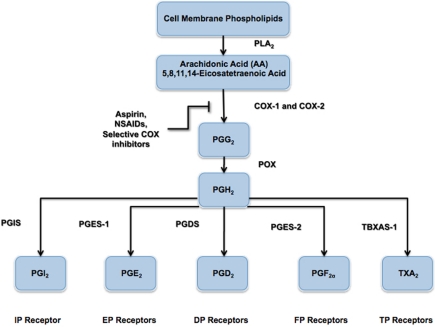
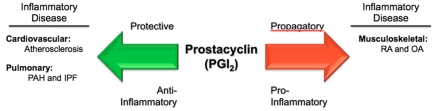
Prostacyclin (PGI(2)) is a member of the prostaglandin family of bioactive lipids. Its best-characterized role is in the cardiovascular system, where it is released by vascular endothelial cells, serving as a potent vasodilator and inhibitor of platelet aggregation. In recent years, prostacyclin (PGI(2)) has also been shown to promote differentiation and inhibit proliferation in vascular smooth muscle cells. In addition to these well-described homeostatic roles within the cardiovascular system, prostacyclin (PGI(2)) also plays an important role as an inflammatory mediator. In this review, we focus on the contribution of prostacyclin (PGI(2)) as both a pathophysiological mediator and therapeutic agent in three major inflammatory-mediated disease processes, namely rheumatoid arthritis, where it promotes disease progression ("pro-inflammatory"), along with pulmonary vascular disease and atherosclerosis, where it inhibits disease progression ("anti-inflammatory"). The emerging role of prostacyclin (PGI(2)) in this context provides new opportunities for understanding the complex molecular basis for inflammatory-related diseases, and insights into the development of current and future anti-inflammatory treatments.
前列环素(PGI₂)是生物活性脂质前列腺素家族的一员。其最显著的作用是在心血管系统中,由血管内皮细胞释放,作为一种强效血管舒张剂和血小板聚集抑制剂。近年来,前列环素(PGI₂)还被证明可促进血管平滑肌细胞分化并抑制其增殖。除了在心血管系统中这些已被充分描述的稳态作用外,前列环素(PGI₂)作为一种炎症介质也发挥着重要作用。在本综述中,我们重点关注前列环素(PGI₂)在三种主要炎症介导的疾病过程中作为病理生理介质和治疗剂的作用,即类风湿性关节炎,在其中它促进疾病进展(“促炎”),以及肺血管疾病和动脉粥样硬化,在其中它抑制疾病进展(“抗炎”)。前列环素(PGI₂)在这种情况下的新作用为理解炎症相关疾病的复杂分子基础提供了新机会,并为当前和未来抗炎治疗的发展提供了见解。