Division of Tuberculosis Elimination, Centers for Disease Control and Prevention, Atlanta, Georgia, United States of America.
PLoS One. 2011;6(6):e20061. doi: 10.1371/journal.pone.0020061. Epub 2011 Jun 8.
Interferon gamma (IFN-γ) release assays, such as QuantiFERON®-TB Gold test (QFT-G) and QuantiFERON®-TB Gold In-Tube test (QFT-GIT) are designed to detect M. tuberculosis (Mtb) infection. Recognition of unusual IFN-γ measurements may help indicate inaccurate results.
We examined QFT-G and QFT-GIT results from subjects who had two or more tests completed. We classified unusual IFN-γ measurements as: 1) High Nil Concentration (HNC) when IFN-γ concentration in plasma from unstimulated blood exceeded 0.7 IU/mL; 2) Low Mitogen Response (LMR) when Mitogen Response was <0.5 IU/mL; 3) Very Low Mitogen Response (VLMR) when Mitogen Response was ≤-0.5 IU/mL; and 4) Very Low Antigen Response (VLAR) when the response to a Mtb antigen was ≤-0.35 IU/mL and ≤-0.5 times the IFN-γ concentration in plasma from unstimulated blood.
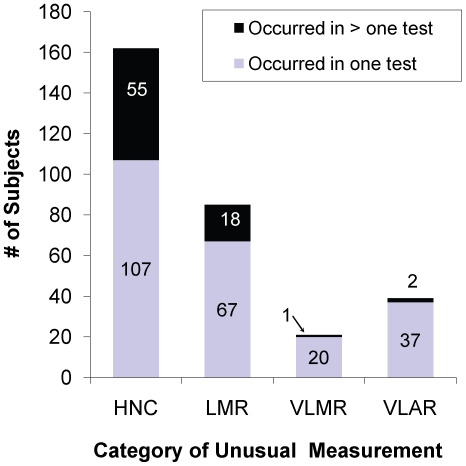
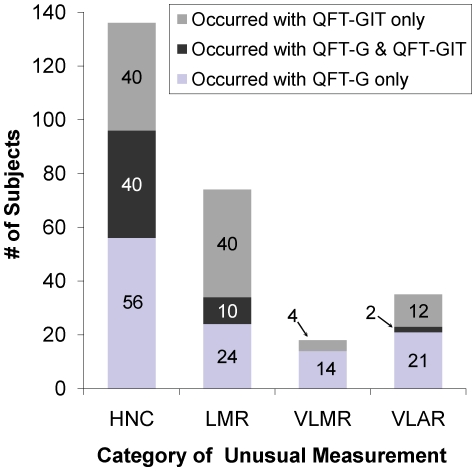
Among 5,309 results from 1,728 subjects, HNC occurred in 234 (4.4%) tests for 162 subjects, LMR in 108 (2.0%) tests for 85 subjects, VLMR in 22 (0.4%) tests for 21 subjects, and VLAR in 41 (0.8%) tests for 39 subjects. QFT-GIT had fewer HNC, VLMR, and VLAR (p = 0.042, 0.004, and 0.067 respectively); QFT-G had fewer LMR (p = 0.005). Twenty-four (51.6%) of 47 subjects with positive results and HNC were negative or indeterminate by all other tests. Thirteen (61.9%) of 21 subjects with positive results and LMR were negative or indeterminate by all other tests.
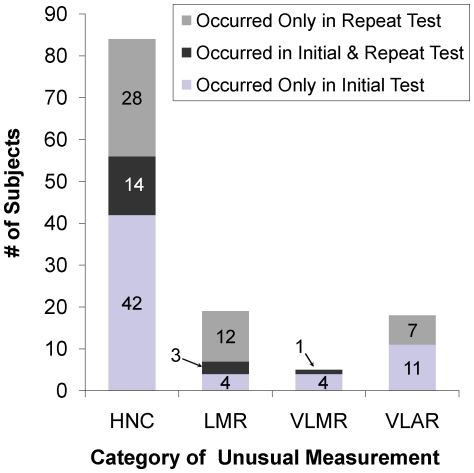
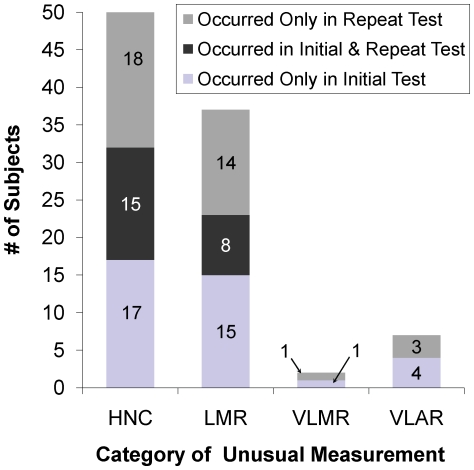
Unusual IFN-γ measurements including HNC, LMR, VLMR, and VLAR were encountered in small numbers, and in most instances were not seen on simultaneously or subsequently performed tests. To avoid erroneous diagnosis of Mtb infection, IGRAs with unusual IFN-γ measurements should be repeated with another blood sample and interpreted with caution if they recur.
干扰素 γ(IFN-γ)释放试验,如 QuantiFERON®-TB Gold 试验(QFT-G)和 QuantiFERON®-TB Gold In-Tube 试验(QFT-GIT),旨在检测结核分枝杆菌(Mtb)感染。对不寻常的 IFN-γ 测量结果的识别可能有助于指示不准确的结果。
我们检查了有两个或更多测试完成的受试者的 QFT-G 和 QFT-GIT 结果。我们将不寻常的 IFN-γ 测量结果分类为:1)高零浓度(HNC),当未刺激血液中的 IFN-γ 浓度超过 0.7 IU/mL 时;2)低有丝分裂原反应(LMR),当有丝分裂原反应<0.5 IU/mL 时;3)非常低有丝分裂原反应(VLMR),当有丝分裂原反应≤-0.5 IU/mL 时;4)非常低抗原反应(VLAR),当 Mtb 抗原的反应≤-0.35 IU/mL 且≤-0.5 倍于未刺激血液中的 IFN-γ 浓度时。
在 1728 名受试者的 5309 个结果中,162 名受试者的 234 个(4.4%)测试出现 HNC,85 名受试者的 108 个(2.0%)测试出现 LMR,21 名受试者的 22 个(0.4%)测试出现 VLMR,39 名受试者的 41 个(0.8%)测试出现 VLAR。QFT-GIT 的 HNC、VLMR 和 VLAR 较少(p = 0.042、0.004 和 0.067);QFT-G 的 LMR 较少(p = 0.005)。47 名阳性结果且 HNC 的受试者中有 24 名(51.6%)的其他所有检测均为阴性或不确定。21 名阳性结果且 LMR 的受试者中有 13 名(61.9%)的其他所有检测均为阴性或不确定。
包括 HNC、LMR、VLMR 和 VLAR 在内的不寻常 IFN-γ 测量结果数量较少,并且在大多数情况下,同时或随后进行的测试中未观察到这些结果。为避免错误诊断 Mtb 感染,应使用另一份血样重复进行异常 IFN-γ 测量的 IGRAs,并在再次出现时谨慎解释。