Department of Molecular Biology, Umeå University, Umeå, Sweden.
PLoS One. 2011;6(6):e20783. doi: 10.1371/journal.pone.0020783. Epub 2011 Jun 7.
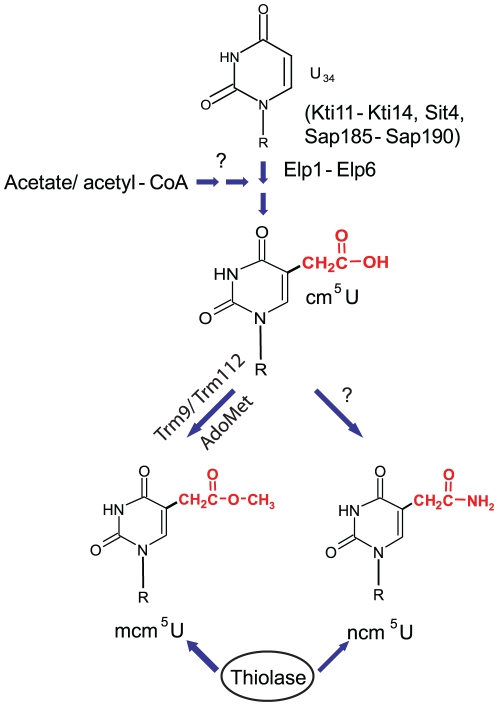
Transfer RNAs are synthesized as a primary transcript that is processed to produce a mature tRNA. As part of the maturation process, a subset of the nucleosides are modified. Modifications in the anticodon region often modulate the decoding ability of the tRNA. At position 34, the majority of yeast cytosolic tRNA species that have a uridine are modified to 5-carbamoylmethyluridine (ncm(5)U), 5-carbamoylmethyl-2'-O-methyluridine (ncm(5)Um), 5-methoxycarbonylmethyl-uridine (mcm(5)U) or 5-methoxycarbonylmethyl-2-thiouridine (mcm(5)s(2)U). The formation of mcm(5) and ncm(5) side chains involves a complex pathway, where the last step in formation of mcm(5) is a methyl esterification of cm(5) dependent on the Trm9 and Trm112 proteins.
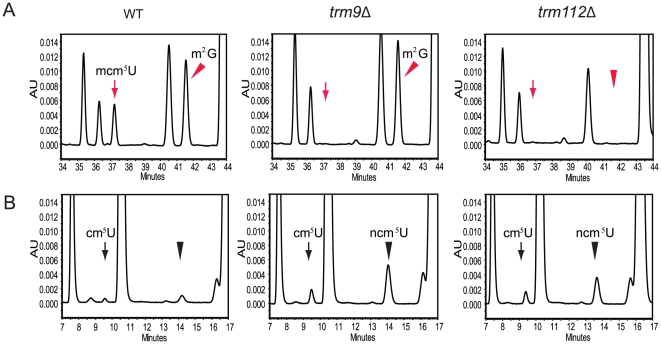
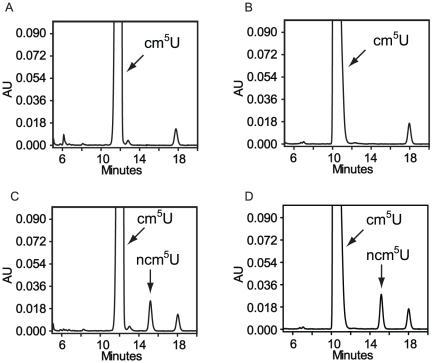
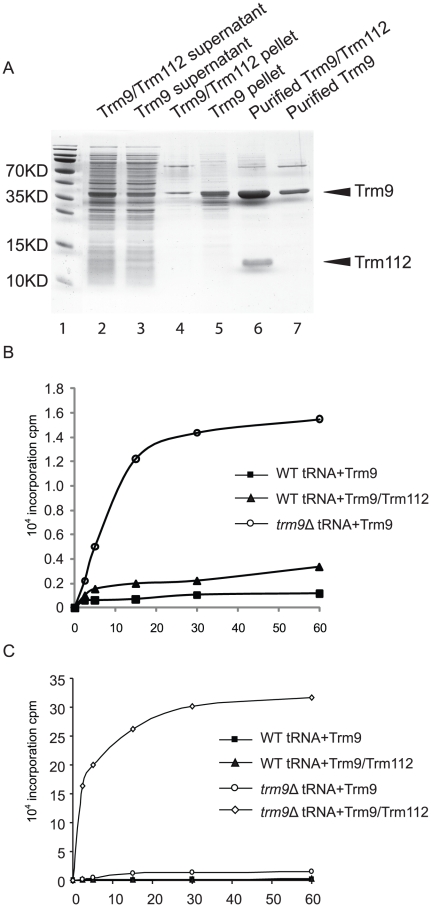
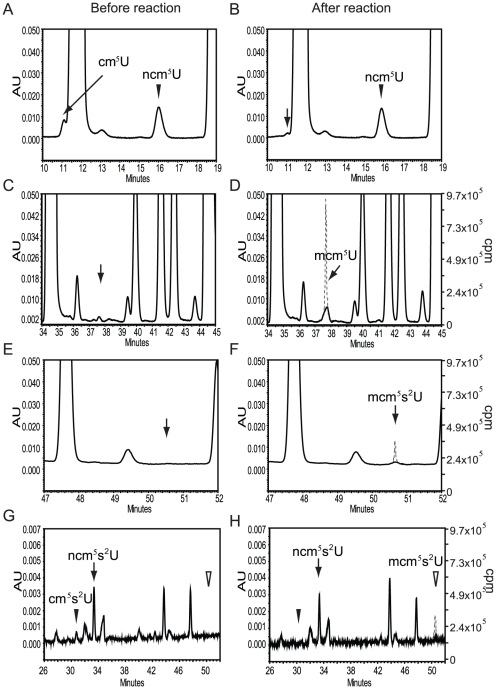
Both Trm9 and Trm112 are required for the last step in formation of mcm(5) side chains at wobble uridines. By co-expressing a histidine-tagged Trm9p together with a native Trm112p in E. coli, these two proteins purified as a complex. The presence of Trm112p dramatically improves the methyltransferase activity of Trm9p in vitro. Single tRNA species that normally contain mcm(5)U or mcm(5)s(2)U nucleosides were isolated from trm9Δ or trm112Δ mutants and the presence of modified nucleosides was analyzed by HPLC. In both mutants, mcm(5)U and mcm(5)s(2)U nucleosides are absent in tRNAs and the major intermediates accumulating were ncm(5)U and ncm(5)s(2)U, not the expected cm(5)U and cm(5)s(2)U.
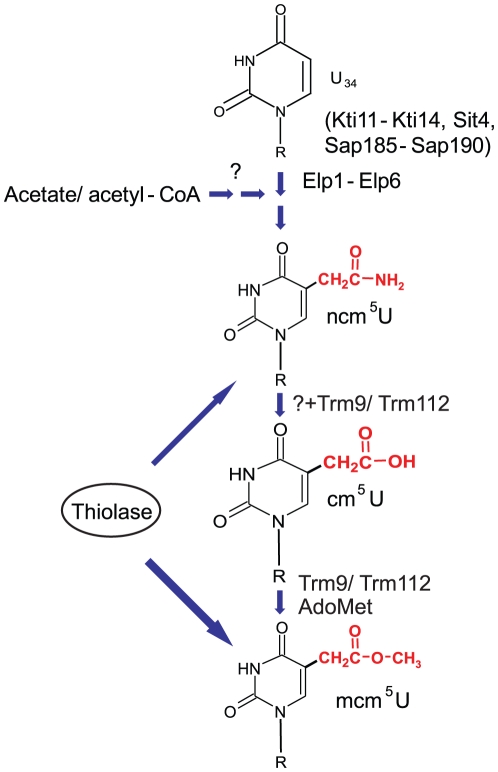
Trm9p and Trm112p function together at the final step in formation of mcm(5)U in tRNA by using the intermediate cm(5)U as a substrate. In tRNA isolated from trm9Δ and trm112Δ strains, ncm(5)U and ncm(5)s(2)U nucleosides accumulate, questioning the order of nucleoside intermediate formation of the mcm(5) side chain. We propose two alternative explanations for this observation. One is that the intermediate cm(5)U is generated from ncm(5)U by a yet unknown mechanism and the other is that cm(5)U is formed before ncm(5)U and mcm(5)U.
转移 RNA 作为初级转录物合成,然后经过加工产生成熟的 tRNA。作为成熟过程的一部分,核苷的一部分被修饰。反密码子区域的修饰通常调节 tRNA 的解码能力。在 34 位,大多数具有尿嘧啶的酵母细胞质 tRNA 物种被修饰为 5-羧甲基尿嘧啶(ncm(5)U)、5-羧甲基-2'-O-甲基尿嘧啶(ncm(5)Um)、5-甲氧基羰基甲基尿嘧啶(mcm(5)U)或 5-甲氧基羰基甲基-2-硫代尿嘧啶(mcm(5)s(2)U)。mcm(5)和 ncm(5)侧链的形成涉及一个复杂的途径,其中 mcm(5)的形成的最后一步是 cm(5)依赖于 Trm9 和 Trm112 蛋白的甲基酯化。
wobble 尿嘧啶处 mcm(5)侧链形成的最后一步需要 Trm9 和 Trm112。通过在大肠杆菌中共表达组氨酸标记的 Trm9p 和天然 Trm112p,这两种蛋白质作为复合物被纯化。Trm112p 的存在大大提高了 Trm9p 在体外的甲基转移酶活性。从 trm9Δ 或 trm112Δ 突变体中分离出通常含有 mcm(5)U 或 mcm(5)s(2)U 核苷的单个 tRNA 物种,并通过 HPLC 分析修饰核苷的存在。在这两种突变体中,tRNA 中都没有 mcm(5)U 和 mcm(5)s(2)U 核苷,积累的主要中间产物是 ncm(5)U 和 ncm(5)s(2)U,而不是预期的 cm(5)U 和 cm(5)s(2)U。
Trm9p 和 Trm112p 一起在 tRNA 中 mcm(5)U 的形成的最后一步中起作用,使用中间产物 cm(5)U 作为底物。在 trm9Δ 和 trm112Δ 菌株中分离的 tRNA 中,ncm(5)U 和 ncm(5)s(2)U 核苷积累,这对 mcm(5)侧链核苷中间产物形成的顺序提出了质疑。我们对这一观察结果提出了两种替代解释。一种是中间产物 cm(5)U 是由未知机制从 ncm(5)U 产生的,另一种是 cm(5)U 是在 ncm(5)U 和 mcm(5)U 之前形成的。