Khweek Arwa Abu, Amer Amal
Division of Pulmonary, Allergy, Critical Care and Sleep Medicine, Center for Microbial Interface Biology and the Department of Internal Medicine, Ohio State University Columbus, OH, USA.
Front Microbiol. 2010 Dec 28;1:133. doi: 10.3389/fmicb.2010.00133. eCollection 2010.
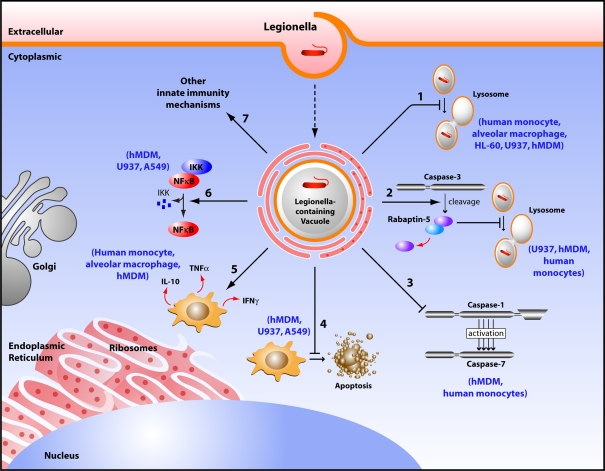
Legionella pneumophila is the causative agent of Legionnaires' disease, a serious and often fatal form of pneumonia. The susceptibility to L. pneumophila arises from the ability of this intracellular pathogen to multiply in human alveolar macrophages and monocytes. L. pneumophila also replicates in several professional and non-professional phagocytic human-derived cell lines. With the exception of the A/J mouse strain, most mice strains are restrictive, thus they do not support L. pneumophila replication. Mice lacking the NOD-like receptor Nlrc4 or caspase-1 are also susceptible to L. pneumophila. On the other hand, in the susceptible human hosts, L. pneumophila utilizes several strategies to ensure intracellular replication and protect itself against the host immune system. Most of these strategies converge to prevent the fusion of the L. pneumophila phagosome with the lysosome, inhibiting host cell apoptosis, activating survival pathways, and sequestering essential nutrients for replication and pathogenesis. In this review, we summarize survival mechanisms employed by L. pneumophila to maintain its replication in human cells. In addition, we highlight different human-derived cell lines that support the multiplication of this intracellular bacterium. Therefore, these in vitro models can be applicable and are reproducible when investigating L. pneumophila/phagocyte interactions at the molecular and cellular levels in the human host.
嗜肺军团菌是军团病的病原体,军团病是一种严重且往往致命的肺炎形式。对嗜肺军团菌的易感性源于这种细胞内病原体在人类肺泡巨噬细胞和单核细胞中繁殖的能力。嗜肺军团菌也能在几种源自人类的专业和非专业吞噬细胞系中复制。除了A/J小鼠品系外,大多数小鼠品系具有限制性,因此它们不支持嗜肺军团菌的复制。缺乏NOD样受体Nlrc4或半胱天冬酶-1的小鼠也易感染嗜肺军团菌。另一方面,在易感的人类宿主中,嗜肺军团菌利用多种策略来确保细胞内复制并保护自身免受宿主免疫系统的攻击。这些策略大多集中于防止嗜肺军团菌吞噬体与溶酶体融合、抑制宿主细胞凋亡、激活生存途径以及隔离复制和致病所需的必需营养物质。在这篇综述中,我们总结了嗜肺军团菌为维持其在人类细胞中复制所采用的生存机制。此外,我们重点介绍了支持这种细胞内细菌繁殖的不同人类来源细胞系。因此,在研究人类宿主中嗜肺军团菌/吞噬细胞相互作用的分子和细胞水平时,这些体外模型是适用且可重复的。