Department of Biology and Biochemistry, Birzeit University, West Bank, Palestine.
Department of Microbial Infection and Immunity, Infectious Disease Institute, College of Medicine, The Ohio State University, Columbus, OH, USA.
Immunol Rev. 2020 Sep;297(1):39-52. doi: 10.1111/imr.12910. Epub 2020 Aug 1.
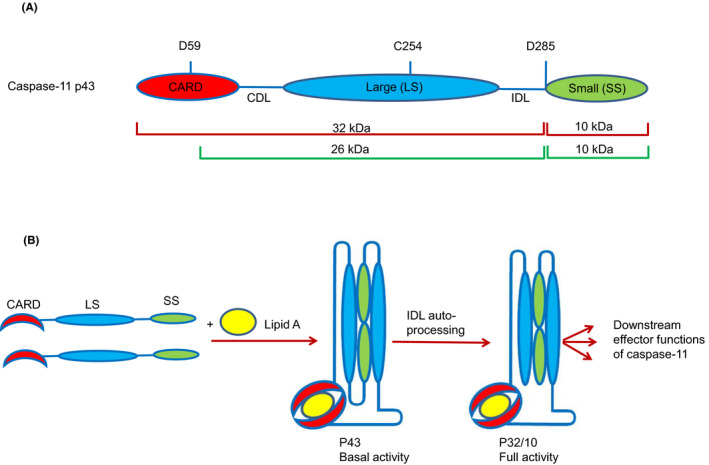
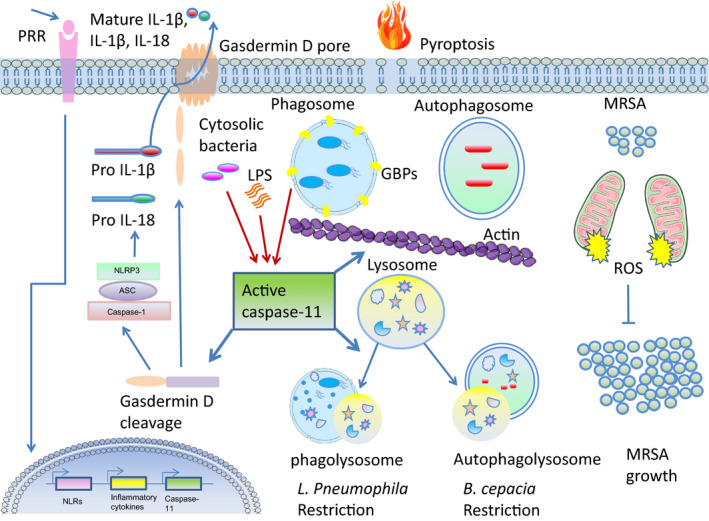
Innate immune cells, epithelial cells, and many other cell types are capable of detecting infection or tissue injury, thus mounting regulated immune response. Inflammasomes are highly sophisticated and effective orchestrators of innate immunity. These oligomerized multiprotein complexes are at the center of various innate immune pathways, including modulation of the cytoskeleton, production and maturation of cytokines, and control of bacterial growth and cell death. Inflammasome assembly often results in caspase-1 activation, which is an inflammatory caspase that is involved in pyroptotic cell death and release of inflammatory cytokines in response to pathogen patterns and endogenous danger stimuli. However, the nature of stimuli and inflammasome components are diverse. Caspase-1 activation mediated release of mature IL-1β and IL-18 in response to canonical stimuli initiated by NOD-like receptor (NLR), and apoptosis-associated speck-like protein containing a caspase recruitment domain (ASC). On the other hand, caspase-11 delineates a non-canonical inflammasome that promotes pyroptotic cell death and non-pyroptotic functions in response to non-canonical stimuli. Caspase-11 in mice and its homologues in humans (caspase-4/5) belong to caspase-1 family of cysteine proteases, and play a role in inflammation. Knockout mice provided new genetic tools to study inflammatory caspases and revealed the role of caspase-11 in mediating septic shock in response to lethal doses of lipopolysaccharide (LPS). Recognition of LPS mediates caspase-11 activation, which promotes a myriad of downstream effects that include pyroptotic and non-pyroptotic effector functions. Therefore, the physiological functions of caspase-11 are much broader than its previously established roles in apoptosis and cytokine maturation. Inflammation induced by exogenous or endogenous agents can be detrimental and, if excessive, can result in organ and tissue damage. Consequently, the existence of sophisticated mechanisms that tightly regulate the specificity and sensitivity of inflammasome pathways provides a fine-tuning balance between adequate immune response and minimal tissue damage. In this review, we summarize effector functions of caspase-11.
先天免疫细胞、上皮细胞和许多其他细胞类型能够检测到感染或组织损伤,从而引发调节性免疫反应。炎性小体是先天免疫的高度复杂和有效的协调器。这些寡聚多蛋白复合物是各种先天免疫途径的核心,包括细胞骨架的调节、细胞因子的产生和成熟以及细菌生长和细胞死亡的控制。炎性小体的组装通常导致半胱天冬酶-1 的激活,这是一种炎症半胱天冬酶,参与对病原体模式和内源性危险刺激的细胞焦亡和炎症细胞因子的释放。然而,刺激物的性质和炎性小体的组成是多样的。半胱天冬酶-1 的激活介导成熟的 IL-1β 和 IL-18 的释放,以响应 NOD 样受体 (NLR) 引发的经典刺激物,并激活凋亡相关斑点样蛋白含有半胱天冬酶募集域 (ASC)。另一方面,半胱天冬酶-11 划定了一种非经典炎性小体,该小体响应非经典刺激物促进细胞焦亡和非细胞焦亡功能。在小鼠中,半胱天冬酶-11 及其人类同源物(半胱天冬酶-4/5)属于半胱天冬酶-1 家族的半胱氨酸蛋白酶,在炎症中发挥作用。敲除小鼠提供了新的遗传工具来研究炎症半胱天冬酶,并揭示了半胱天冬酶-11 在介导对致死剂量脂多糖 (LPS) 的败血症休克中的作用。LPS 的识别介导半胱天冬酶-11 的激活,这促进了包括细胞焦亡和非细胞焦亡效应功能在内的众多下游效应。因此,半胱天冬酶-11 的生理功能远不止其先前在细胞凋亡和细胞因子成熟中的作用。外源性或内源性因子引起的炎症可能是有害的,如果过度,会导致器官和组织损伤。因此,存在复杂的机制可以严格调节炎性小体途径的特异性和敏感性,在适当的免疫反应和最小的组织损伤之间提供精细的平衡。在这篇综述中,我们总结了半胱天冬酶-11 的效应功能。