Mammalian Developmental Epigenetics Group, Unit of Genetics and Developmental Biology, Institut Curie, CNRS UMR3215, INSERM U934, 75248 Paris, France.
Hum Genet. 2011 Aug;130(2):307-27. doi: 10.1007/s00439-011-1029-2. Epub 2011 Jun 18.
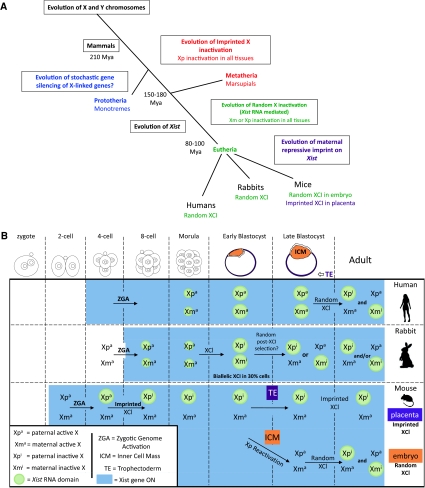
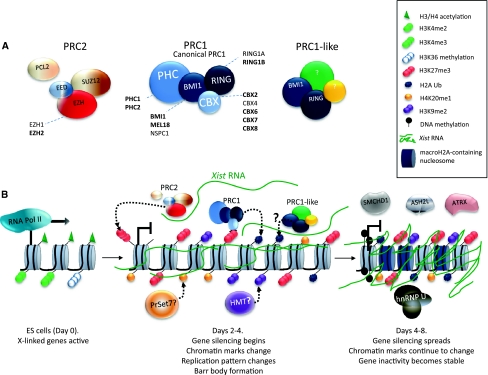
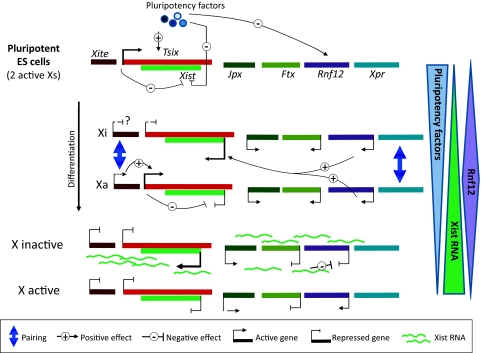
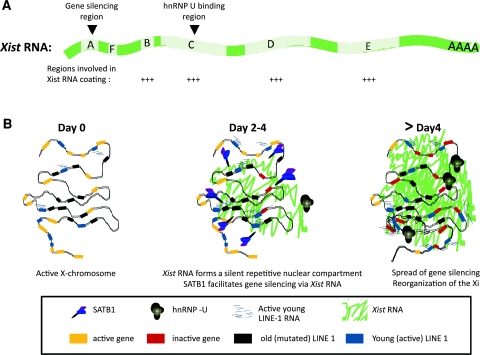
X-chromosome inactivation (XCI) results in the transcriptional silencing of one X-chromosome in females to attain gene dosage parity between XX female and XY male mammals. Mammals appear to have developed rather diverse strategies to initiate XCI in early development. In placental mammals XCI depends on the regulatory noncoding RNA X-inactive specific transcript (Xist), which is absent in marsupials and monotremes. Surprisingly, even placental mammals show differences in the initiation of XCI in terms of Xist regulation and the timing to acquire dosage compensation. Despite this, all placental mammals achieve chromosome-wide gene silencing at some point in development, and this is maintained by epigenetic marks such as chromatin modifications and DNA methylation. In this review, we will summarise recent findings concerning the events that occur downstream of Xist RNA coating of the inactive X-chromosome (Xi) to ensure its heterochromatinization and the maintenance of the inactive state in the mouse and highlight similarities and differences between mammals.
X 染色体失活 (XCI) 导致女性的一条 X 染色体转录沉默,以达到 XX 女性和 XY 男性哺乳动物之间的基因剂量均等。哺乳动物似乎已经发展出相当多样化的策略来在早期发育中启动 XCI。在胎盘哺乳动物中,XCI 依赖于调节性非编码 RNA X 失活特异性转录本 (Xist),而 Xist 在有袋动物和单孔目动物中不存在。令人惊讶的是,即使是胎盘哺乳动物,在 Xist 调控和获得剂量补偿的时间方面,XCI 的启动也存在差异。尽管如此,所有胎盘哺乳动物在发育的某个时刻都会实现染色体范围的基因沉默,并且通过染色质修饰和 DNA 甲基化等表观遗传标记来维持这种沉默。在这篇综述中,我们将总结最近关于 Xist RNA 覆盖失活 X 染色体 (Xi) 后发生的事件的发现,以确保其异染色质化和在小鼠中保持非活性状态,并强调哺乳动物之间的相似性和差异。