VU University Amsterdam, Van der Boechorststraat 1, 1081 BT, Amsterdam, The Netherlands.
Behav Genet. 2012 Jan;42(1):19-29. doi: 10.1007/s10519-011-9478-x. Epub 2011 Jun 18.
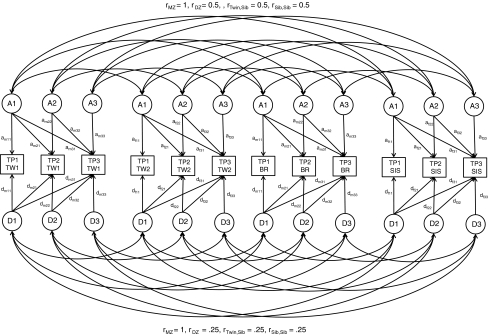
This study investigates the longitudinal heritability in Thought Problems (TP) as measured with ten items from the Adult Self Report (ASR). There were ~9,000 twins, ~2,000 siblings and ~3,000 additional family members who participated in the study and who are registered at the Netherlands Twin Register. First an exploratory factor analysis was conducted to examine the underlying factor structure of the TP-scale. Then the TP-scale was tested for measurement invariance (MI) across age and sex. Next, genetic and environmental influences were modeled on the longitudinal development of TP across three age groups (12-18, 19-27 and 28-59 year olds) based on the twin and sibling relationships in the data. An exploratory factor analysis yielded a one-factor solution, and MI analyses indicated that the same TP-construct is assessed across age and sex. Two additive genetic components influenced TP across age: the first influencing TP throughout all age groups, while the second arises during young adulthood and stays significant throughout adulthood. The additive genetic components explained 37% of the variation across all age groups. The remaining variance (63%) was explained by unique environmental influences. The longitudinal phenotypic correlation between these age groups was entirely explained by the additive genetic components. We conclude that the TP-scale measures a single underlying construct across sex and different ages. These symptoms are significantly influenced by additive genetic factors from adolescence to late adulthood.
本研究调查了使用成人自我报告(ASR)中的十个项目测量的思维问题(TP)的纵向遗传性。约有 9000 对双胞胎、2000 对兄弟姐妹和约 3000 名其他家庭成员参加了这项研究,并在荷兰双胞胎登记处注册。首先进行了探索性因素分析,以检验 TP 量表的潜在因素结构。然后,测试了 TP 量表在年龄和性别上的测量不变性(MI)。接下来,根据数据中的双胞胎和兄弟姐妹关系,对三个年龄组(12-18 岁、19-27 岁和 28-59 岁)的 TP 进行纵向发展建模,探讨遗传和环境影响。探索性因素分析得出了一个单因素解决方案,MI 分析表明,相同的 TP 结构在年龄和性别上进行评估。两个加性遗传因素影响了整个年龄组的 TP:第一个因素影响所有年龄组的 TP,而第二个因素在青年期出现,并在整个成年期保持显著。加性遗传因素解释了所有年龄组变异的 37%。剩余的方差(63%)由独特的环境影响解释。这些年龄组之间的纵向表型相关性完全由加性遗传因素解释。我们得出结论,TP 量表在性别和不同年龄之间测量单一的潜在结构。这些症状受到从青春期到成年晚期的加性遗传因素的显著影响。