Health Sciences Research Institute, Warwick Medical School, University of Warwick, Coventry, CV4 7AL, UK.
BMC Public Health. 2011 Jun 21;11:487. doi: 10.1186/1471-2458-11-487.
Understanding and measuring mental health and wellbeing amongst teenagers has recently become a priority. The Warwick-Edinburgh Mental Well-being Scale (WEMWBS) is validated for measuring mental wellbeing in populations aged 16 years and over in the UK. We report here a study designed to establish the validity and reliability of WEMWBS in teenagers in the UK.
WEMWBS and comparator scales, together with socio-demographic information and self-reported health, were incorporated into a self-administered questionnaire given to pupils aged 13 to 16 years in six schools in Scotland and England. Psychometric properties including internal consistency, correlations with comparator scales, test-retest stability and unidimensionality were investigated for WEMWBS. Twelve focus groups were undertaken to assess acceptability and comprehensibility of WEMWBS and were taped, transcribed and analysed thematically.
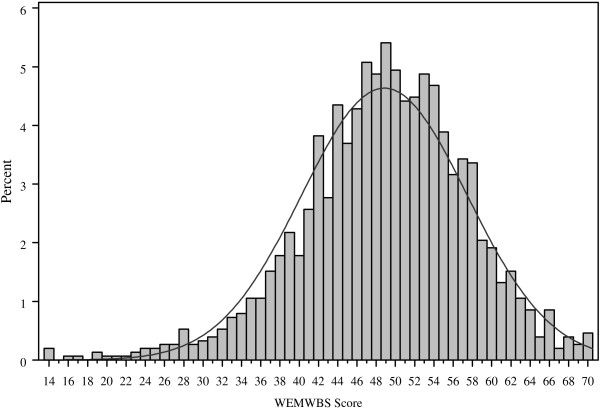
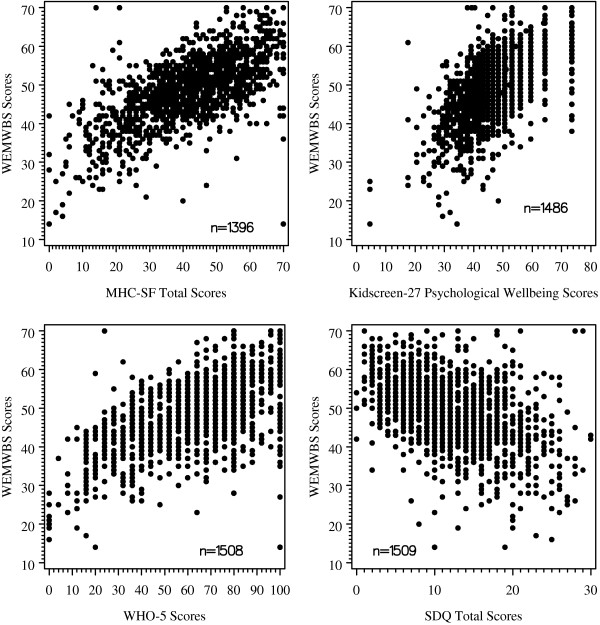
A total of 1,650 teenagers completed the questionnaire (response rate 80.8%). Mean WEMWBS score was 48.8 (SD 6.8; median 49). Response scores covered the full range (from 14 to 70). WEMWBS demonstrated strong internal consistency and a high Cronbach's alpha of 0.87 (95% CI (0.85-0.88), n = 1517). Measures of construct validity gave values as predicted. The correlation coefficient for WEMWBS total score and psychological wellbeing domain of the Kidscreen-27 was 0.59 (95% CI [0.55; 0.62]); for the Mental Health Continuum Short Form (MHC-SF) was 0.65, 95% CI [0.62; 0.69]; and for the WHO (WHO-5) Well-being Index 0.57 (95% CI [0.53; 0.61]). The correlation coefficient for the Strengths and Difficulties Questionnaire (SDQ) was -0.44 (95% CI [-0.49; -0.40]) and for the 12-item General Health Questionnaire (GHQ12) -0.45 (95% CI [-0.49; -0.40]). Test-retest reliability was acceptable (Intraclass correlation coefficient (ICC) 0.66 (95% CI [0.59; 0.72] n = 212)). Confirmatory factor analysis demonstrated one underlying factor. WEMWBS was significantly associated with the Family Affluence Score (WEMWBS increased with increasing household socio-economic status) and had a positive association with the physical health dimension of the Kidscreen-27, but was unrelated to age, gender or location/school. Eighty students took part in focus groups. In general, although some students considered some items open to misunderstanding or misinterpretation, WEMWBS was received positively and was considered comprehensible, and acceptable.
WEMWBS is a psychometrically strong population measure of mental wellbeing, and can be used for this purpose in teenagers aged 13 and over.
理解和衡量青少年的心理健康和幸福感已成为当务之急。华威-爱丁堡心理健康量表(WEMWBS)已在英国 16 岁及以上的人群中得到验证,可用于衡量心理健康。我们在此报告一项旨在确定 WEMWBS 在英国青少年中的有效性和可靠性的研究。
WEMWBS 及其比较量表与社会人口统计学信息和自我报告的健康状况一起纳入了在苏格兰和英格兰的六所学校中 13 至 16 岁的学生的自我管理问卷中。研究了 WEMWBS 的内部一致性、与比较量表的相关性、重测信度和维度性等心理测量特性。还进行了 12 次焦点小组讨论,以评估 WEMWBS 的可接受性和理解性,并对其进行了录音、转录和主题分析。
共有 1650 名青少年完成了问卷(回应率为 80.8%)。平均 WEMWBS 得分为 48.8(SD 6.8;中位数 49)。反应得分涵盖了整个范围(从 14 到 70)。WEMWBS 表现出很强的内部一致性和很高的克朗巴赫 alpha 系数为 0.87(95%CI(0.85-0.88),n = 1517)。结构有效性的衡量指标给出了预期的值。WEMWBS 总分与儿童生活质量量表(Kidscreen-27)心理幸福感维度的相关系数为 0.59(95%CI[0.55;0.62]);与心理健康连续体简短形式(MHC-SF)的相关系数为 0.65,95%CI[0.62;0.69];与世界卫生组织(WHO)幸福感指数的相关系数为 0.57(95%CI[0.53;0.61])。与长处和困难问卷(SDQ)的相关系数为-0.44(95%CI[-0.49;-0.40]),与 12 项一般健康问卷(GHQ12)的相关系数为-0.45(95%CI[-0.49;-0.40])。重测信度可接受(组内相关系数(ICC)0.66(95%CI[0.59;0.72],n = 212))。验证性因子分析表明存在一个潜在因素。WEMWBS 与家庭富裕程度呈正相关(随着家庭社会经济地位的提高,WEMWBS 得分增加),与儿童生活质量量表的身体健康维度呈正相关,但与年龄、性别或地点/学校无关。80 名学生参加了焦点小组讨论。总的来说,尽管一些学生认为某些项目容易产生误解或误解,但 WEMWBS 得到了积极的评价,被认为是可以理解的,并且是可以接受的。
WEMWBS 是一种具有良好心理测量特性的人群心理健康测量工具,可用于衡量 13 岁及以上青少年的心理健康。