Department of Obstetrics, Gynecology & Reproductive Sciences, Yale University School of Medicine, 333 Cedar street, New Haven, CT 06519, USA.
BMC Cancer. 2011 Jun 22;11:263. doi: 10.1186/1471-2407-11-263.
Cervical cancer continues to be an important worldwide health problem for women. Up to 35% of patients who are diagnosed with and appropriately treated for cervical cancer will recur and treatment results are poor for recurrent disease. Given these sobering statistics, development of novel therapies for cervical cancer remains a high priority. We evaluated the expression of Tissue Factor (TF) in cervical cancer and the potential of hI-con1, an antibody-like-molecule targeted against TF, as a novel form of immunotherapy against multiple primary cervical carcinoma cell lines with squamous- and adenocarcinoma histology.
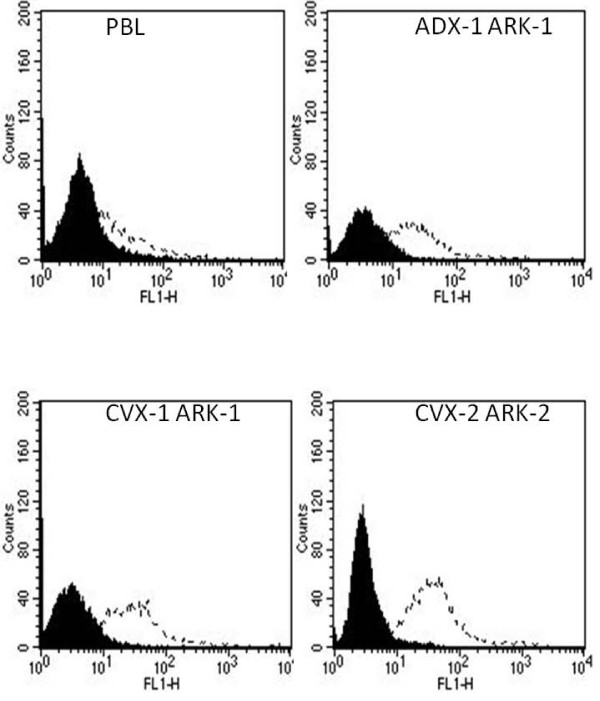
Because TF is a transmembrane receptor for coagulation factor VII/VIIa (fVII), in this study we evaluated the in vitro expression of TF in cervical carcinoma cell lines by immunohistochemistry (IHC), real time-PCR (qRT-PCR) and flow cytometry. Sensitivity to hI-con1-dependent cell-mediated-cytotoxicity (IDCC) was evaluated in 5-hrs-51chromium-release-assays against cervical cancer cell lines in vitro.
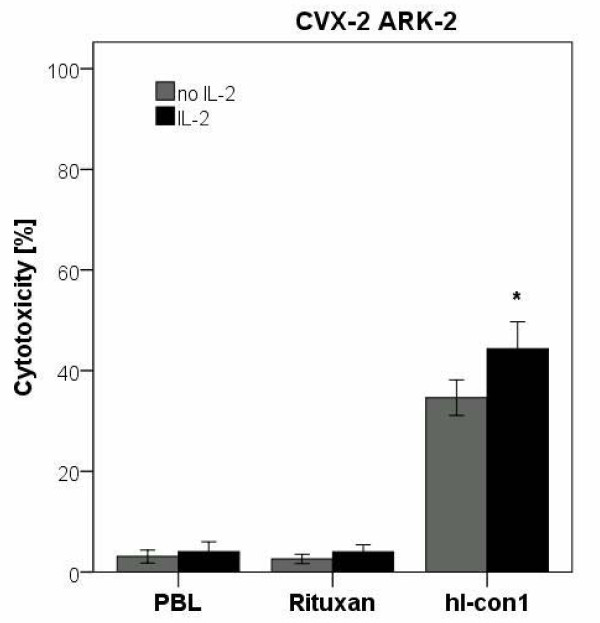
Cytoplasmic and/or membrane TF expression was observed in 8 out of 8 (100%) of the tumor tissues tested by IHC and in 100% (11 out of 11) of the cervical carcinoma cell lines tested by real-time-PCR and flow cytometry but not in normal cervical keratinocytes (p=0.0023 qRT-PCR; p=0.0042 flow cytometry). All primary cervical cancer cell lines tested overexpressing TF, regardless of their histology, were highly sensitive to IDCC (mean killing±SD, 56.2%±15.9%, range, 32.4%-76.9%, p<0.001), while negligible cytotoxicity was seen in the absence of hI-con1 or in the presence of rituximab-control-antibody. Low doses of interleukin-2 further increased the cytotoxic effect induced by hI-con1 (p=0.025) while human serum did not significantly decrease IDCC against cervical cancer cell lines (p=0.597).
TF is highly expressed in squamous and adenocarcinoma of the uterine cervix. hI-con1 induces strong cytotoxicity against primary cervical cancer cell lines overexpressing TF and may represent a novel therapeutic agent for the treatment of cervical cancer refractory to standard treatment modalities.
宫颈癌仍然是全球女性面临的一个重要健康问题。多达 35%被诊断为宫颈癌并接受适当治疗的患者会复发,而复发性疾病的治疗效果不佳。鉴于这些严峻的统计数据,开发治疗宫颈癌的新疗法仍然是当务之急。我们评估了组织因子(TF)在宫颈癌中的表达,并评估了 hI-con1(一种针对 TF 的抗体样分子)作为一种新型免疫疗法,用于针对具有鳞癌和腺癌组织学的多种原发性宫颈癌细胞系。
因为 TF 是凝血因子 VII/VIIa(fVII)的跨膜受体,所以在这项研究中,我们通过免疫组织化学(IHC)、实时 PCR(qRT-PCR)和流式细胞术评估了宫颈癌细胞系中 TF 的体外表达。通过 5 小时 51 铬释放测定法,在体外评估了 hI-con1 依赖性细胞介导的细胞毒性(IDCC)对宫颈癌细胞系的敏感性。
通过 IHC 检测到 8 个肿瘤组织中有 8 个(100%)表达细胞质和/或膜 TF,通过实时 PCR 和流式细胞术检测到 11 个宫颈癌细胞系中有 100%(11 个)表达 TF,但在正常宫颈角质形成细胞中未检测到(p=0.0023 qRT-PCR;p=0.0042 流式细胞术)。所有测试的原发性宫颈癌细胞系均过度表达 TF,无论其组织学如何,对 IDCC 均高度敏感(平均杀伤率±SD,56.2%±15.9%,范围 32.4%-76.9%,p<0.001),而在不存在 hI-con1 或存在利妥昔单抗对照抗体的情况下,观察到可忽略不计的细胞毒性。低剂量白细胞介素 2 进一步增加了 hI-con1 诱导的细胞毒性(p=0.025),而人血清对 IDCC 对宫颈癌细胞系的抑制作用无明显影响(p=0.597)。
TF 在子宫颈鳞癌和腺癌中高度表达。hI-con1 诱导过度表达 TF 的原发性宫颈癌细胞系产生强烈的细胞毒性,可能成为治疗对标准治疗方法耐药的宫颈癌的新型治疗剂。