Department of Neuropsychology, Max Planck Institute for Human Cognitive and Brain Sciences, Leipzig, Germany.
PLoS One. 2011;6(6):e20726. doi: 10.1371/journal.pone.0020726. Epub 2011 Jun 13.
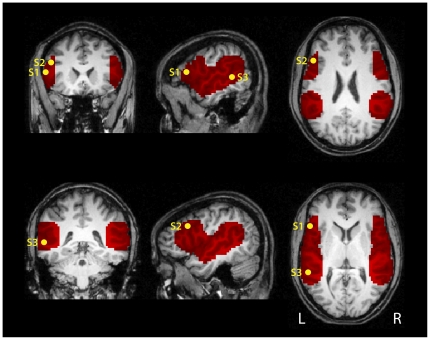
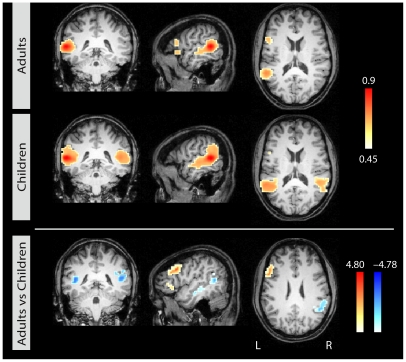
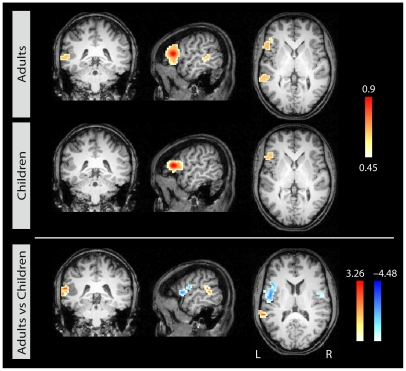
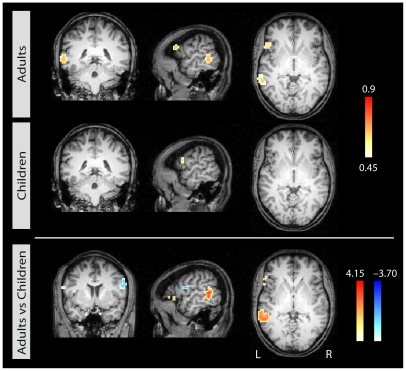
Language development must go hand-in-hand with brain maturation. Little is known about how the brain develops to serve language processing, in particular, the processing of complex syntax, a capacity unique to humans. Behavioral reports indicate that the ability to process complex syntax is not yet adult-like by the age of seven years. Here, we apply a novel method to demonstrate that the basic neural basis of language, as revealed by low frequency fluctuation stemming from functional MRI data, differs between six-year-old children and adults in crucial aspects. Although the classical language regions are actively in place by the age of six, the functional connectivity between these regions clearly is not. In contrast to adults who show strong connectivities between frontal and temporal language regions within the left hemisphere, children's default language network is characterized by a strong functional interhemispheric connectivity, mainly between the superior temporal regions. These data indicate a functional reorganization of the neural network underlying language development towards a system that allows a close interplay between frontal and temporal regions within the left hemisphere.
语言发展必须与大脑成熟齐头并进。人们对于大脑如何发育以服务于语言处理,特别是复杂语法的处理,这种能力是人类独有的,知之甚少。行为报告表明,到七岁时,处理复杂语法的能力还不成熟。在这里,我们应用一种新的方法来证明,作为从功能磁共振成像数据中低频波动所揭示的语言的基本神经基础,在关键方面,在六岁儿童和成年人之间存在差异。虽然到六岁时经典的语言区域已经活跃,但这些区域之间的功能连接显然还没有。与成年人在左半球的额颞语言区域之间表现出强烈的连接性相反,儿童的默认语言网络的特征是功能上较强的半球间连接性,主要是在高级颞区之间。这些数据表明,语言发展的神经网络的功能重新组织为一个系统,允许左半球的额部和颞部区域之间进行紧密的相互作用。