Department of Molecular and Cell Biology, University of California Davis, Davis, California, United States of America.
PLoS One. 2011;6(6):e20995. doi: 10.1371/journal.pone.0020995. Epub 2011 Jun 10.
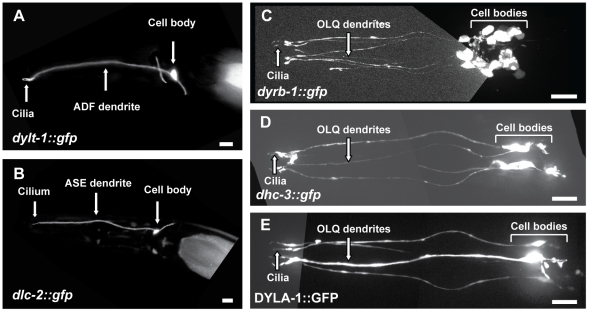
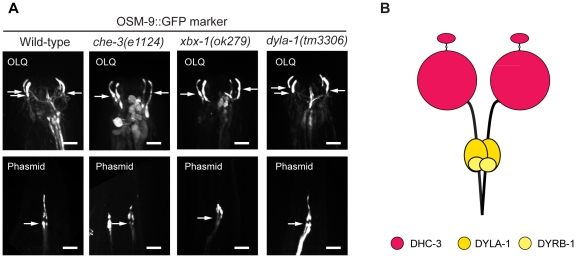
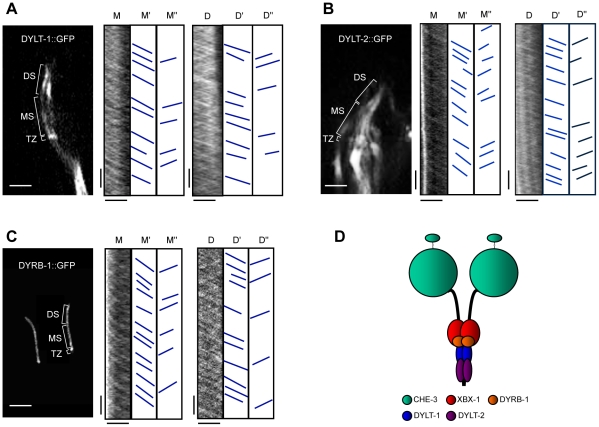
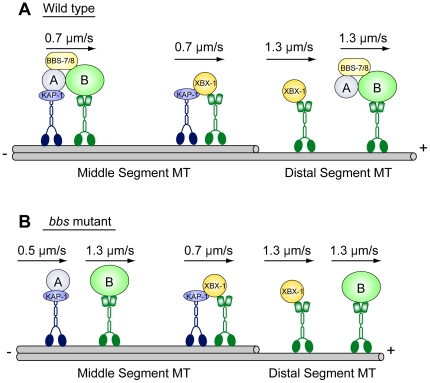
We analyzed the relatively poorly understood IFT-dynein (class DYNC2)-driven retrograde IFT pathway in C. elegans cilia, which yielded results that are surprising in the context of current models of IFT. Assays of C. elegans dynein gene expression and intraflagellar transport (IFT) suggest that conventional IFT-dynein contains essential heavy (CHE-3), light-intermediate (XBX-1), plus three light polypeptide chains that participate in IFT, but no "essential" intermediate chain. IFT assays of XBX-1::YFP suggest that IFT-dynein is transported as cargo to the distal tip of the cilium by kinesin-2 motors, but independent of the IFT-particle/BBSome complexes. Finally, we were surprised to find that the subset of cilia present on the OLQ (outer labial quadrant) neurons assemble independently of conventional "CHE-3" IFT-dynein, implying that there is a second IFT-dynein acting in these cilia. We have found a novel gene encoding a dynein heavy chain, DHC-3, and two light chains, in OLQ neurons, which could constitute an IFT-dynein complex in OLQ neuronal cilia. Our results underscore several surprising features of retrograde IFT that require clarification.
我们分析了在秀丽隐杆线虫纤毛中相对不太了解的 IFT-动力蛋白(DYNC2 类)驱动的逆行 IFT 途径,这些结果在 IFT 当前模型的背景下令人惊讶。秀丽隐杆线虫动力蛋白基因表达和内鞭毛运输(IFT)的测定表明,传统的 IFT-动力蛋白包含必需的重链(CHE-3)、轻-中间链(XBX-1)和参与 IFT 的三个轻多肽链,但没有“必需”的中间链。XBX-1::YFP 的 IFT 测定表明,IFT-动力蛋白作为货物被运输到纤毛的远端尖端,由驱动蛋白-2 马达驱动,但不依赖于 IFT 颗粒/BBSome 复合物。最后,我们惊讶地发现,存在于 OLQ(外唇象限)神经元上的纤毛子集独立于传统的“CHE-3”IFT-动力蛋白组装,这意味着存在第二种 IFT-动力蛋白在这些纤毛中起作用。我们在 OLQ 神经元中发现了一个编码动力蛋白重链 DHC-3 和两个轻链的新基因,它可以在 OLQ 神经元纤毛中构成 IFT-动力蛋白复合物。我们的结果强调了逆行 IFT 的几个令人惊讶的特征,需要进一步澄清。