Department of Psychiatry and EMGO institute, VU University Medical Center/GGZ inGeest, Amsterdam, the Netherlands.
BMC Psychiatry. 2011 Jun 24;11:102. doi: 10.1186/1471-244X-11-102.
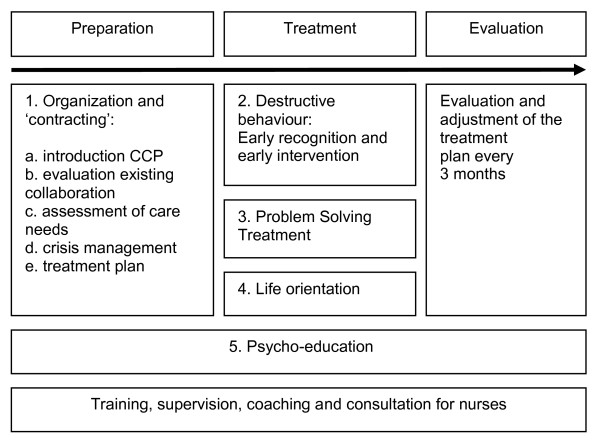
Structured psychotherapy is recommended as the preferred treatment of personality disorders. A substantial group of patients, however, has no access to these therapies or does not benefit. For those patients who have no (longer) access to psychotherapy a Collaborative Care Program (CCP) is developed. Collaborative Care originated in somatic health care to increase shared decision making and to enhance self management skills of chronic patients. Nurses have a prominent position in CCP's as they are responsible for optimal continuity and coordination of care. The aim of the CCP is to improve quality of life and self management skills, and reduce destructive behaviour and other manifestations of the personality disorder.
METHODS/DESIGN: Quantitative and qualitative data are combined in a comparative multiple case study. This makes it possible to test the feasibility of the CCP, and also provides insight into the preliminary outcomes of CCP. Two treatment conditions will be compared, one in which the CCP is provided, the other in which Care as Usual is offered. In both conditions 16 patients will be included. The perspectives of patients, their informal carers and nurses are integrated in this study. Data (questionnaires, documents, and interviews) will be collected among these three groups of participants. The process of treatment and care within both research conditions is described with qualitative research methods. Additional quantitative data provide insight in the preliminary results of the CCP compared to CAU. With a stepped analysis plan the 'black box' of the application of the program will be revealed in order to understand which characteristics and influencing factors are indicative for positive or negative outcomes.
The present study is, as to the best of our knowledge, the first to examine Collaborative Care for patients with severe personality disorders receiving outpatient mental health care. With the chosen design we want to examine how and which elements of the CC Program could contribute to a better quality of life for the patients.
Netherlands Trial Register (NTR): NTR2763.
结构性心理治疗被推荐为治疗人格障碍的首选方法。然而,相当一部分患者无法获得这些治疗或从中获益。对于那些无法(再)接受心理治疗的患者,开发了一种协作护理计划(CCP)。协作护理最初起源于躯体保健,旨在增加共同决策,并提高慢性患者的自我管理技能。护士在 CCP 中占有突出地位,因为他们负责最佳的连续性和护理协调。CCP 的目的是提高生活质量和自我管理技能,减少破坏性行为和人格障碍的其他表现。
方法/设计:定量和定性数据结合在一项比较性多案例研究中。这使得测试 CCP 的可行性成为可能,同时也提供了对 CCP 初步结果的洞察。将比较两种治疗条件,一种提供 CCP,另一种提供常规护理。在这两种情况下,将纳入 16 名患者。本研究整合了患者、他们的非正式照顾者和护士的观点。将从这三组参与者中收集数据(问卷、文件和访谈)。将使用定性研究方法描述两种研究条件下的治疗和护理过程。额外的定量数据提供了 CCP 与 CAU 相比的初步结果的见解。通过逐步分析计划,揭示程序应用的“黑箱”,以了解哪些特征和影响因素对积极或消极结果具有指示性。
就我们所知,目前的研究是首次检查协作护理对接受门诊心理健康护理的严重人格障碍患者的应用。通过选择的设计,我们希望研究 CCP 的哪些元素以及如何有助于改善患者的生活质量。
荷兰试验注册处(NTR):NTR2763。