Division of Gastroenterology, Department of Medicine Northwestern University Feinberg School of Medicine, Chicago, Illinois, USA.
Gastroenterology. 2011 Sep;141(3):1036-45. doi: 10.1053/j.gastro.2011.05.032. Epub 2011 May 27.
BACKGROUND & AIMS: Inflammatory bowel disease (IBD) is associated with increased apoptosis of intestinal epithelial cells (IECs). Mutations in the tumor suppressor p53 appear during early stages of progression from colitis to cancer. We investigated the role of p53 and its target, p53-upregulated modulator of apoptosis (PUMA), in inflammation-induced apoptosis of IECs.
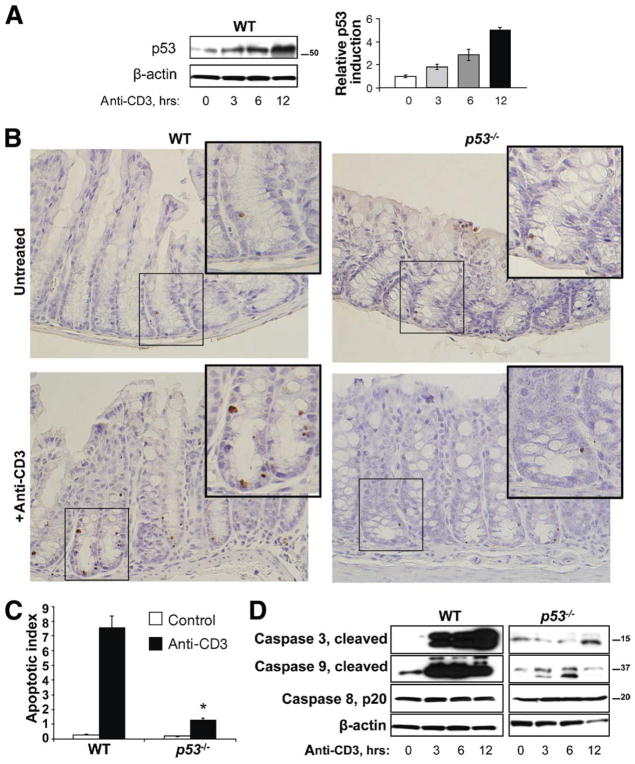
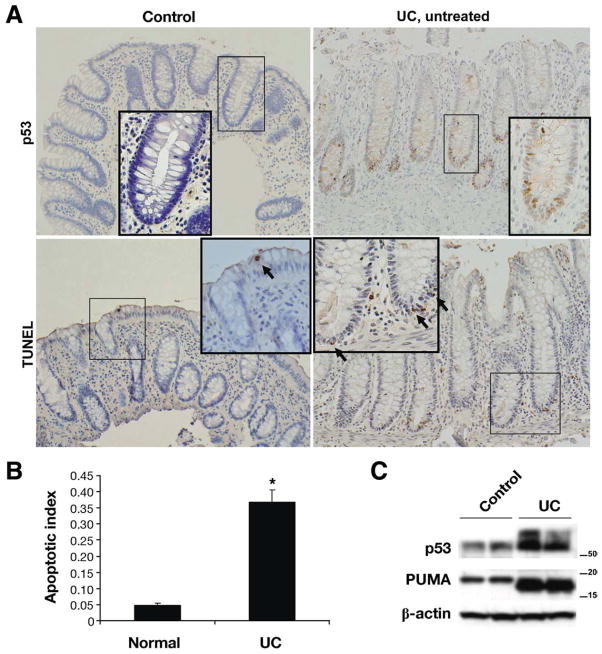
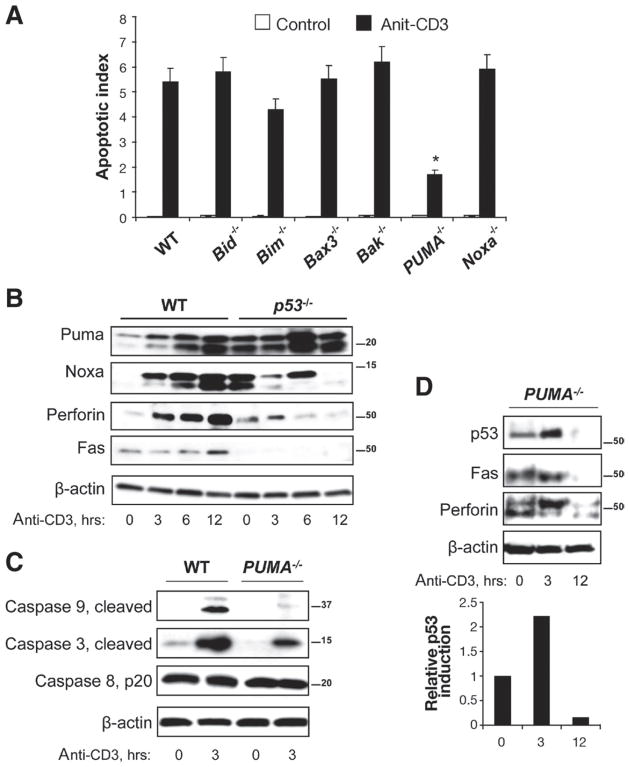
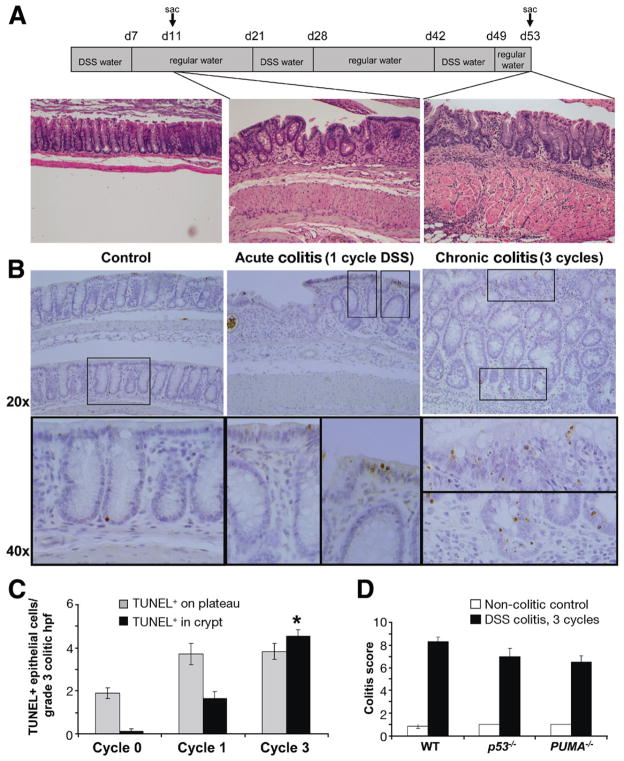
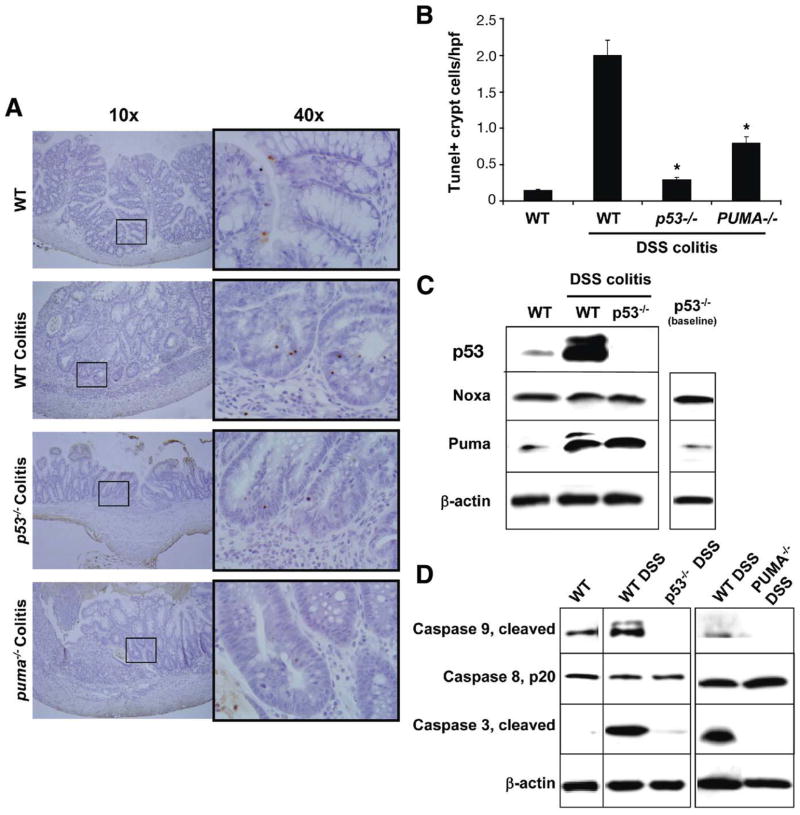
Apoptosis was induced in mouse models of mucosal inflammation. Responses of IECs to acute, T-cell activation were assessed in wild-type, p53⁻/⁻, Bid⁻/⁻, Bim⁻/⁻, Bax3⁻/⁻, Bak⁻/⁻, PUMA⁻/⁻, and Noxa⁻/⁻ mice. Responses of IECs to acute and chronic colitis were measured in mice following 1 or 3 cycles of dextran sulfate sodium (DSS), respectively. Apoptosis was assessed by TUNEL staining and measuring activity of caspases 3 and 9; levels of p53 and PUMA were assessed in colon tissue from patients with and without ulcerative colitis.
Apoptosis of IECs occurred in the lower crypts of colitic tissue from humans and mice. Colitis induction with anti-CD3 or 3 cycles of DSS increased apoptosis and protein levels of p53 and PUMA in colonic crypt IECs. In p53⁻/⁻ and PUMA⁻/⁻ mice, apoptosis of IECs was significantly reduced but inflammation was not. Levels of p53 and PUMA were increased in inflamed mucosal tissues of mice with colitis and in patients with UC, compared with controls. Induction of PUMA in IECs of p53⁻/⁻ mice indicated that PUMA-mediated apoptosis was independent of p53.
In mice and humans, colon inflammation induces apoptosis of IECs via p53-dependent and - independent mechanisms; PUMA also activates an intrinsic apoptosis pathway associated with colitis.
炎症性肠病(IBD)与肠上皮细胞(IEC)凋亡增加有关。在从结肠炎到癌症的进展早期,肿瘤抑制因子 p53 出现突变。我们研究了 p53 及其靶基因 p53 上调凋亡调节剂(PUMA)在 IEC 炎症诱导凋亡中的作用。
在黏膜炎症的小鼠模型中诱导凋亡。在野生型、p53-/-、Bid-/-、Bim-/-、Bax3-/-、Bak-/-、PUMA-/-和 Noxa-/-小鼠中评估 T 细胞激活的急性 IEC 反应。分别用葡聚糖硫酸钠(DSS)诱导 1 或 3 个周期后,在小鼠中测量 IEC 对急性和慢性结肠炎的反应。通过 TUNEL 染色和测量半胱天冬酶 3 和 9 的活性来评估细胞凋亡;评估溃疡性结肠炎患者和无溃疡性结肠炎患者结肠组织中的 p53 和 PUMA 水平。
在人类和小鼠的结肠炎组织的下部隐窝中观察到 IEC 的凋亡。用抗 CD3 或 3 个周期的 DSS 诱导结肠炎增加了结肠隐窝 IEC 中的凋亡和 p53 和 PUMA 的蛋白水平。在 p53-/-和 PUMA-/-小鼠中,IEC 的凋亡明显减少,但炎症并未减少。与对照组相比,患有结肠炎的小鼠和患有 UC 的患者的炎症性黏膜组织中 p53 和 PUMA 的水平增加。在 p53-/-小鼠的 IEC 中诱导 PUMA 表明 PUMA 介导的凋亡独立于 p53。
在小鼠和人类中,结肠炎症通过 p53 依赖和非依赖机制诱导 IEC 凋亡;PUMA 还激活了与结肠炎相关的固有凋亡途径。