Department of Epidemiology and Public Health, University College London, London, UK.
BMC Public Health. 2011 Jun 25;11:499. doi: 10.1186/1471-2458-11-499.
Few prospective cohort studies have assessed the association between social capital and mortality. The studies were conducted only in Western countries and did not use the same social capital indicators. The present prospective cohort study aimed to examine the relationships between various forms of individual social capital and all-cause mortality in Japan.
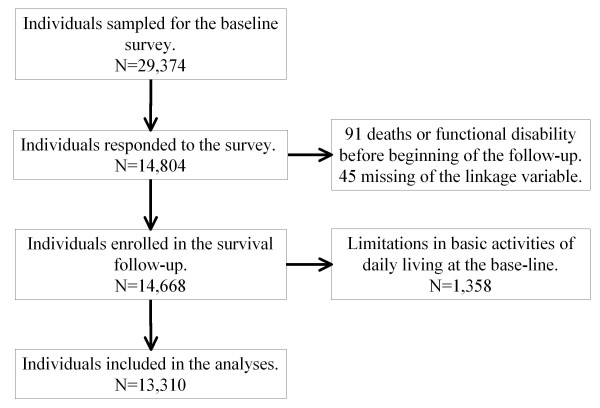
Self-administered questionnaires were mailed to subjects in the Aichi Gerontological Evaluation Study (AGES) Project in 2003. Mortality data from 2003 to 2008 were analyzed for 14,668 respondents. Both cognitive and structural components of individual social capital were collected: 8 for cognitive social capital (trust, 3; social support, 3; reciprocity, 2) and 9 for structural social capital (social network). Cox proportional hazard models stratified by sex with multiple imputation were used. Age, body mass index, self-rated health, current illness, smoking history, alcohol consumption, exercise, equivalent income and education were used as covariates.
During 27,571 person-years of follow-up for men and 29,561 person-years of follow-up for women, 790 deaths in men and 424 in women were observed. In the univariate analyses for men, lower social capital was significantly related to higher mortality in one general trust variable, all generalised reciprocity variables and four social network variables. For women, lower social capital was significantly related to higher mortality in all generalised reciprocity and four social network variables. After adjusting for covariates, lower friendship network was significantly associated with higher all-cause mortality among men (meet friends rarely; HR = 1.30, 95%CI = 1.10-1.53) and women (having no friends; HR = 1.81, 95%CI = 1.02-3.23). Among women, lower general trust was significantly related to lower mortality (most people cannot be trusted; HR = 0.65, 95%CI = 0.45-0.96).
Friendship network was a good predictor for all-cause mortality among older Japanese. In contrast, mistrust was associated with lower mortality among women. Studies with social capital indices considering different culture backgrounds are needed.
很少有前瞻性队列研究评估社会资本与死亡率之间的关系。这些研究仅在西方国家进行,并且没有使用相同的社会资本指标。本前瞻性队列研究旨在检验日本各种形式的个体社会资本与全因死亡率之间的关系。
2003 年,通过自我管理问卷向爱知老年人评估研究(AGES)项目的参与者邮寄问卷。对 2003 年至 2008 年的死亡率数据进行了分析,共涉及 14668 名应答者。个体社会资本的认知和结构成分都有收集:8 个认知社会资本(信任,3 个;社会支持,3 个;互惠,2 个)和 9 个结构社会资本(社会网络)。采用按性别分层的 Cox 比例风险模型和多重插补。年龄、体重指数、自我评估健康状况、当前疾病、吸烟史、饮酒、运动、等效收入和教育被用作协变量。
在男性 27571 人年和女性 29561 人年的随访期间,男性观察到 790 例死亡,女性观察到 424 例死亡。在男性的单变量分析中,较低的社会资本与一种普遍信任变量、所有普遍互惠变量和四个社会网络变量中的较高死亡率显著相关。对于女性,较低的社会资本与所有普遍互惠和四个社会网络变量中的较高死亡率显著相关。在校正协变量后,男性中较低的友谊网络与全因死亡率显著相关(很少与朋友见面;HR = 1.30,95%CI = 1.10-1.53)和女性(没有朋友;HR = 1.81,95%CI = 1.02-3.23)。对于女性,较低的普遍信任与较低的死亡率显著相关(大多数人不可信;HR = 0.65,95%CI = 0.45-0.96)。
友谊网络是日本老年人全因死亡率的一个良好预测指标。相比之下,不信任与女性较低的死亡率相关。需要进行考虑不同文化背景的社会资本指数的研究。