Department of Psychiatry and Biobehavioral Sciences, University of California–Los Angeles, Los Angeles, CA 90095, USA.
J Am Acad Child Adolesc Psychiatry. 2011 Jul;50(7):669-80. doi: 10.1016/j.jaac.2011.03.021. Epub 2011 Jun 2.
Given the fundamental role of thought disorder in schizophrenia, subtle communication disturbance may be a valuable predictor of subsequent development of psychosis. Here we examined the contribution of thought and communication disturbance to the prediction of outcome in adolescents identified as putatively prodromal for psychosis.
Transcribed speech samples were elicited from 105 adolescents (54 identified as being at clinical high risk for a first episode of psychosis [CHR], and 51 demographically comparable comparison subjects) and coded for formal thought disorder (FTD) and linguistic cohesion. We then examined the association of baseline FTD/cohesion with conversion to psychosis and social and role outcome at follow-up, approximately 1 year later.
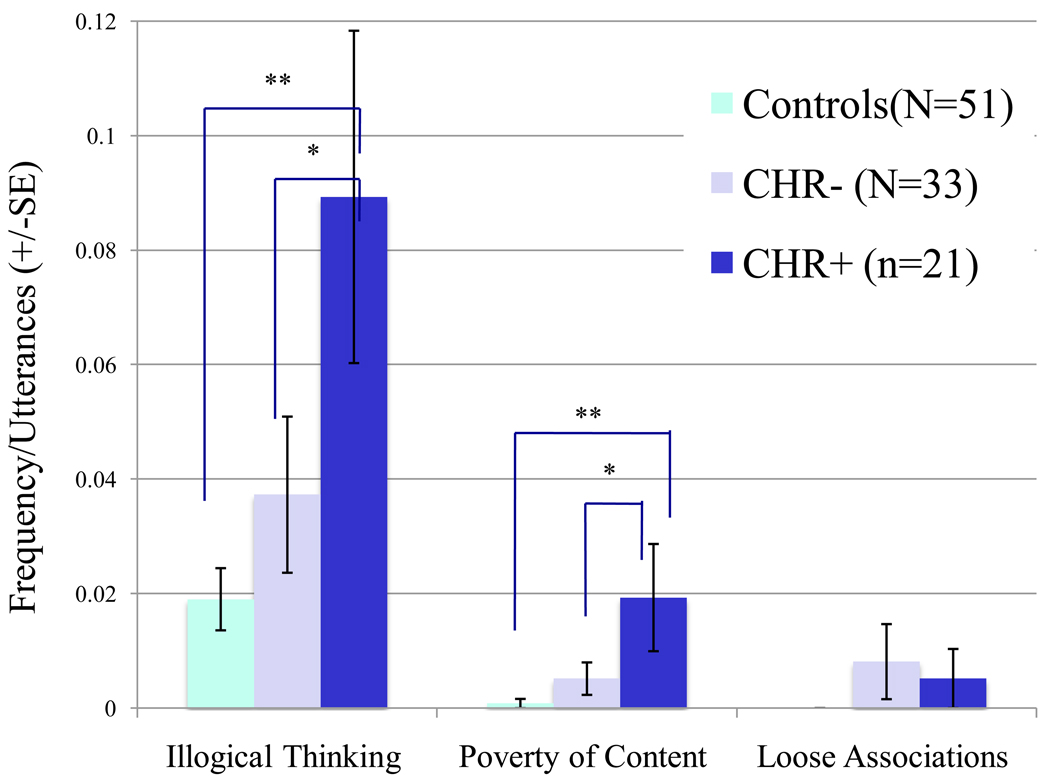
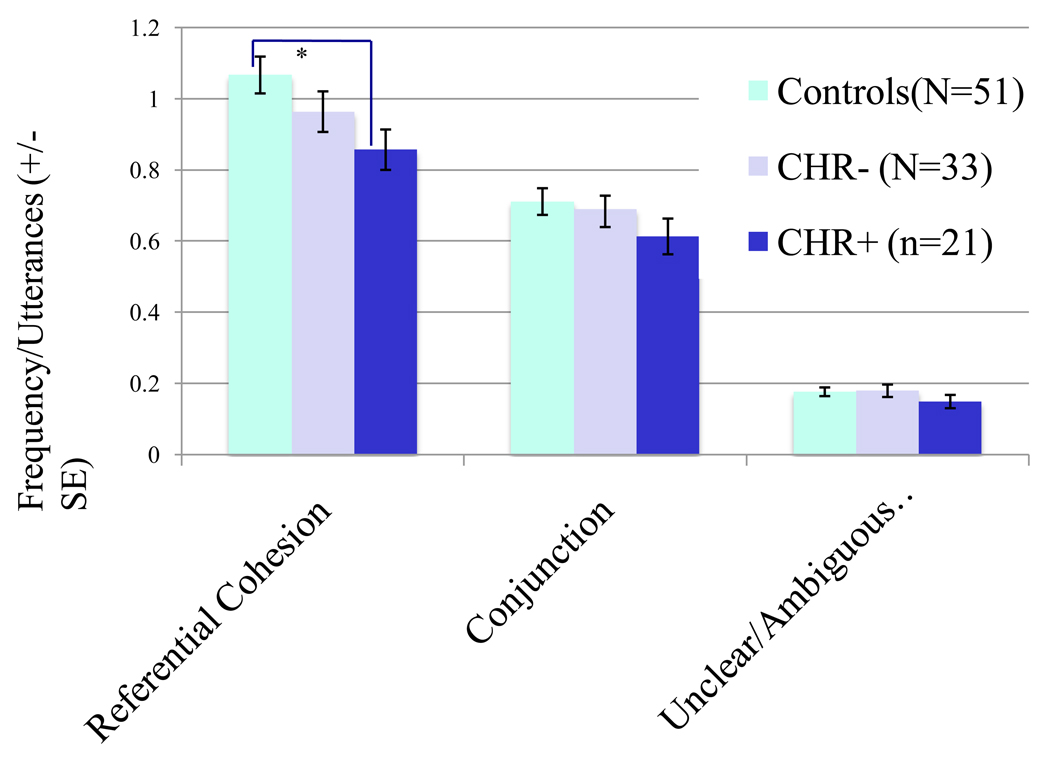
At baseline, CHR patients who subsequently converted to psychosis (CHR+) showed an elevated rate of illogical thinking and poverty of content (POC) in their speech, relative to both typically developing controls and CHR patients who did not convert to psychosis (CHR-). CHR+ youth also used significantly less referential cohesion at baseline, indicating that they provide fewer references to persons, objects, or events mentioned in preceding utterances. Multiple regression models indicated that, among measures of FTD/cohesion, illogical thinking was uniquely predictive of subsequent conversion to psychosis, whereas POC and referential cohesion were significant predictors of social and role functioning, respectively.
Despite the absence of fully psychotic symptoms, putatively prodromal individuals evidence signs of communication disturbance that are qualitatively similar to those seen in schizophrenia and are predictive of both conversion to psychosis and psychosocial outcome. These findings suggest that FTD measures have prognostic significance for at-risk youth.
鉴于思维障碍在精神分裂症中的基本作用,细微的交流障碍可能是预测随后精神病发展的一个有价值的指标。在这里,我们研究了思维和交流障碍对被认为是精神病前期的青少年结局的预测作用。
从 105 名青少年(54 名被确定为首次精神病发作的临床高风险[CHR],51 名在人口统计学上可比的对照组)中提取转录的言语样本,并对其进行思维障碍(FTD)和语言连贯性的编码。然后,我们检查了基线 FTD/凝聚力与随后精神病转化和随访时(大约 1 年后)社会和角色结局的关联。
在基线时,随后转化为精神病的 CHR 患者(CHR+)在其言语中表现出逻辑思维和内容贫困(POC)的发生率较高,与正常发育的对照组和未转化为精神病的 CHR 患者(CHR-)相比。CHR+青年在基线时也使用了明显较少的指称凝聚力,表明他们在前面的话语中提供的参考人物、物体或事件较少。多元回归模型表明,在 FTD/凝聚力的测量中,逻辑思维是后续转化为精神病的唯一预测指标,而 POC 和指称凝聚力分别是社会和角色功能的显著预测指标。
尽管没有完全的精神病症状,疑似前驱个体表现出的交流障碍与精神分裂症中所见的障碍具有定性相似性,并可预测精神病转化和心理社会结局。这些发现表明,FTD 测量对高危青年具有预后意义。