Department of Internal Medicine II - Cardiology, University of Ulm, Ulm, Germany.
J Cell Mol Med. 2012 Apr;16(4):927-35. doi: 10.1111/j.1582-4934.2011.01365.x.
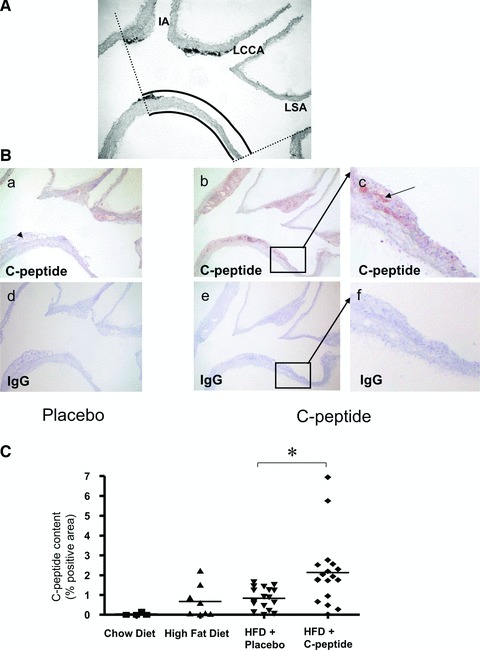
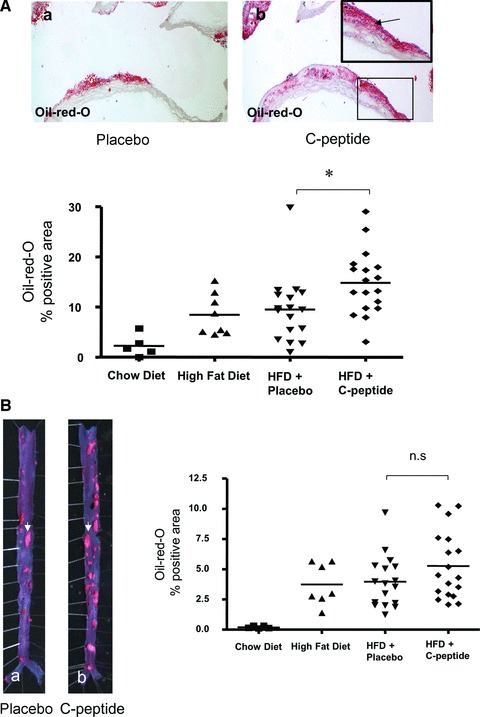
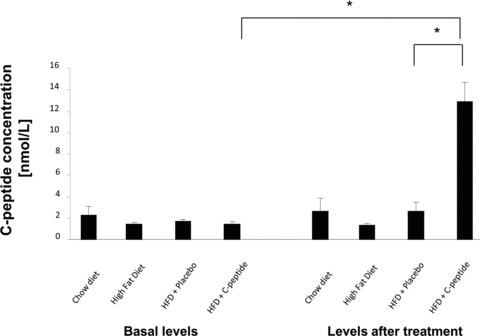
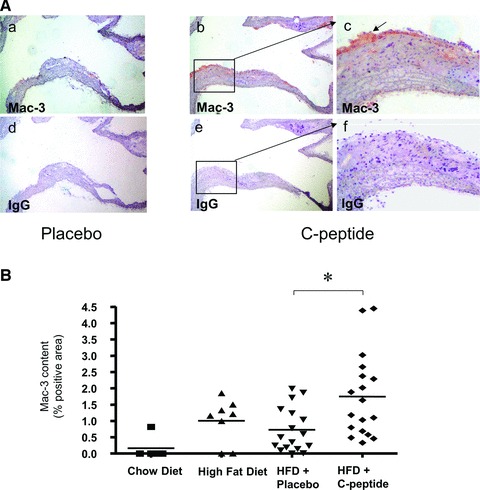
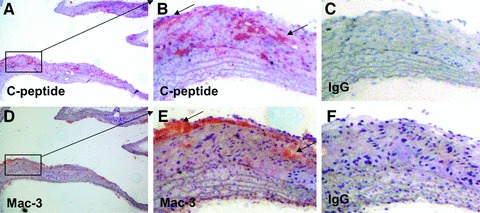
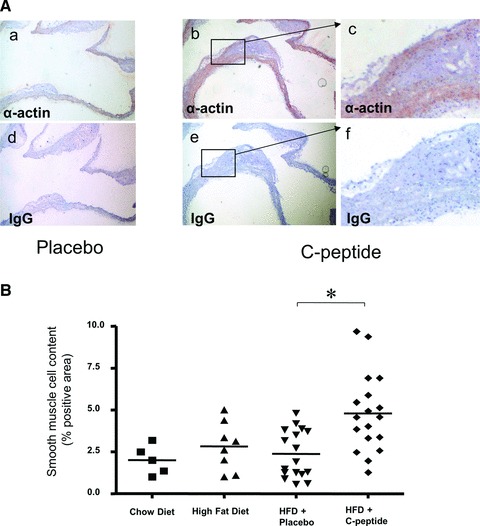
Patients with insulin resistance and early type 2 diabetes exhibit an increased propensity to develop a diffuse and extensive pattern of arteriosclerosis. Typically, these patients show elevated serum levels of the proinsulin cleavage product C-peptide and immunohistochemical data from our group revealed C-peptide deposition in early lesions of these individuals. Moreover, in vitro studies suggest that C-peptide could promote atherogenesis. This study examined whether C-peptide promotes vascular inflammation and lesion development in a mouse model of arteriosclerosis. ApoE-deficient mice on a high fat diet were treated with C-peptide or control injections for 12 weeks and the effect on lesion size and plaque composition was analysed. C-peptide treatment significantly increased C-peptide blood levels by 4.8-fold without having an effect on glucose or insulin levels, nor on the lipid profile. In these mice, C-peptide deposition in atherosclerotic plaques was significantly increased compared with controls. Moreover, lesions of C-peptide-treated mice contained significantly more macrophages (1.6 ± 0.3% versus 0.7 ± 0.2% positive area; P < 0.01) and more vascular smooth muscle cells (4.8 ± 0.6% versus 2.4 ± 0.3% positive area; P < 0.01). Finally, lipid deposition measured by Oil-red-O staining in the aortic arch was significantly higher in the C-peptide group compared with controls. Our results demonstrate that elevated C-peptide levels promote inflammatory cell infiltration and lesion development in ApoE-deficient mice without having metabolic effects. These data obtained in a mouse model of arteriosclerosis support the hypothesis that C-peptide may have an active role in atherogenesis in patients with diabetes and insulin resistance.
胰岛素抵抗和早期 2 型糖尿病患者表现出发展弥漫性广泛动脉粥样硬化的倾向增加。通常,这些患者的血清前胰岛素裂解产物 C 肽水平升高,我们小组的免疫组织化学数据显示 C 肽在这些个体的早期病变中沉积。此外,体外研究表明 C 肽可促进动脉粥样硬化形成。本研究探讨了 C 肽是否在动脉粥样硬化小鼠模型中促进血管炎症和病变发展。高脂饮食的载脂蛋白 E 缺陷小鼠接受 C 肽或对照注射治疗 12 周,分析对病变大小和斑块组成的影响。C 肽治疗使 C 肽血液水平显著增加 4.8 倍,而对血糖或胰岛素水平没有影响,也不影响血脂谱。在这些小鼠中,与对照组相比,C 肽在动脉粥样硬化斑块中的沉积显著增加。此外,C 肽治疗小鼠的病变含有明显更多的巨噬细胞(1.6 ± 0.3%对 0.7 ± 0.2%阳性面积;P < 0.01)和更多的血管平滑肌细胞(4.8 ± 0.6%对 2.4 ± 0.3%阳性面积;P < 0.01)。最后,通过主动脉弓的油红 O 染色测量的脂质沉积在 C 肽组中明显高于对照组。我们的结果表明,升高的 C 肽水平在载脂蛋白 E 缺陷小鼠中促进炎症细胞浸润和病变发展,而没有代谢作用。这些在动脉粥样硬化小鼠模型中获得的数据支持 C 肽在糖尿病和胰岛素抵抗患者的动脉粥样硬化形成中可能具有积极作用的假说。