National Institute of Neurological Disorders and Stroke, NIH, Bethesda, MD 20892-1065, USA.
Neuroimage. 2011 Sep 1;58(1):75-81. doi: 10.1016/j.neuroimage.2011.06.030. Epub 2011 Jun 25.
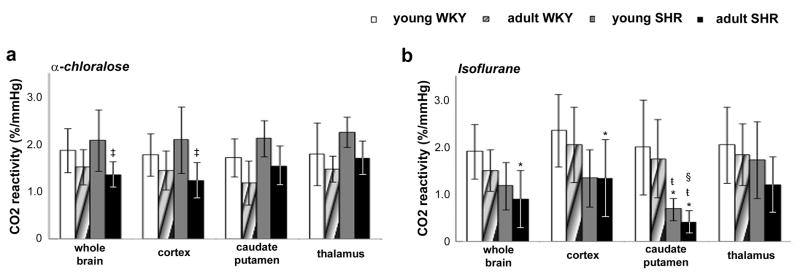
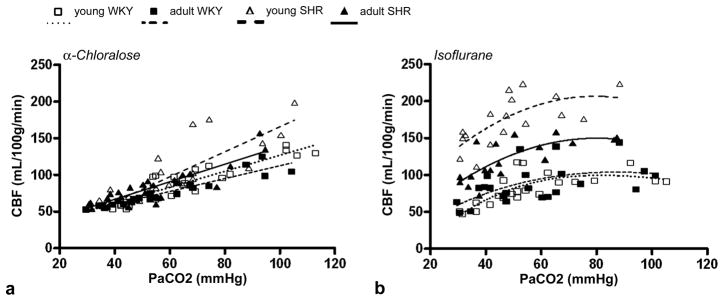
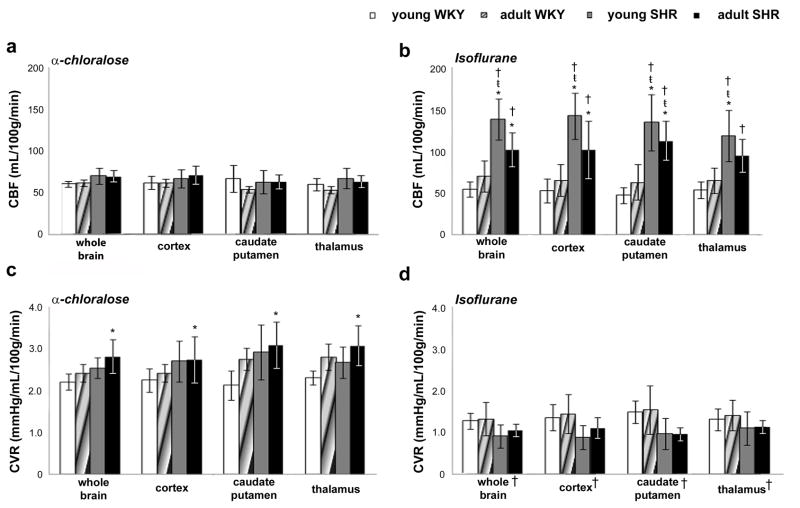
Hypertension afflicts 25% of the general population and over 50% of the elderly. In the present work, arterial spin labeling MRI was used to non-invasively quantify regional cerebral blood flow (CBF), cerebrovascular resistance and CO(2) reactivity in spontaneously hypertensive rats (SHR) and in normotensive Wistar Kyoto rats (WKY), at two different ages (3 months and 10 months) and under the effects of two anesthetics, α-chloralose and 2% isoflurane (1.5 MAC). Repeated CBF measurements were highly consistent, differing by less than 10% and 18% within and across animals, respectively. Under α-chloralose, whole brain CBF at normocapnia did not differ between groups (young WKY: 61 ± 3ml/100g/min; adult WKY: 62 ± 4ml/100g/min; young SHR: 70 ± 9ml/100g/min; adult SHR: 69 ± 8ml/100g/min), indicating normal cerebral autoregulation in SHR. At hypercapnia, CBF values increased significantly, and a linear relationship between CBF and PaCO(2) levels was observed. In contrast, 2% isoflurane impaired cerebral autoregulation. Whole brain CBF in SHR was significantly higher than in WKY rats at normocapnia (young SHR: 139 ± 25ml/100g/min; adult SHR: 104 ± 23ml/100g/min; young WKY: 55± 9ml/100g/min; adult WKY: 71 ± 19ml/100g/min). CBF values increased significantly with increasing CO(2); however, there was a clear saturation of CBF at PaCO(2) levels greater than 70mmHg in both young and adult rats, regardless of absolute CBF values, suggesting that isoflurane interferes with the vasodilatory mechanisms of CO(2). This behavior was observed for both cortical and subcortical structures. Under either anesthetic, CO(2) reactivity values in adult SHR were decreased, confirming that hypertension, when combined with age, increases cerebrovascular resistance and reduces cerebrovascular compliance.
高血压影响 25%的普通人群和 50%以上的老年人。在本工作中,我们使用动脉自旋标记 MRI 无创地定量测量自发性高血压大鼠 (SHR) 和正常血压的 Wistar Kyoto 大鼠 (WKY) 的局部脑血流 (CBF)、脑血管阻力和 CO₂反应性,这些大鼠具有两种不同的年龄 (3 个月和 10 个月) 和两种麻醉剂的影响,即 α-氯醛和 2%异氟烷 (1.5 MAC)。重复的 CBF 测量高度一致,在动物内和动物间分别相差不到 10%和 18%。在 α-氯醛下,正常碳酸血症时两组间全脑 CBF 无差异(年轻 WKY:61 ± 3ml/100g/min;成年 WKY:62 ± 4ml/100g/min;年轻 SHR:70 ± 9ml/100g/min;成年 SHR:69 ± 8ml/100g/min),表明 SHR 的脑自动调节正常。高碳酸血症时,CBF 值显著增加,并且观察到 CBF 与 PaCO₂ 水平之间的线性关系。相比之下,2%异氟烷损害脑自动调节。正常碳酸血症时,SHR 的全脑 CBF 明显高于 WKY 大鼠(年轻 SHR:139 ± 25ml/100g/min;成年 SHR:104 ± 23ml/100g/min;年轻 WKY:55 ± 9ml/100g/min;成年 WKY:71 ± 19ml/100g/min)。CBF 值随 CO₂ 增加而显著增加;然而,无论绝对 CBF 值如何,在年轻和成年大鼠中,PaCO₂ 水平大于 70mmHg 时 CBF 明显饱和,表明异氟烷干扰了 CO₂ 的血管扩张机制。这种行为在皮质和皮质下结构中均观察到。在两种麻醉剂下,成年 SHR 的 CO₂ 反应性值降低,证实高血压与年龄相结合会增加脑血管阻力并降低脑血管顺应性。