Montano X, Millikan R, Milhaven J M, Newsom D A, Ludlow J W, Arthur A K, Fanning E, Bikel I, Livingston D M
Dana-Farber Cancer Institute, Harvard Medical School, Boston, MA 02115.
Proc Natl Acad Sci U S A. 1990 Oct;87(19):7448-52. doi: 10.1073/pnas.87.19.7448.
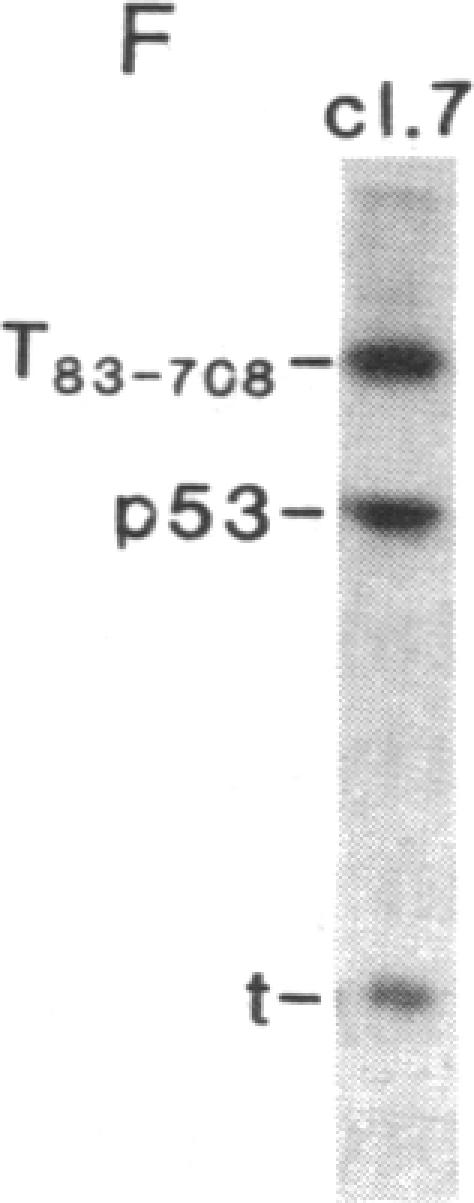
The 82-residue amino-terminal sequences of simian virus 40 large tumor antigen (TAg) and small tumor antigen (tAg) are identical. Genetic analysis of TAg lacking amino acids 1-82 revealed that it was transformation-defective, as revealed by the agar growth assay, except when introduced in the presence of tAg. Since the latter, alone, lacks overt transforming activity, it would appear that the function of the sequence common to TAg and tAg is necessary, but not sufficient, for TAg transforming activity and that tAg can provide that function or its equivalent in trans. Thus, tAg may, in part, be viewed as a "portable" copy of a TAg functional domain.
猿猴病毒40大肿瘤抗原(TAg)和小肿瘤抗原(tAg)的82个氨基酸的氨基末端序列是相同的。对缺失氨基酸1-82的TAg进行遗传分析表明,如琼脂生长试验所示,它是转化缺陷型的,除非在tAg存在的情况下引入。由于单独的后者缺乏明显的转化活性,似乎TAg和tAg共有的序列功能对于TAg的转化活性是必要的,但不是充分的,并且tAg可以在反式中提供该功能或其等效物。因此,tAg在一定程度上可被视为TAg功能域的“可携带”拷贝。