Scientific Institute for Quality of Healthcare, Radboud University Nijmegen Medical Centre, Geert Grooteplein 21, 6525 EX Nijmegen, The Netherlands.
BMC Musculoskelet Disord. 2011 Jun 28;12:139. doi: 10.1186/1471-2474-12-139.
Shoulder pain is reported to be highly prevalent and tends to be recurrent or persistent despite medical treatment. The pathophysiological mechanisms of shoulder pain are poorly understood. Furthermore, there is little evidence supporting the effectiveness of current treatment protocols. Although myofascial trigger points (MTrPs) are rarely mentioned in relation to shoulder pain, they may present an alternative underlying mechanism, which would provide new treatment targets through MTrP inactivation. While previous research has demonstrated that trained physiotherapists can reliably identify MTrPs in patients with shoulder pain, the percentage of patients who actually have MTrPs remains unclear. The aim of this observational study was to assess the prevalence of muscles with MTrPs and the association between MTrPs and the severity of pain and functioning in patients with chronic non-traumatic unilateral shoulder pain.
An observational study was conducted. Subjects were recruited from patients participating in a controlled trial studying the effectiveness of physical therapy on patients with unilateral non-traumatic shoulder pain. Sociodemographic and patient-reported symptom scores, including the Disabilities of the Arm, Shoulder, and Hand (DASH) Questionnaire, and Visual Analogue Scales for Pain were compared with other studies. To test for differences in age, gender distribution, and education level between the current study population and the populations from Dutch shoulder studies, the one sample T-test was used. One observer examined all subjects (n = 72) for the presence of MTrPs. Frequency distributions, means, medians, standard deviations, and 95% confidence intervals were calculated for descriptive purposes. The Spearman's rank-order correlation (ρ) was used to test for association between variables.
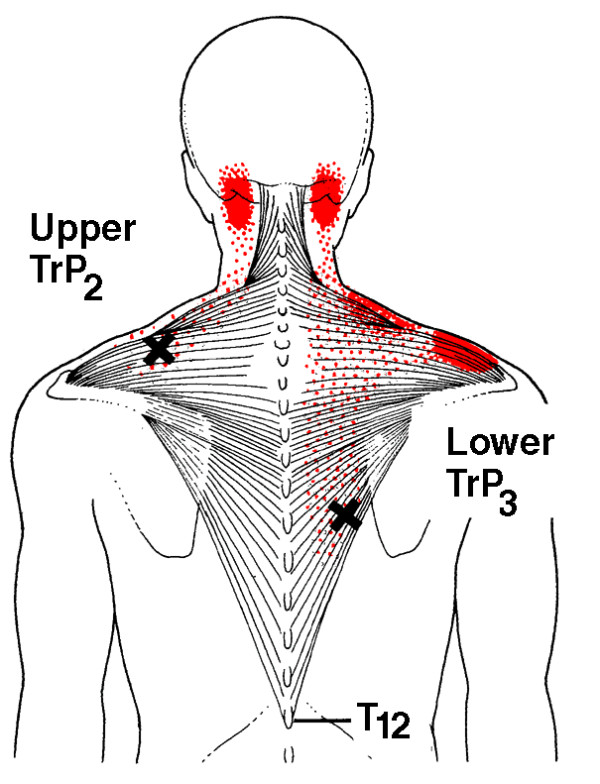
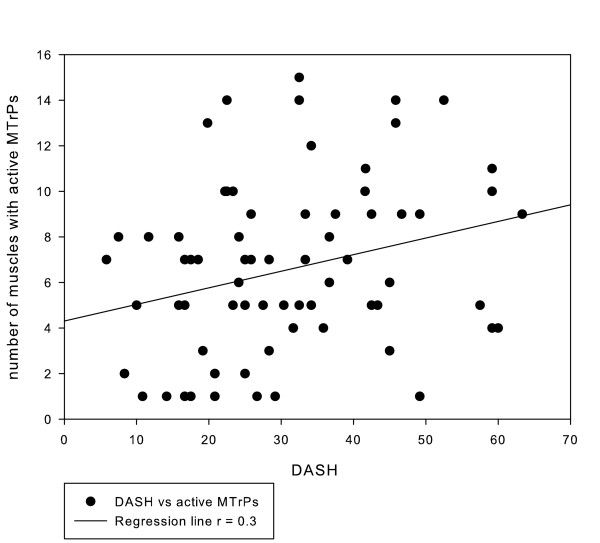
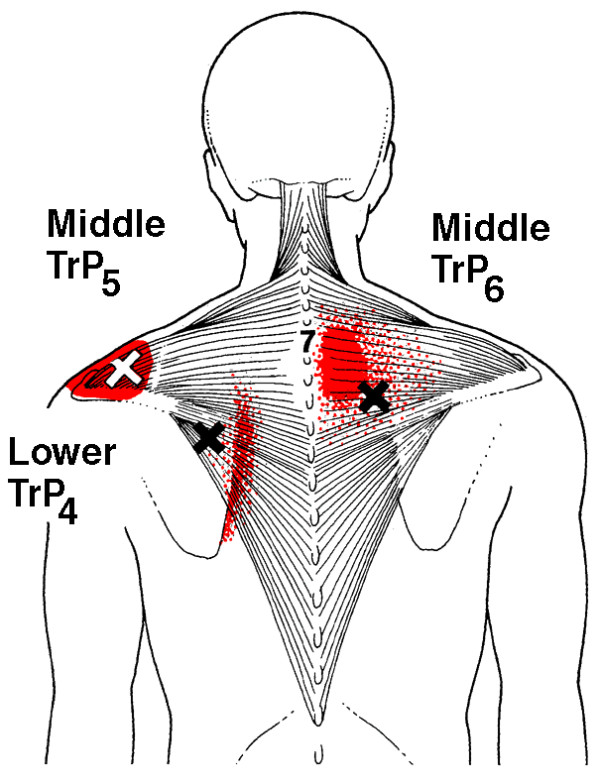
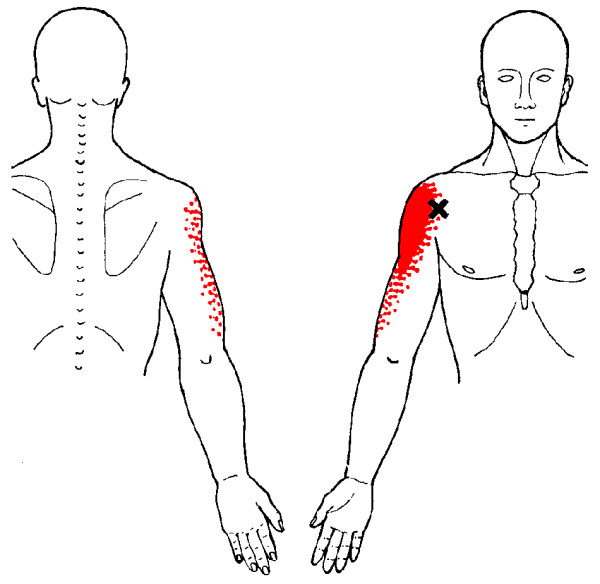
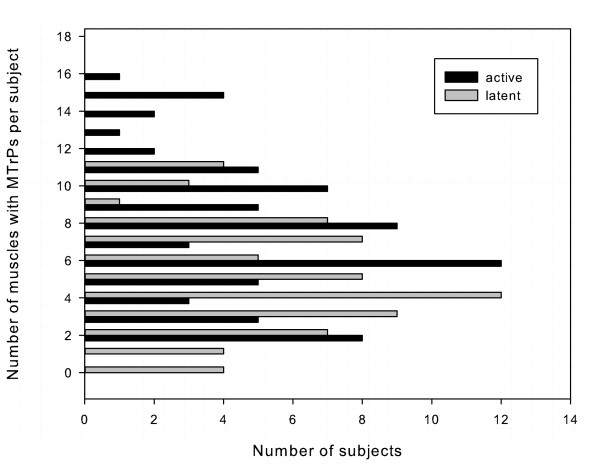
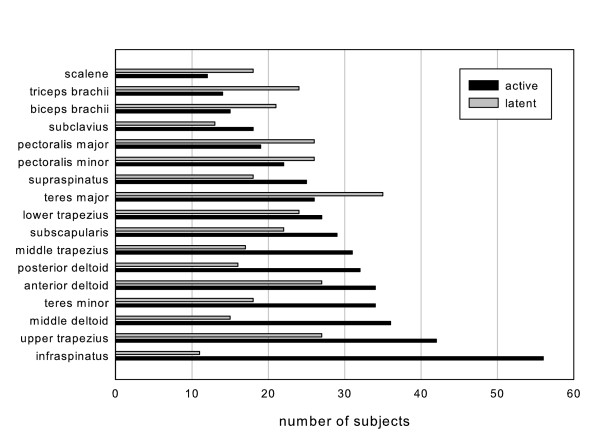
MTrPs were identified in all subjects. The median number of muscles with MTrPs per subject was 6 (active MTrPs) and 4 (latent MTrPs). Active MTrPs were most prevalent in the infraspinatus (77%) and the upper trapezius muscles (58%), whereas latent MTrPs were most prevalent in the teres major (49%) and anterior deltoid muscles (38%). The number of muscles with active MTrPs was only moderately correlated with the DASH score.
The prevalence of muscles containing active and latent MTrPs in a sample of patients with chronic non-traumatic shoulder pain was high.
肩部疼痛的发病率很高,且经治疗后往往会复发或持续存在。肩部疼痛的病理生理机制尚不清楚。此外,目前的治疗方案也几乎没有证据支持其有效性。尽管肌筋膜触发点(MTrPs)在肩部疼痛中很少被提及,但它们可能代表一种潜在的发病机制,通过 MTrP 失活提供新的治疗靶点。虽然之前的研究已经证明,经过训练的物理治疗师可以可靠地识别肩部疼痛患者的 MTrPs,但实际上有多少患者存在 MTrPs 尚不清楚。本观察性研究旨在评估慢性非创伤性单侧肩部疼痛患者中存在 MTrPs 的肌肉的患病率,以及 MTrPs 与疼痛严重程度和功能之间的关系。
进行了一项观察性研究。研究对象从参与一项物理治疗对单侧非创伤性肩部疼痛患者有效性的对照试验的患者中招募。社会人口统计学和患者报告的症状评分,包括上肢功能障碍问卷(DASH)和视觉模拟评分(VAS)与其他研究进行了比较。为了检验当前研究人群与荷兰肩部研究人群在年龄、性别分布和教育水平方面的差异,使用了单样本 T 检验。一名观察者对所有受试者(n=72)进行 MTrPs 检查。为了描述性目的,计算了频率分布、平均值、中位数、标准差和 95%置信区间。使用 Spearman 秩相关系数(ρ)来检验变量之间的相关性。
所有受试者均发现有 MTrPs。每位受试者的肌肉中存在 MTrPs 的中位数为 6(活跃的 MTrPs)和 4(潜伏的 MTrPs)。活跃的 MTrPs 在前锯肌(77%)和上斜方肌(58%)中最为常见,而潜伏的 MTrPs 在前锯肌(49%)和三角肌前束(38%)中最为常见。活跃的 MTrPs 数量与 DASH 评分仅中度相关。
在慢性非创伤性肩部疼痛患者样本中,存在活跃和潜伏 MTrPs 的肌肉的患病率很高。