Norwegian Veterinary Institute, N-0106 Oslo, Norway.
Acta Vet Scand. 2011 Jun 28;53(1):44. doi: 10.1186/1751-0147-53-44.
In Gram-negative bacteria, the most commonly studied quorum sensing signals are the N-acylhomoserine lactones (AHLs). In Salmonella, AHLs are recognized by SdiA, which is believed to be a sensor of AHLs produced by other bacteria, since Salmonella does not produce AHLs itself. It has been speculated that AHLs produced by the gastrointestinal flora may influence the regulation of virulence traits in Salmonella. The aim of the present work was to study the effect of AHLs on epithelial cell invasion by Salmonella in vitro.
Invasion by Salmonella enterica subspecies enterica serovar Typhimurium (S. Typhimurium) strain and its isogenc sdiA mutant was studied using a conventional gentamycin invasion assay with HEp-2 cells at 37°C. Gene expression was studied using a semi-quantitative PCR.
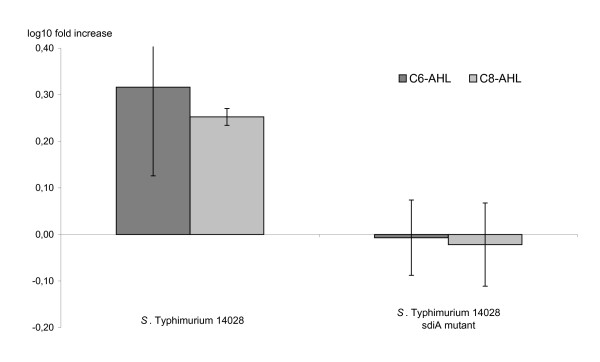
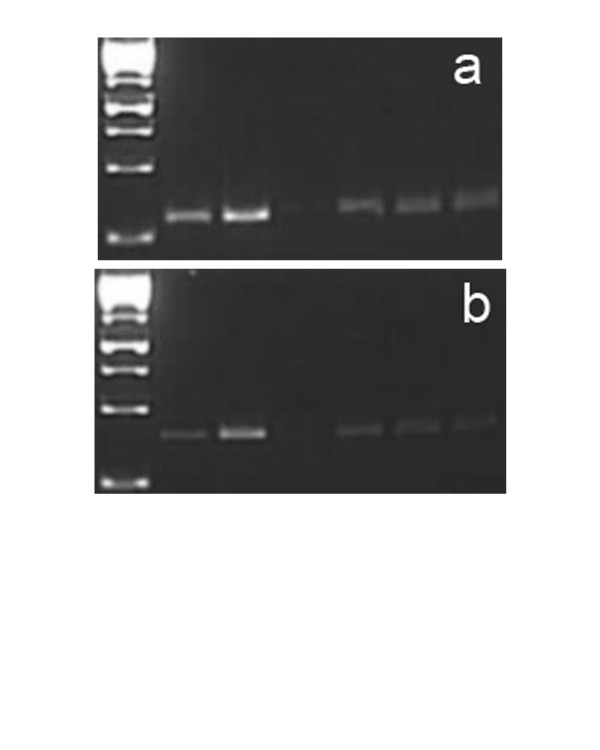
The S. Typhimurium strain, but not its isogenic sdiA mutant, displayed increased in vitro invasion after addition of both N-hexanoyl-DL-homoserine lactone (C6-AHL) and N-octanoyl-DL-homoserine lactone (C8-AHL). Increased expression of two of the genes in the SdiA regulon (rck and srgE) was observed in the wild type strain, but not in the sdiA mutant.
The results from the present study show that S. Typhimurium can respond to two different AHL quorum sensing signals (C6-AHL and C8-AHL) with increased cell invasion at 37°C in vitro, and that this response most likely is sdiA mediated. These results indicate that if AHLs are present in the intestinal environment, they may increase the invasiveness of Salmonella.
在革兰氏阴性菌中,最常见的群体感应信号是 N-酰基高丝氨酸内酯(AHLs)。在沙门氏菌中,AHLs 被 SdiA 识别,SdiA 被认为是其他细菌产生的 AHLs 的传感器,因为沙门氏菌本身不产生 AHLs。有人推测,胃肠道菌群产生的 AHLs 可能影响沙门氏菌毒力性状的调节。本研究旨在研究 AHLs 对沙门氏菌体外上皮细胞侵袭的影响。
使用常规庆大霉素侵袭试验,在 37°C 下用 HEp-2 细胞研究沙门氏菌亚种肠炎血清型鼠伤寒菌(S. Typhimurium)及其同基因 sdiA 突变株的侵袭情况。使用半定量 PCR 研究基因表达。
S. Typhimurium 株,但不是其同基因 sdiA 突变株,在添加 N-己酰基-DL-高丝氨酸内酯(C6-AHL)和 N-辛酰基-DL-高丝氨酸内酯(C8-AHL)后,体外侵袭能力增加。在野生型菌株中观察到 SdiA 调控子中的两个基因(rck 和 srgE)的表达增加,但在 sdiA 突变株中没有观察到。
本研究结果表明,S. Typhimurium 可以对两种不同的 AHL 群体感应信号(C6-AHL 和 C8-AHL)作出反应,在 37°C 体外增加细胞侵袭能力,而这种反应很可能是 sdiA 介导的。这些结果表明,如果肠道环境中存在 AHLs,它们可能会增加沙门氏菌的侵袭性。