Preventative Medicine and Epidemiology Unit, Hospital Clínic, C/Villarroel 174, Barcelona, Spain.
Malar J. 2011 Jun 29;10:179. doi: 10.1186/1475-2875-10-179.
As part of comprehensive malaria control strategies, the Bioko Island Malaria Control Project (BIMCP) distributed 110,000 long-lasting insecticide-treated nets (LLIN) in late 2007 with the aim of providing one net for each sleeping area. Despite attaining initially very high levels of net coverage and net use, many children under five years of age did not sleep under a net by 2009, according to annual malaria indicator surveys. The aim of this study was to assess the determinants of bed net use in children under five and bed net ownership of the households in which they live.
Using data from annual cross-sectional household surveys of 2008 and 2009, we investigated factors associated with sleeping under a mosquito net the night prior to the survey, and a households owning at least one net, in all households which had at least one child under five years. Amongst others, caregiver's knowledge of malaria and household characteristics including a socio-economic score (SES), based on ownership of household assets, were analysed for their effect on net ownership and use.
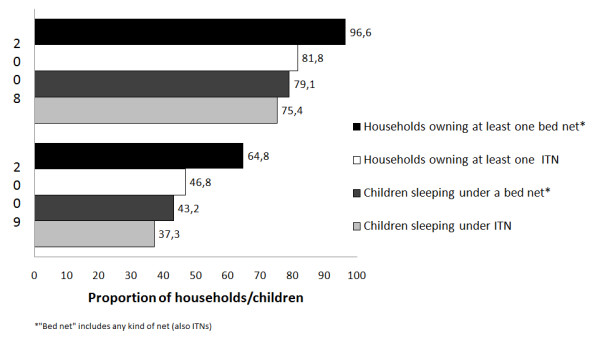
There was a decline of around 32% in the proportion of households that owned at least one net between 2008 and 2009. Higher household bed net ownership was associated with knowing how malaria was prevented and transmitted, having the house sprayed in the previous 12 months, having fewer children under five in the household, and children being sick at some point in the previous 14 days. Higher bed net use in children < 5 was associated with being sick at some point in the last 14 days prior to the survey, living in an urban area, more years of education of the head of the household, household ownership of at least one ITN (as opposed to an untreated net) and the year in which the survey took place.
The big fall in bed net use from 2008 to 2009 was attributable to the striking decline in ownership. Although ownership was similar in rural and urban areas, rural households were less likely to protect their children with bed nets. Knowledge about malaria was an important determinant of bed net ownership. Further research is needed to elucidate the decline in bed net ownership between 2008 and 2009.
作为综合疟疾控制策略的一部分,比奥科岛疟疾控制项目(BIMCP)于 2007 年末分发了 110,000 顶长效驱虫蚊帐(LLIN),旨在为每个睡眠区提供一顶蚊帐。尽管最初蚊帐的覆盖率和使用率非常高,但根据年度疟疾指标调查,2009 年仍有许多 5 岁以下儿童没有睡在蚊帐下。本研究旨在评估 5 岁以下儿童使用蚊帐和居住家庭拥有蚊帐的决定因素。
利用 2008 年和 2009 年年度横断面家庭调查的数据,我们调查了与调查前一晚睡在蚊帐下以及家庭拥有至少一顶蚊帐相关的因素,这些家庭至少有一个 5 岁以下的孩子。除其他外,分析了照顾者对疟疾的了解以及包括社会经济评分(SES)在内的家庭特征(基于家庭资产的所有权)对蚊帐所有权和使用的影响。
2008 年至 2009 年间,拥有至少一顶蚊帐的家庭比例下降了约 32%。较高的家庭蚊帐拥有率与了解疟疾的预防和传播方式、家中在过去 12 个月内进行了喷洒、家中 5 岁以下儿童较少以及儿童在过去 14 天内生病有关。5 岁以下儿童更高的蚊帐使用率与调查前 14 天内生病有关,居住在城市地区,家庭主要成员受教育年限较长,家庭拥有至少一顶 ITN(而非未处理的蚊帐)以及调查年份。
2008 年至 2009 年期间,蚊帐使用率大幅下降归因于拥有量的显著下降。尽管农村和城市地区的拥有率相似,但农村家庭不太可能用蚊帐保护其子女。对疟疾的了解是蚊帐拥有的重要决定因素。需要进一步研究来阐明 2008 年至 2009 年期间蚊帐拥有量的下降。