Section on Critical Brain Dynamics, National Institute of Mental Health, Bethesda, MD 20892, USA.
PLoS One. 2011;6(5):e19779. doi: 10.1371/journal.pone.0019779. Epub 2011 May 26.
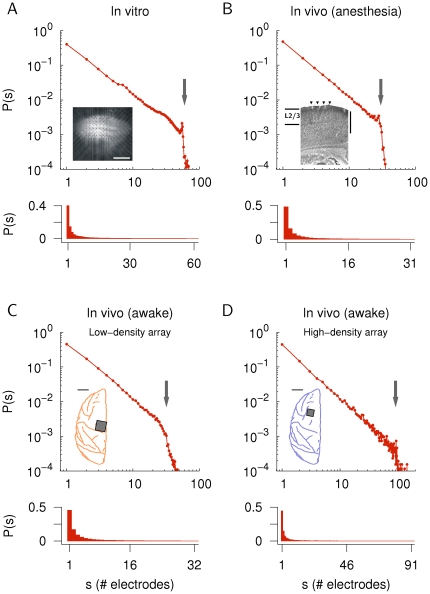
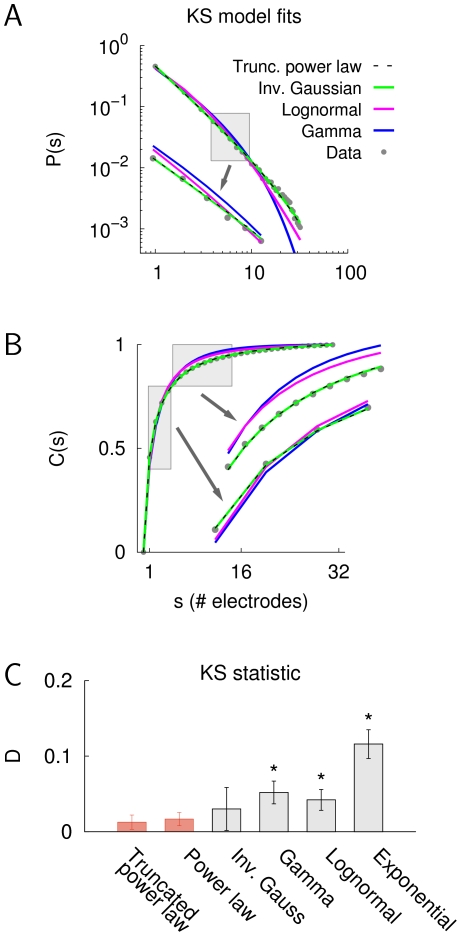
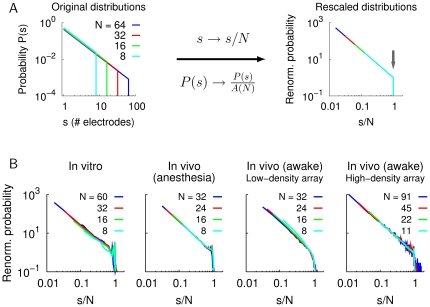
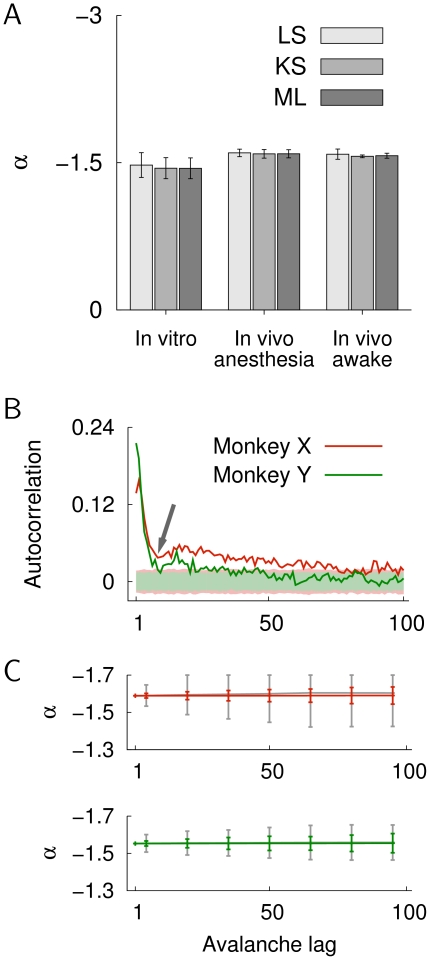
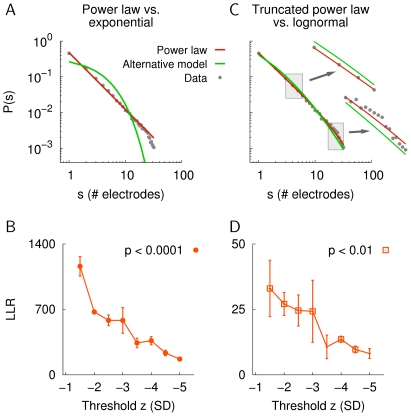
The size distribution of neuronal avalanches in cortical networks has been reported to follow a power law distribution with exponent close to -1.5, which is a reflection of long-range spatial correlations in spontaneous neuronal activity. However, identifying power law scaling in empirical data can be difficult and sometimes controversial. In the present study, we tested the power law hypothesis for neuronal avalanches by using more stringent statistical analyses. In particular, we performed the following steps: (i) analysis of finite-size scaling to identify scale-free dynamics in neuronal avalanches, (ii) model parameter estimation to determine the specific exponent of the power law, and (iii) comparison of the power law to alternative model distributions. Consistent with critical state dynamics, avalanche size distributions exhibited robust scaling behavior in which the maximum avalanche size was limited only by the spatial extent of sampling ("finite size" effect). This scale-free dynamics suggests the power law as a model for the distribution of avalanche sizes. Using both the Kolmogorov-Smirnov statistic and a maximum likelihood approach, we found the slope to be close to -1.5, which is in line with previous reports. Finally, the power law model for neuronal avalanches was compared to the exponential and to various heavy-tail distributions based on the Kolmogorov-Smirnov distance and by using a log-likelihood ratio test. Both the power law distribution without and with exponential cut-off provided significantly better fits to the cluster size distributions in neuronal avalanches than the exponential, the lognormal and the gamma distribution. In summary, our findings strongly support the power law scaling in neuronal avalanches, providing further evidence for critical state dynamics in superficial layers of cortex.
神经元爆发的大小分布在皮质网络中被报道遵循幂律分布,指数接近-1.5,这反映了自发神经元活动中的长程空间相关性。然而,在经验数据中识别幂律缩放可能很困难,有时甚至存在争议。在本研究中,我们使用更严格的统计分析来检验神经元爆发的幂律假设。具体而言,我们执行了以下步骤:(i)分析有限大小标度以识别神经元爆发中的无标度动力学,(ii)模型参数估计以确定幂律的特定指数,以及(iii)将幂律与替代模型分布进行比较。与临界状态动力学一致,爆发大小分布表现出稳健的标度行为,其中最大爆发大小仅受采样的空间范围限制(“有限大小”效应)。这种无标度动力学表明幂律是爆发大小分布的模型。使用柯尔莫哥洛夫-斯米尔诺夫统计量和最大似然方法,我们发现斜率接近-1.5,与之前的报告一致。最后,基于柯尔莫哥洛夫-斯米尔诺夫距离和对数似然比检验,将神经元爆发的幂律模型与指数和各种重尾分布进行了比较。无指数截断和带有指数截断的幂律分布都比指数分布、对数正态分布和伽马分布更能很好地拟合神经元爆发中的簇大小分布。总之,我们的发现强烈支持神经元爆发中的幂律缩放,为皮质浅层的临界状态动力学提供了进一步的证据。