Department of Surgical Sciences and Integrated Diagnostics, University of Genoa, Largo Rosanna Benzi 8, 16132, Genoa, Italy.
Crit Care. 2011;15(3):168. doi: 10.1186/cc10259. Epub 2011 Jun 30.
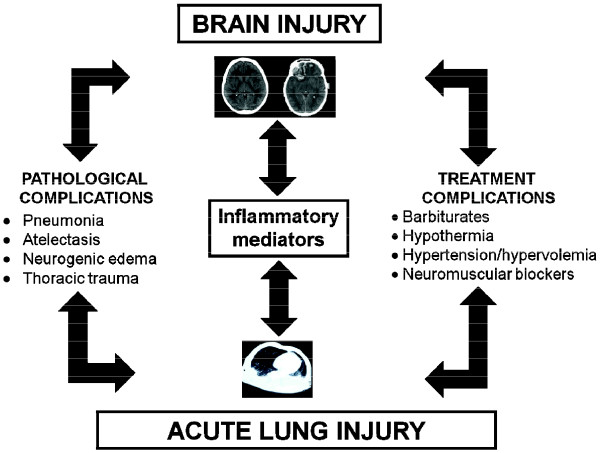
Brain or lung injury or both are frequent causes of admission to intensive care units and are associated with high morbidity and mortality rates. Mechanical ventilation, which is commonly used in the management of these critically ill patients, can induce an inflammatory response, which may be involved in distal organ failure. Thus, there may be a complex crosstalk between the lungs and other organs, including the brain. Interestingly, survivors from acute lung injury/acute respiratory distress syndrome frequently have some cognitive deterioration at hospital discharge. Such neurologic dysfunction might be a secondary marker of injury and the neuroanatomical substrate for downstream impairment of other organs. Brainlung interactions have received little attention in the literature, but recent evidence suggests that both the lungs and brain can promote inflammation through common mediators. The present commentary discusses the main physiological issues related to brain-lung interactions.
脑或肺损伤或两者都是经常导致入住重症监护病房的原因,并与高发病率和死亡率相关。机械通气常用于这些危重病患者的治疗,可以诱导炎症反应,这可能与远端器官衰竭有关。因此,肺部和其他器官(包括大脑)之间可能存在复杂的相互作用。有趣的是,急性肺损伤/急性呼吸窘迫综合征的幸存者在出院时经常出现一些认知能力下降。这种神经功能障碍可能是损伤的次要标志物,也是下游其他器官损伤的神经解剖学基础。脑-肺相互作用在文献中很少受到关注,但最近的证据表明,肺部和大脑都可以通过共同的介质促进炎症。本评论讨论了与脑-肺相互作用相关的主要生理问题。