Institute of Biophysics, University of Linz, Altenbergerstrasse 69, 4040 Linz, Austria.
J Biol Chem. 2011 Sep 9;286(36):31565-75. doi: 10.1074/jbc.M111.227546. Epub 2011 Jul 1.
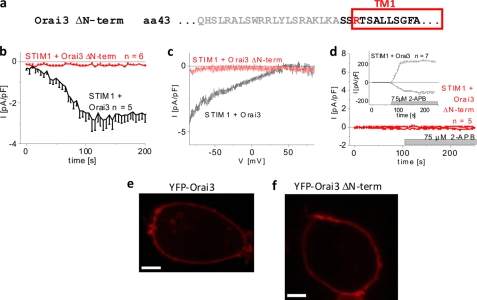
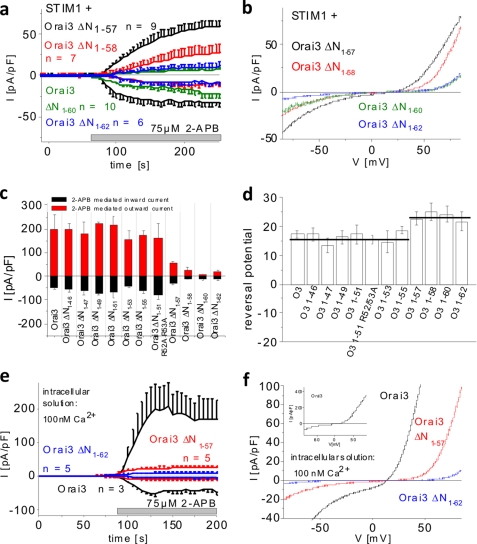
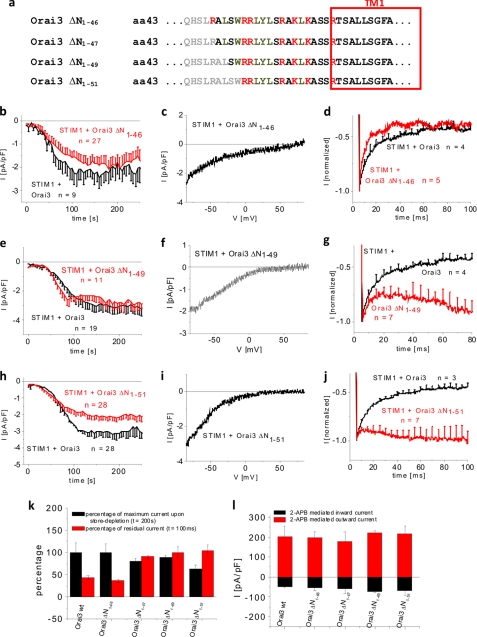
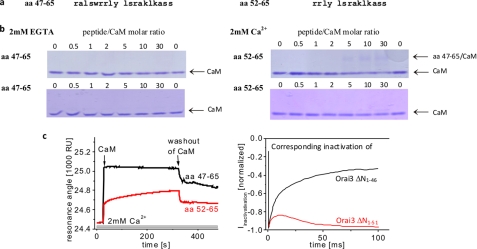
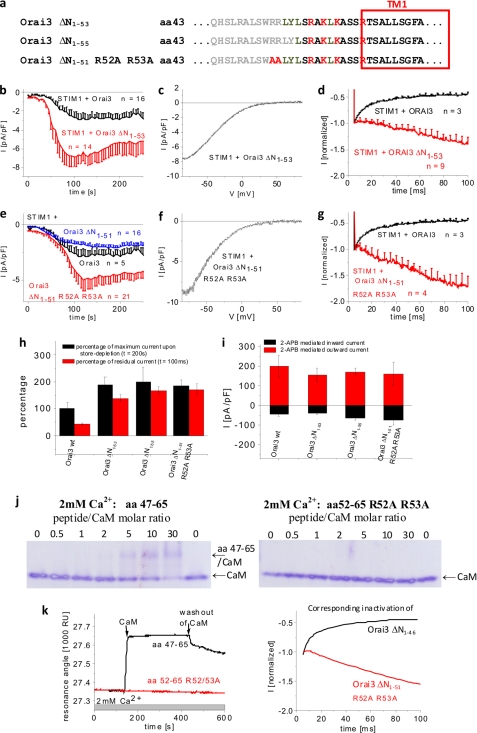
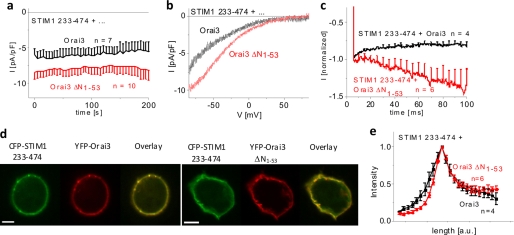
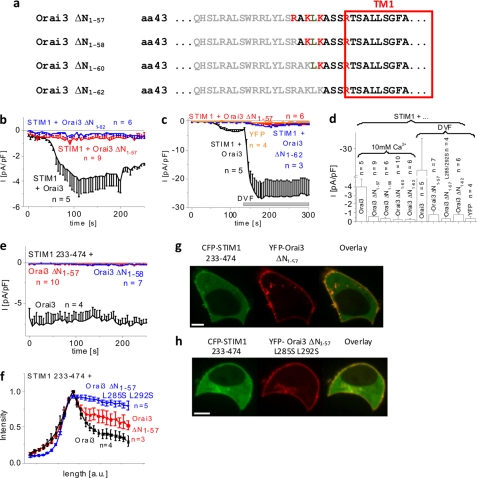
STIM1 and Orai represent the key components of Ca(2+) release-activated Ca(2+) channels. Activation of Orai channels requires coupling of the C terminus of STIM1 to the N and C termini of Orai. Although the latter appears to be central in the interaction with STIM1, the role of the N terminus and particularly of the conserved region close to the first transmembrane sequence is less well understood. Here, we investigated in detail the functional role of this conserved region in Orai3 by stepwise deletions. Molecular determinants were mapped for the two modes of Orai3 activation via STIM1 or 2-aminoethoxydiphenyl borate (2-APB) and for current gating characteristics. Increasing N-terminal truncations revealed a progressive decrease of the specific fast inactivation of Orai3 concomitant with diminished binding to calmodulin. STIM1-dependent activation of Orai3 was maintained as long as the second half of this conserved N-terminal domain was present. Further truncations abolished it, whereas Orai3 stimulation via 2-APB was partially retained. In aggregate, the N-terminal conserved region plays a multifaceted role in Orai3 current gating with distinct structural requirements for STIM1- and 2-APB-stimulated activation.
STIM1 和 Orai 是 Ca(2+) 释放激活 Ca(2+) 通道的关键组成部分。Orai 通道的激活需要将 STIM1 的 C 端与 Orai 的 N 和 C 端偶联。虽然后者似乎是与 STIM1 相互作用的核心,但 N 端的作用,特别是靠近第一个跨膜序列的保守区域的作用,了解得较少。在这里,我们通过逐步缺失详细研究了 Orai3 中这个保守区域的功能作用。通过 STIM1 或 2-氨基乙氧基二苯硼酸盐 (2-APB) 对两种 Orai3 激活模式以及电流门控特性进行了分子鉴定。随着 N 端截短的增加,Orai3 的特异性快速失活逐渐减少,同时与钙调蛋白的结合减少。只要存在这个保守的 N 端结构域的后半部分,STIM1 依赖性的 Orai3 激活就能维持。进一步的截短使其失活,而通过 2-APB 刺激 Orai3 则部分保留。总之,N 端保守区域在 Orai3 电流门控中发挥着多方面的作用,其结构要求与 STIM1 和 2-APB 刺激的激活不同。