Center for Infectious Disease Dynamics, Department of Biology, Mueller Laboratory, The Pennsylvania State University, University Park, USA.
Nat Rev Microbiol. 2011 Jul 4;9(8):617-26. doi: 10.1038/nrmicro2614.
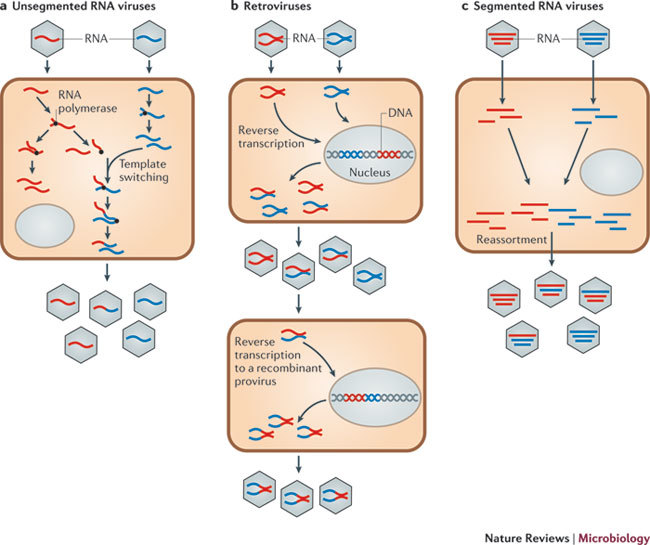
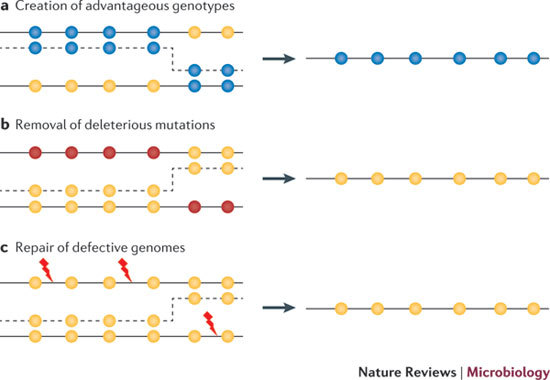
Recombination occurs in many RNA viruses and can be of major evolutionary significance. However, rates of recombination vary dramatically among RNA viruses, which can range from clonal to highly recombinogenic. Here, we review the factors that might explain this variation in recombination frequency and show that there is little evidence that recombination is favoured by natural selection to create advantageous genotypes or purge deleterious mutations, as predicted if recombination functions as a form of sexual reproduction. Rather, recombination rates seemingly reflect larger-scale patterns of viral genome organization, such that recombination may be a mechanistic by-product of the evolutionary pressures acting on other aspects of virus biology.
重组发生在许多 RNA 病毒中,具有重要的进化意义。然而,RNA 病毒的重组率差异很大,从无性繁殖到高度重组。在这里,我们回顾了可能解释这种重组频率变化的因素,并表明几乎没有证据表明重组受到自然选择的青睐,以产生有利的基因型或清除有害突变,就像重组作为一种有性繁殖形式所预测的那样。相反,重组率似乎反映了病毒基因组组织的更大规模模式,因此重组可能是病毒生物学其他方面进化压力的一种机制性副产品。