Queen Margaret University, Edinburgh, Scotland, UK.
Hum Resour Health. 2011 Jul 5;9:17. doi: 10.1186/1478-4491-9-17.
This paper reports on progress in implementing human resources for health (HRH) policies in Brazil, in the context of the implementation and expansion of the Unified Health System (Sistema Unico de Saúde - SUS).The three main objectives were: i) to reconstruct the chronology of long term HRH change in Brazil, and to identify and discuss the precursors, drivers, and enablers for these changes over a long time period; (ii) to examine how change was achieved by describing facilitators and constraints, and how policies were adapted to deal with the latter; and (iii) to report on the current situation and draw policy implications.
A mixed methods approach was used. A literature review was conducted using pre-defined keywords; and stakeholders were contacted and asked to provide relevant information, data and policy reports.
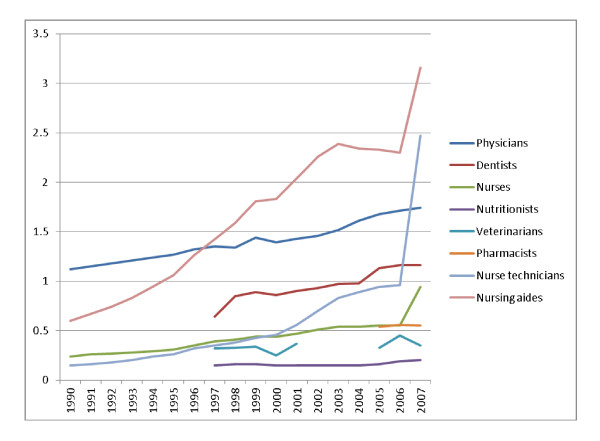
There are two key features of HRH change which are related to the implementation of SUS which merit attention: the achievement of staffing growth, and the improvement in HRH policy making and management. Staff growth rates across the period have been high enough to exceed population growth rates. As a consequence, the ratio of staff to population has improved. In 1990 the physician ratio per 1000 inhabitants was 1.12. In 2007, it was 1.74. Another critical factor in achieving staffing growth has been HRH policy making capacity and influence within the political establishment.
Policies have had to adapt to changing circumstances, whilst focusing on sequential improvements aimed at achieving long term goals. The end objectives, of improving care and access to care, have been kept in view. No one Ministry could secure all the resources and impetus for change that has been required, hence the need for inter-ministry, inter-governmental and inter-agency collaboration, and the development of alliances of shared interest. Across the period of thirty years or more, not all initiatives have been equally successful, but a momentum has been maintained. There was no single long term plan or strategy, but in Brazil this has enabled the progress to be adapted and re-oriented as the broader context changed over the years.
本文报告了在实施统一卫生系统(Sistema Unico de Saúde-SUS)的背景下,巴西在实施和扩大卫生人力政策方面所取得的进展。主要目标有三个:i)重构巴西长期卫生人力变化的时间顺序,并确定和讨论这些变化在很长一段时间内的前兆、驱动因素和促成因素;ii)通过描述促进因素和制约因素来考察变革是如何实现的,以及政策是如何适应后者的;iii)报告现状并提出政策建议。
采用混合方法。使用预定义的关键词进行文献综述;并联系利益相关者,请他们提供相关信息、数据和政策报告。
与 SUS 实施相关的卫生人力变化有两个值得关注的关键特征:人员配备的增长,以及卫生人力政策制定和管理的改善。在此期间,人员增长率一直很高,足以超过人口增长率。因此,人员与人口的比例有所改善。1990 年,每千名居民的医生比例为 1.12。2007 年,这一比例为 1.74。实现人员配备增长的另一个关键因素是人力资源政策制定能力和在政治机构中的影响力。
政策必须适应不断变化的情况,同时注重实现长期目标的逐步改进。改善护理和获得护理的最终目标一直是关注的焦点。没有一个部委能够获得实现变革所需的所有资源和动力,因此需要部委间、政府间和机构间的合作,以及发展共同利益联盟。在三十年或更长的时间里,并非所有举措都同样成功,但保持了势头。没有一个长期的计划或战略,但在巴西,这使得进展能够随着多年来更广泛的背景变化而进行调整和重新定位。