Goodman Cancer Research Centre, Montréal, Canada.
PLoS Genet. 2011 Jun;7(6):e1002143. doi: 10.1371/journal.pgen.1002143. Epub 2011 Jun 23.
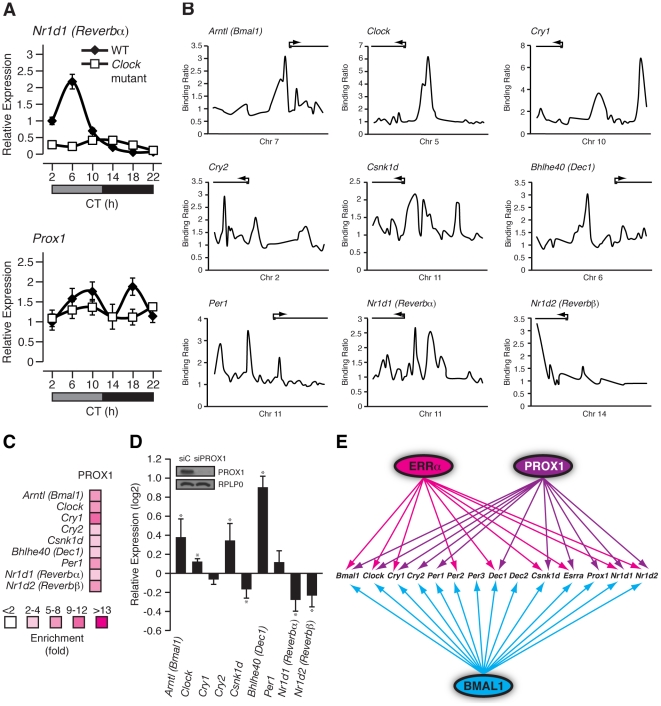
Metabolic homeostasis and circadian rhythms are closely intertwined biological processes. Nuclear receptors, as sensors of hormonal and nutrient status, are actively implicated in maintaining this physiological relationship. Although the orphan nuclear receptor estrogen-related receptor α (ERRα, NR3B1) plays a central role in the control of energy metabolism and its expression is known to be cyclic in the liver, its role in temporal control of metabolic networks is unknown. Here we report that ERRα directly regulates all major components of the molecular clock. ERRα-null mice also display deregulated locomotor activity rhythms and circadian period lengths under free-running conditions, as well as altered circulating diurnal bile acid and lipid profiles. In addition, the ERRα-null mice exhibit time-dependent hypoglycemia and hypoinsulinemia, suggesting a role for ERRα in modulating insulin sensitivity and glucose handling during the 24-hour light/dark cycle. We also provide evidence that the newly identified ERRα corepressor PROX1 is implicated in rhythmic control of metabolic outputs. To help uncover the molecular basis of these phenotypes, we performed genome-wide location analyses of binding events by ERRα, PROX1, and BMAL1, an integral component of the molecular clock. These studies revealed the existence of transcriptional regulatory loops among ERRα, PROX1, and BMAL1, as well as extensive overlaps in their target genes, implicating these three factors in the control of clock and metabolic gene networks in the liver. Genomic convergence of ERRα, PROX1, and BMAL1 transcriptional activity thus identified a novel node in the molecular circuitry controlling the daily timing of metabolic processes.
代谢稳态和昼夜节律是密切相关的生物学过程。核受体作为激素和营养状态的传感器,积极参与维持这种生理关系。虽然孤儿核受体雌激素相关受体α(ERRα,NR3B1)在控制能量代谢中发挥核心作用,并且其在肝脏中的表达呈周期性,但它在代谢网络的时间控制中的作用尚不清楚。本文报道 ERRα 可直接调节分子钟的所有主要成分。ERRα 缺失小鼠在自由运行条件下也表现出运动活动节律和昼夜节律周期的失调,以及循环昼夜胆汁酸和脂质谱的改变。此外,ERRα 缺失小鼠表现出时间依赖性低血糖和低胰岛素血症,表明 ERRα 在调节 24 小时光照/黑暗周期中的胰岛素敏感性和葡萄糖处理中起作用。我们还提供了证据表明,新发现的 ERRα 核心抑制因子 PROX1 参与代谢产物的节律控制。为了帮助揭示这些表型的分子基础,我们对 ERRα、PROX1 和分子钟的组成部分 BMAL1 的结合事件进行了全基因组定位分析。这些研究揭示了 ERRα、PROX1 和 BMAL1 之间转录调控环的存在,以及它们靶基因之间的广泛重叠,表明这三个因素参与控制肝脏中时钟和代谢基因网络。ERRα、PROX1 和 BMAL1 转录活性的基因组融合因此确定了控制代谢过程每日时间的分子电路中的一个新节点。