Department of Experimental Medicine, University of Milan-Bicocca, Via Pergolesi 33, 20052 Monza, Italy.
Intensive Care Med. 2011 Sep;37(9):1447-57. doi: 10.1007/s00134-011-2301-6. Epub 2011 Jul 6.
In view of the expected 2009 influenza A(H1N1) pandemic, the Italian Health Authorities set up a national referral network of selected intensive care units (ICU) able to provide advanced respiratory care up to extracorporeal membrane oxygenation (ECMO) for patients with acute respiratory distress syndrome (ARDS). We describe the organization and results of the network, known as ECMOnet.
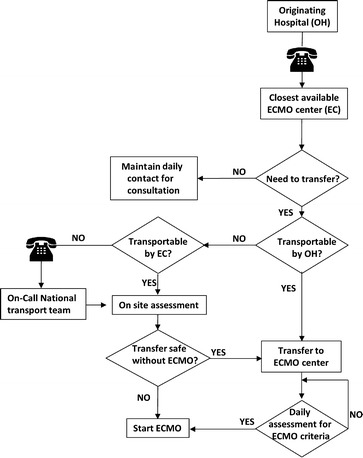
The network consisted of 14 ICUs with ECMO capability and a national call center. The network was set up to centralize all severe patients to the ECMOnet centers assuring safe transfer. An ad hoc committee defined criteria for both patient transfer and ECMO institutions.
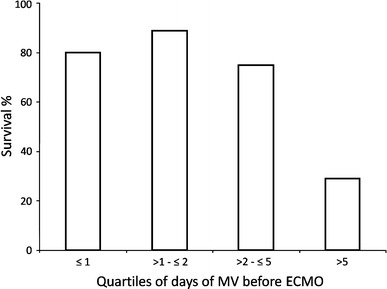
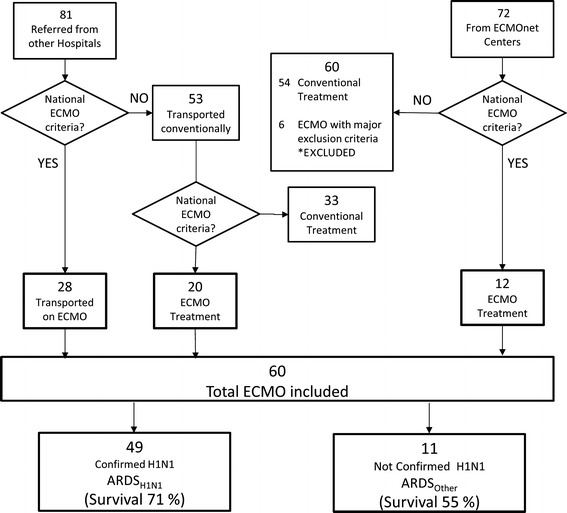
Between August 2009 and March 2010, 153 critically ill patients (53% referred from other hospitals) were admitted to the ECMOnet ICU with suspected H1N1. Sixty patients (48 of the referred patients, 49 with confirmed H1N1 diagnosis) received ECMO according to ECMOnet criteria. All referred patients were successfully transferred to the ECMOnet centers; 28 were transferred while on ECMO. Survival to hospital discharge in patients receiving ECMO was 68%. Survival of patients receiving ECMO within 7 days from the onset of mechanical ventilation was 77%. The length of mechanical ventilation prior to ECMO was an independent predictor of mortality.
A network organization based on preemptive patient centralization allowed a high survival rate and provided effective and safe referral of patients with severe H1N1-suspected ARDS.
鉴于 2009 年甲型 H1N1 流感大流行的预期,意大利卫生当局建立了一个由选定的重症监护病房 (ICU) 组成的国家转诊网络,这些 ICU 能够为急性呼吸窘迫综合征 (ARDS) 患者提供高级呼吸支持,直至体外膜氧合 (ECMO)。我们描述了该网络的组织和结果,称为 ECMOnet。
该网络由 14 家具有 ECMO 能力的 ICU 和一个国家呼叫中心组成。该网络的建立旨在将所有重症患者集中到 ECMOnet 中心,以确保安全转运。一个特别委员会为患者转诊和 ECMO 机构制定了标准。
2009 年 8 月至 2010 年 3 月期间,153 名危重症患者(53%来自其他医院)因疑似 H1N1 被收入 ECMOnet ICU。根据 ECMOnet 标准,60 名患者(48 名转诊患者,49 名确诊为 H1N1)接受了 ECMO。所有转诊患者均成功转至 ECMOnet 中心;28 例在 ECMO 支持下转院。接受 ECMO 治疗的患者的住院存活率为 68%。机械通气开始后 7 天内接受 ECMO 治疗的患者的存活率为 77%。接受 ECMO 治疗前机械通气的时间是死亡率的独立预测因素。
基于预先集中患者的网络组织使高存活率成为可能,并为疑似严重 H1N1 性 ARDS 的患者提供了有效和安全的转诊。