Howard Hughes Medical Institute, University of Texas Southwestern Medical Center, 6001 Forest Park Road, Dallas, TX 75390, USA.
Biol Direct. 2011 Jul 6;6:37. doi: 10.1186/1745-6150-6-37.
A number of membrane-spanning proteins possess enzymatic activity and catalyze important reactions involving proteins, lipids or other substrates located within or near lipid bilayers. Alkaline ceramidases are seven-transmembrane proteins that hydrolyze the amide bond in ceramide to form sphingosine. Recently, a group of putative transmembrane receptors called progestin and adipoQ receptors (PAQRs) were found to be distantly related to alkaline ceramidases, raising the possibility that they may also function as membrane enzymes.
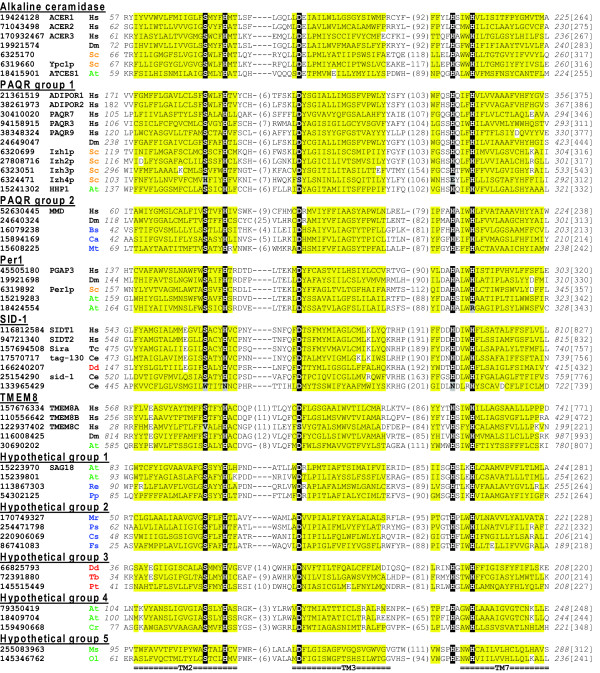
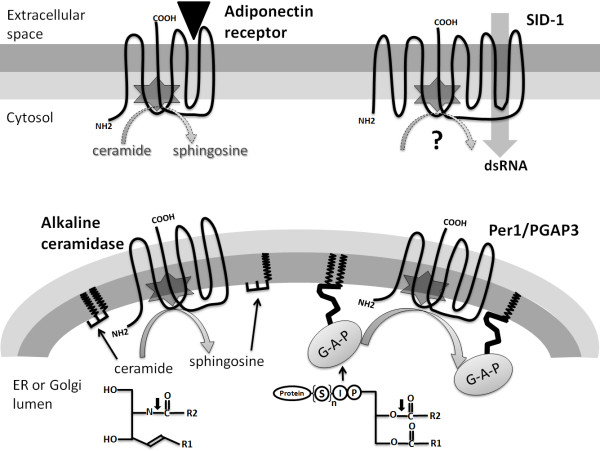
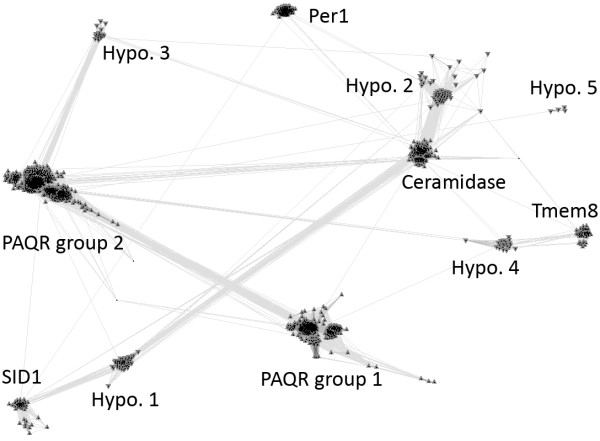
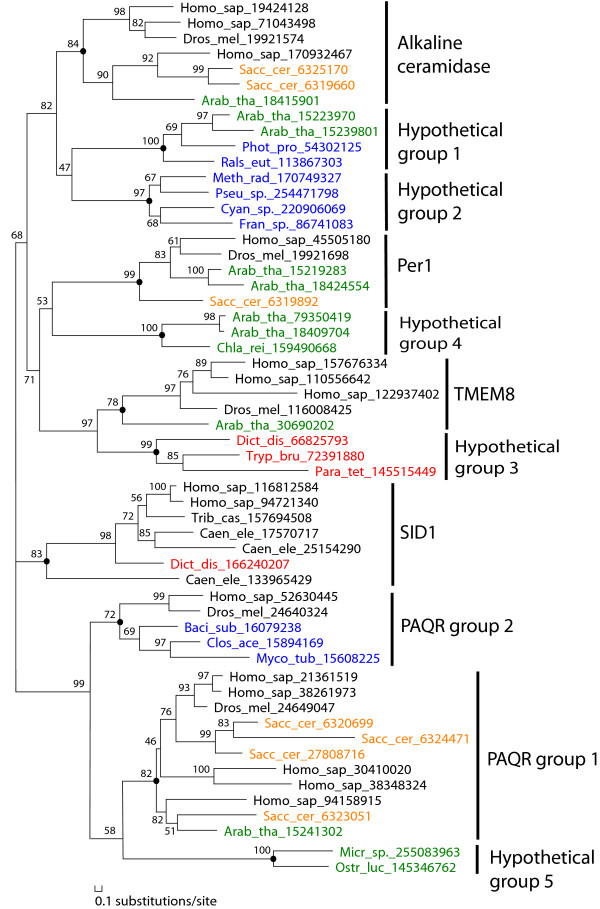
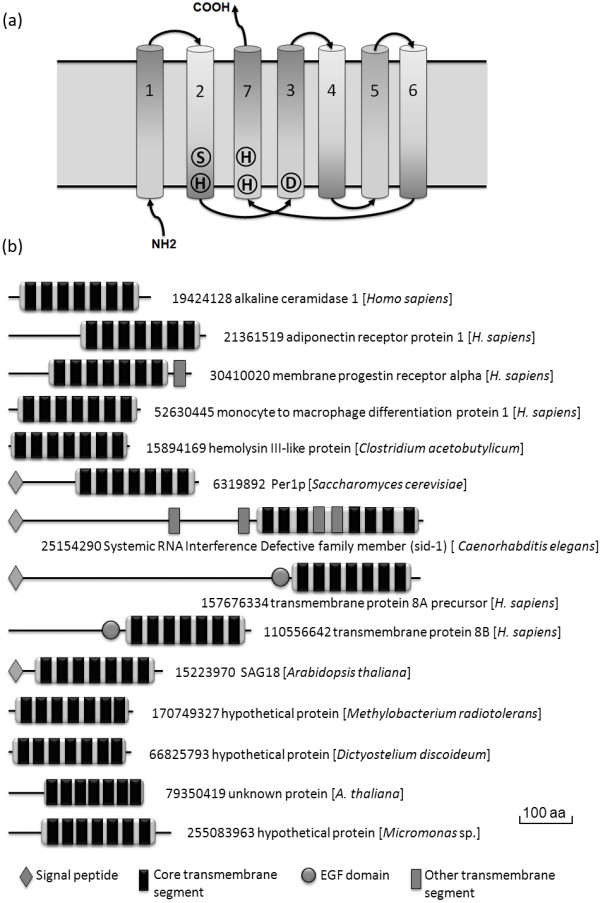
Using sensitive similarity search methods, we identified statistically significant sequence similarities among several transmembrane protein families including alkaline ceramidases and PAQRs. They were unified into a large and diverse superfamily of putative membrane-bound hydrolases called CREST (alkaline ceramidase, PAQR receptor, Per1, SID-1 and TMEM8). The CREST superfamily embraces a plethora of cellular functions and biochemical activities, including putative lipid-modifying enzymes such as ceramidases and the Per1 family of putative phospholipases involved in lipid remodeling of GPI-anchored proteins, putative hormone receptors, bacterial hemolysins, the TMEM8 family of putative tumor suppressors, and the SID-1 family of putative double-stranded RNA transporters involved in RNA interference. Extensive similarity searches and clustering analysis also revealed several groups of proteins with unknown function in the CREST superfamily. Members of the CREST superfamily share seven predicted core transmembrane segments with several conserved sequence motifs.
Universal conservation of a set of histidine and aspartate residues across all groups in the CREST superfamily, coupled with independent discoveries of hydrolase activities in alkaline ceramidases and the Per1 family as well as results from previous mutational studies of Per1, suggests that the majority of CREST members are metal-dependent hydrolases.
This article was reviewed by Kira S. Markarova, Igor B. Zhulin and Rob Knight.
许多跨膜蛋白具有酶活性,并催化涉及蛋白质、脂质或其他位于脂质双层内或附近的底物的重要反应。碱性神经酰胺酶是一种七跨膜蛋白,它水解神经酰胺中的酰胺键,形成神经鞘氨醇。最近,一组被称为孕激素和脂联素受体(PAQR)的假定跨膜受体被发现与碱性神经酰胺酶有远缘关系,这使得它们可能也具有膜酶的功能。
使用敏感的相似性搜索方法,我们在包括碱性神经酰胺酶和 PAQR 在内的几个跨膜蛋白家族中发现了具有统计学意义的序列相似性。它们被统一到一个称为 CREST(碱性神经酰胺酶、PAQR 受体、Per1、SID-1 和 TMEM8)的大型多样的假定膜结合水解酶超家族中。CREST 超家族包含了众多的细胞功能和生化活性,包括假定的脂质修饰酶,如神经酰胺酶和 Per1 家族的假定磷脂酶,它们参与 GPI 锚定蛋白的脂质重塑;假定的激素受体;细菌溶血素;TMEM8 家族的假定肿瘤抑制因子;以及 SID-1 家族的假定双链 RNA 转运蛋白,它们参与 RNA 干扰。广泛的相似性搜索和聚类分析还揭示了 CREST 超家族中几个具有未知功能的蛋白质组。CREST 超家族的成员共享七个预测的核心跨膜片段和几个保守的序列基序。
在 CREST 超家族的所有组中,一组组氨酸和天冬氨酸残基的普遍保守性,加上碱性神经酰胺酶和 Per1 家族的水解酶活性的独立发现,以及 Per1 的先前突变研究的结果,表明大多数 CREST 成员是金属依赖性水解酶。
本文由 Kira S. Markarova、Igor B. Zhulin 和 Rob Knight 审稿。