Molecular Cardiology Laboratory, Ee2389a, Experimental Cardiology, Thoraxcenter, Erasmus University Medical Center, 's-Gravendijkwal 230, 3015 GE Rotterdam, The Netherlands.
Eur Heart J. 2012 Jan;33(1):120-8. doi: 10.1093/eurheartj/ehr196. Epub 2011 Jul 6.
The Genous™ Bio-engineered R™ stent (GS) aims to promote vascular healing by capture of circulatory endothelial progenitor cells (EPCs) to the surface of the stent struts, resulting in accelerated re-endothelialization. Here, we assessed the function of the GS in comparison to bare-metal stent (BMS), when exposed to the human and animal circulation.
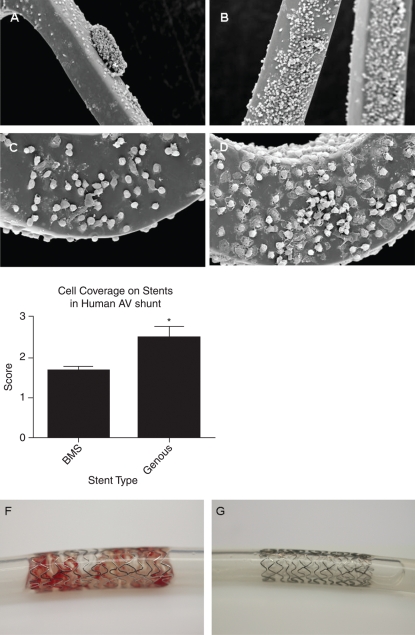
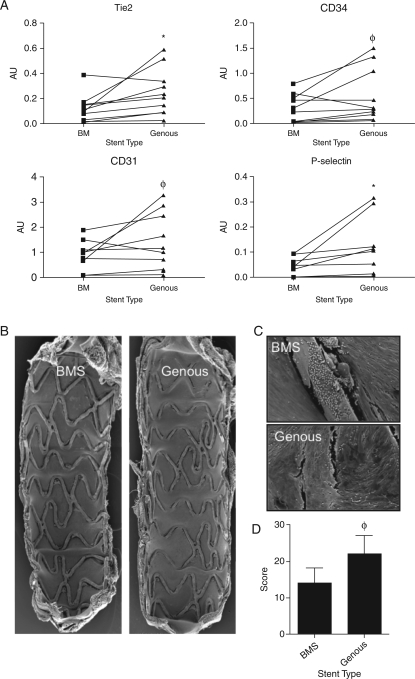
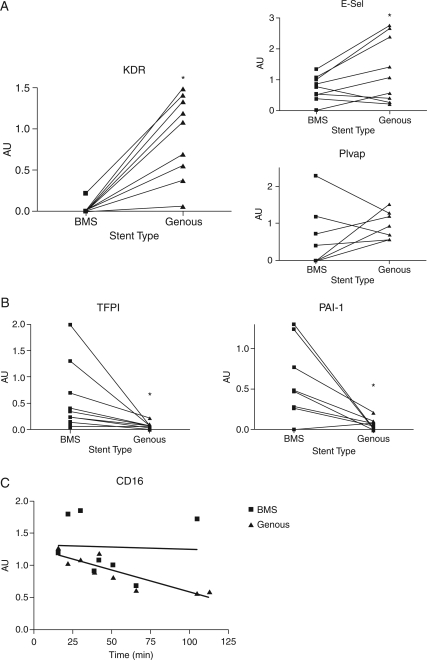
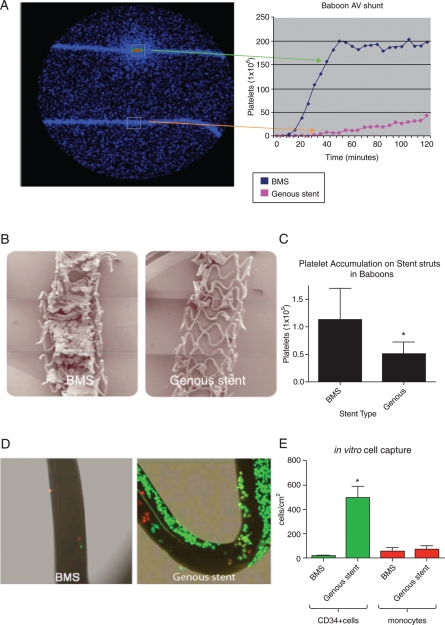
First, 15 patients undergoing coronary angiography received an extracorporeal femoral arteriovenous (AV) shunt containing BMS and GS. Macroscopical mural thrombi were observed in BMS, whereas GS remained visibly clean. Confocal and scanning electron microscopic (SEM) analysis of GS showed an increase in strut coverage. Quantitative polymerase chain reaction (qPCR) analysis of captured cells on the GS demonstrated increased expression of endothelial markers KDR/VEGFR2 and E-selectin, and a decrease in pro-thrombogenic markers tissue factor pathway inhibitor and plasminogen activator inhibitor-1 compared with BMS. Secondly, a similar primate AV shunt model was used to validate these findings and occlusion of BMS was observed, while GS remained patent, as demonstrated by live imaging of indium-labelled platelets. Thirdly, in an in vitro cell-capture assay, GS struts showed increased coverage by EPCs, whereas monocyte coverage remained similar to BMS. Finally, the assessment of re-endothelialization was studied in a rabbit denudation model. Twenty animals received BMS and GS in the aorta and iliac arteries for 7 days. Scanning electron microscopic analysis showed a trend towards increased strut coverage, confirmed by qPCR analysis revealing increased levels of endothelial markers (Tie2, CD34, PCD31, and P-selectin) in GS.
In this proof-of-concept study, we have demonstrated that the bio-engineered EPC-capture stent, Genous™ R™ stent, is effective in EPC capture, resulting in accelerated re-endothelialization and reduced thrombogenicity.
Genous™ 生物工程 R™ 支架(GS)旨在通过捕获循环内皮祖细胞(EPC)到支架支柱的表面来促进血管愈合,从而加速再内皮化。在这里,我们将 GS 与裸金属支架(BMS)进行了比较,评估了它们在暴露于人体和动物循环时的功能。
首先,15 名接受冠状动脉造影的患者接受了包含 BMS 和 GS 的体外股动静脉(AV)分流术。在 BMS 中观察到宏观壁血栓,而 GS 仍然明显干净。GS 的共聚焦和扫描电子显微镜(SEM)分析显示支架覆盖率增加。对 GS 上捕获细胞的定量聚合酶链反应(qPCR)分析表明,与 BMS 相比,内皮标记物 KDR/VEGFR2 和 E-选择素的表达增加,而促血栓形成标记物组织因子途径抑制剂和纤溶酶原激活物抑制剂-1 的表达减少。其次,使用类似的灵长类动物 AV 分流模型验证了这些发现,并观察到 BMS 闭塞,而 GS 保持通畅,这通过铟标记血小板的活体成像得到证实。第三,在体外细胞捕获实验中,GS 支架显示出 EPC 覆盖的增加,而单核细胞覆盖与 BMS 相似。最后,在兔剥脱模型中研究了再内皮化的评估。20 只动物在主动脉和髂动脉中接受 BMS 和 GS 治疗 7 天。扫描电子显微镜分析显示出增加的支架覆盖率趋势,qPCR 分析证实了这一点,结果显示内皮标记物(Tie2、CD34、PCD31 和 P-选择素)水平升高。
在这项概念验证研究中,我们已经证明了生物工程 EPC 捕获支架 Genous™ R™ 支架在 EPC 捕获方面是有效的,从而加速再内皮化并降低血栓形成性。