Department of Adolescent Psychiatry, National Center for Child and Adolescent Psychiatry, Seoul National Hospital, Seoul, Korea.
Environ Health Perspect. 2011 Oct;119(10):1495-500. doi: 10.1289/ehp.1003178. Epub 2011 Jul 7.
There are increasing concerns over adverse effects of prenatal phthalate exposure on the neurodevelopment of infants.
Our goal was to explore the association between prenatal di(2-ethylhexyl) phthalate and dibutyl phthalate exposure and the Mental and Psychomotor Developmental Indices (MDI and PDI, respectively) of the Bayley Scales of Infant Development at 6 months, as part of the Mothers and Children's Environmental Health Study.
Between 2006 and 2009, 460 mother-infant pairs from Seoul, Cheonan, and Ulsan, Korea, participated. Prenatal mono(2-ethyl-5-hydroxyhexyl) phthalate (MEHHP), mono(2-ethyl-5-oxohexyl) phthalate (MEOHP), and mono-n-butyl phthalate (MBP) were measured in one urine sample acquired from each mother during the third trimester of pregnancy. Associations with log-transformed creatinine-corrected phthalate concentrations were estimated using linear regression models adjusted for potential confounders.
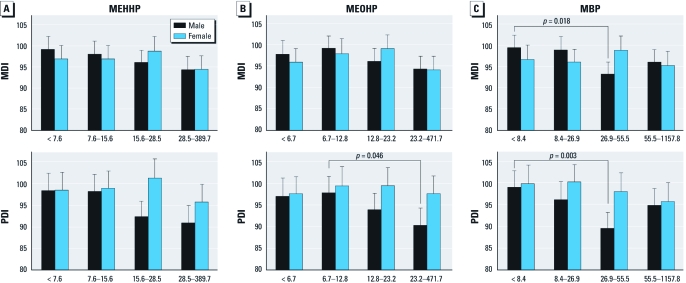
MDI was inversely associated with the natural log concentrations (micrograms per gram creatinine) of MEHHP [β = -0.97; confidence interval (CI), -1.85 to -0.08] and MEOHP (β = -0.95; CI, -1.87 to -0.03), and PDI was inversely associated with MEHHP (β = -1.20; CI, -2.33 to -0.08). In males, MDI was inversely associated with MEHHP (β = -1.46; CI, -2.70 to -0.22), MEOHP (β = -1.57; CI, -2.87 to -0.28), and MBP (β = -0.93; CI, -1.82 to -0.05); PDI was inversely associated with MEHHP (β = -2.36; CI, -3.94 to -0.79), MEOHP (β = -2.05; CI, -3.71 to -0.39), and MBP (β = -1.25; CI, -2.40 to -0.11). No significant linear associations were observed for females.
The results suggest that prenatal exposure to phthalates may be inversely associated with the MDI and PDI of infants, particularly males, at 6 months.
人们越来越关注产前邻苯二甲酸酯暴露对婴儿神经发育的不良影响。
我们的目标是探索产前邻苯二甲酸二(2-乙基己基)酯和邻苯二甲酸二丁酯暴露与贝利婴幼儿发展量表 6 个月时的精神和心理运动发育指数(分别为 MDI 和 PDI)之间的关系,这是母亲和儿童环境健康研究的一部分。
2006 年至 2009 年,来自韩国首尔、天安和蔚山的 460 对母婴参与了这项研究。在妊娠晚期,从每位母亲那里采集一份尿液样本来测量单(2-乙基-5-羟基己基)邻苯二甲酸酯(MEHHP)、单(2-乙基-5-氧代己基)邻苯二甲酸酯(MEOHP)和单正丁基邻苯二甲酸酯(MBP)。使用线性回归模型,根据潜在混杂因素进行调整,估计与 log 转换肌酐校正的邻苯二甲酸浓度的关联。
MDI 与 MEHHP [β=-0.97;置信区间(CI),-1.85 至 -0.08]和 MEOHP(β=-0.95;CI,-1.87 至 -0.03)的自然对数浓度呈负相关,PDI 与 MEHHP 呈负相关(β=-1.20;CI,-2.33 至 -0.08)。在男性中,MDI 与 MEHHP(β=-1.46;CI,-2.70 至 -0.22)、MEOHP(β=-1.57;CI,-2.87 至 -0.28)和 MBP(β=-0.93;CI,-1.82 至 -0.05)呈负相关;PDI 与 MEHHP(β=-2.36;CI,-3.94 至 -0.79)、MEOHP(β=-2.05;CI,-3.71 至 -0.39)和 MBP(β=-1.25;CI,-2.40 至 -0.11)呈负相关。在女性中没有观察到显著的线性关联。
结果表明,产前邻苯二甲酸酯暴露可能与婴儿 6 个月时的 MDI 和 PDI 呈负相关,尤其是男性。