Rawls J A, Pusztai R, Green M
Institute for Molecular Virology, St. Louis University Medical Center, Missouri 63110.
J Virol. 1990 Dec;64(12):6121-9. doi: 10.1128/JVI.64.12.6121-6129.1990.
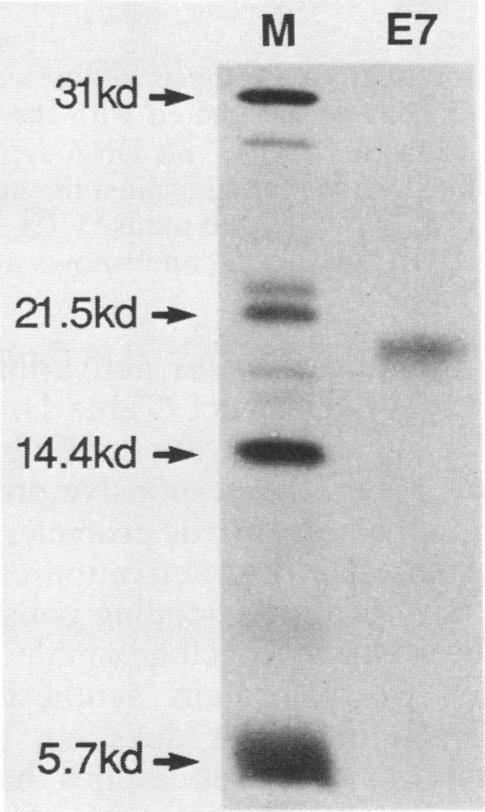
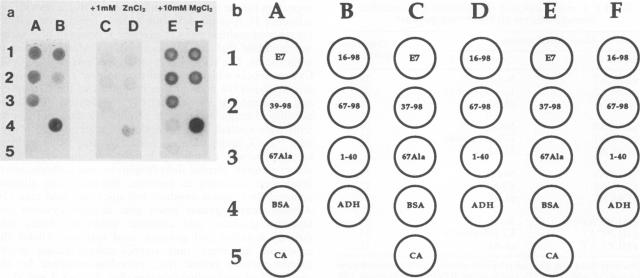
The human papillomavirus type 16 E7 protein belongs to a family of nuclear oncoproteins that share amino acid sequences and functional homology. To localize biochemical activities associated with E7, we chemically synthesized the full-length 98-amino-acid polypeptide and several deletion mutant peptides. We show that the E7 polypeptide is biologically active and possesses at least two functional domains; the first induces cellular DNA synthesis in quiescent rodent cells, and the second trans activates the adenovirus E1A-inducible early E2 promoter and binds zinc. Further, each domain is autonomous and can function on separate peptides. DNA synthesis induction activity maps within the N-terminal portion of the molecule, which contains sequences related to adenovirus E1A conserved domains 1 and 2 required for cell transformation and binding of the retinoblastoma gene product. trans-Activation and Zn-binding activities map within the C-terminal portion of the molecule, a region which contains Cys-X-X-Cys motifs. trans Activation does not require protein synthesis, implying a mechanism that involves interaction with a preexisting cellular factor(s). E7 trans activates the adenovirus E2 promoter but not other E1A-inducible viral promoters, suggesting the possibility that E7 trans activation involves interaction, directly or indirectly, with cellular transcription factor E2F.
人乳头瘤病毒16型E7蛋白属于一类核癌蛋白家族,这些蛋白具有氨基酸序列和功能同源性。为了定位与E7相关的生化活性,我们化学合成了全长98个氨基酸的多肽和几个缺失突变肽。我们发现E7多肽具有生物活性,并拥有至少两个功能结构域;第一个结构域可在静止的啮齿动物细胞中诱导细胞DNA合成,第二个结构域可反式激活腺病毒E1A诱导的早期E2启动子并结合锌。此外,每个结构域都是自主的,可在单独的肽上发挥作用。DNA合成诱导活性定位于分子的N端部分,该部分包含与腺病毒E1A保守结构域1和2相关的序列,这些序列是细胞转化和成视网膜细胞瘤基因产物结合所必需的。反式激活和锌结合活性定位于分子的C端部分,该区域包含Cys-X-X-Cys基序。反式激活不需要蛋白质合成,这意味着其机制涉及与预先存在的细胞因子相互作用。E7可反式激活腺病毒E2启动子,但不能激活其他E1A诱导的病毒启动子,这表明E7反式激活可能直接或间接涉及与细胞转录因子E2F的相互作用。