Yoo Eun Sun
Division of Pediatric Hematology-Oncology, Department of Pediatrics, Ewha Womans University, School of Medicine, Seoul, Korea.
Korean J Pediatr. 2011 Mar;54(3):95-105. doi: 10.3345/kjp.2011.54.3.95. Epub 2011 Mar 31.
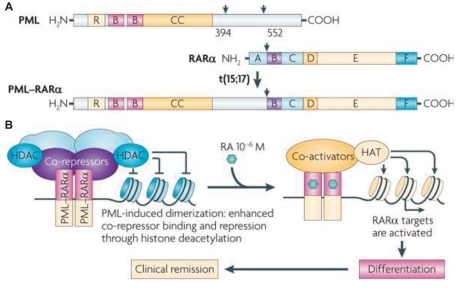
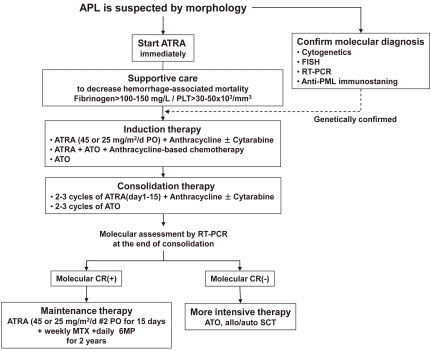
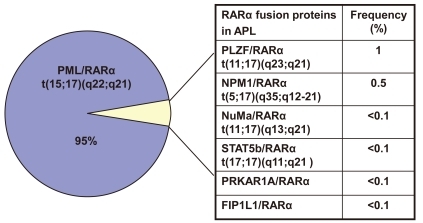
Since the successful introduction of all-trans-retinoic acid (ATRA) and its combination with anthracycline-containing chemotherapy, the prognosis for acute promyelocytic leukemia (APL) has markedly improved. With ATRA and anthracycline-based-chemotherapy, the complete remission rate is greater than 90%, and the long-term survival rate is 70-89%. Moreover, arsenic trioxide (ATO), which was introduced for APL treatment in 1994, resulted in excellent remission rates in relapsed patients with APL, and more recently, several clinical studies have been designed to explore its role in initial therapy either alone or in combination with ATRA. APL is a rare disease in children and is frequently associated with hyperleukocytosis, which is a marker for higher risk of relapse and an increased incidence of microgranular morphology. The frequency of occurrence of the promyelocytic leukemia/retinoic acid receptor-alpha (PML/RARα) isoforms bcr 2 and bcr 3 is higher in children than in adults. Although recent clinical studies have reported comparable long-term survival rates in patients with APL, therapy for APL in children is challenging because of the risk of early death and the potential long-term cardiac toxicity resulting from the need to use high doses of anthracyclines. Additional prospective, randomized, large clinical trials are needed to address several issues in pediatric APL and to possibly minimize or eliminate the need for chemotherapy by combining ATRA and ATO. In this review article, we discuss the molecular pathogenesis, diagnostic progress, and most recent therapeutic advances in the treatment of children with APL.
自从全反式维甲酸(ATRA)成功引入并与含蒽环类药物的化疗联合使用以来,急性早幼粒细胞白血病(APL)的预后有了显著改善。采用ATRA和基于蒽环类药物的化疗,完全缓解率大于90%,长期生存率为70%-89%。此外,1994年引入用于治疗APL的三氧化二砷(ATO),使复发的APL患者获得了优异的缓解率,最近,一些临床研究旨在探索其在初始治疗中单独使用或与ATRA联合使用的作用。APL在儿童中是一种罕见疾病,常与白细胞增多症相关,白细胞增多症是复发风险较高和微颗粒形态发生率增加的一个标志。早幼粒细胞白血病/维甲酸受体-α(PML/RARα)异构体bcr 2和bcr 3在儿童中的出现频率高于成人。尽管最近的临床研究报告了APL患者具有相当的长期生存率,但由于早期死亡风险以及因需要使用高剂量蒽环类药物而导致的潜在长期心脏毒性,儿童APL的治疗具有挑战性。需要开展更多前瞻性、随机、大型临床试验,以解决儿童APL中的几个问题,并可能通过联合使用ATRA和ATO将化疗需求降至最低或消除。在这篇综述文章中,我们讨论了儿童APL治疗中的分子发病机制、诊断进展和最新治疗进展。