UCSF, Department of Pediatrics, San Francisco, CA 94118, USA.
J Sch Health. 2011 Aug;81(8):462-70. doi: 10.1111/j.1746-1561.2011.00615.x.
Protective factors associated with positive youth development predict health and education outcomes. This study explored trends in these protective factors and in physical activity among low-income students, and determined the impact of a school-based youth development program on these trends.
This study used a quasi-experimental time series design including data from 158 low-income schools from 2001 to 2007. Ninety-four schools had exposure to a school-based program promoting physical activity and youth development through structured play; 64 schools served as controls. Primary outcomes were 5th-grade student scores (n = 13,109) on a California statewide survey for physical activity (1-6 scale) and measures of protective factors including problem solving skills, meaningful participation in school, and caring adults (1-4 scales). Predictors were time (year) and school's number of years of exposure to the program.
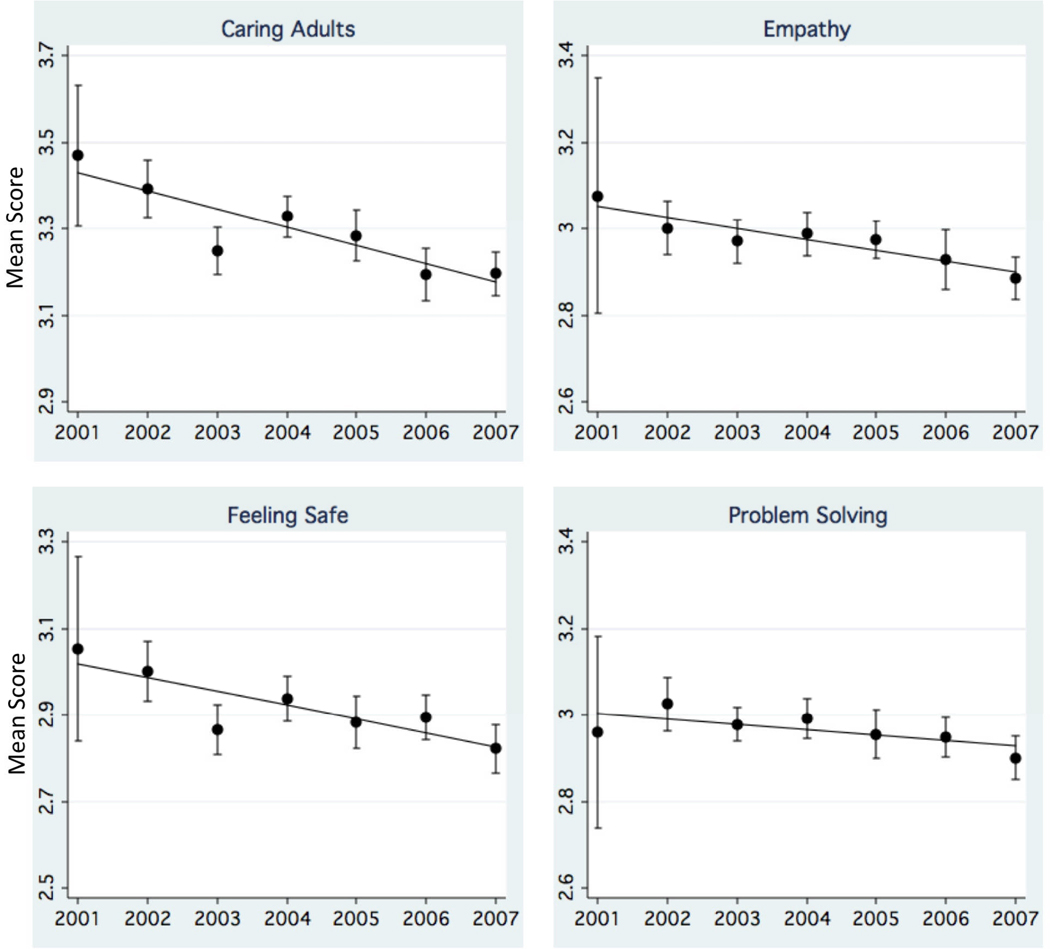
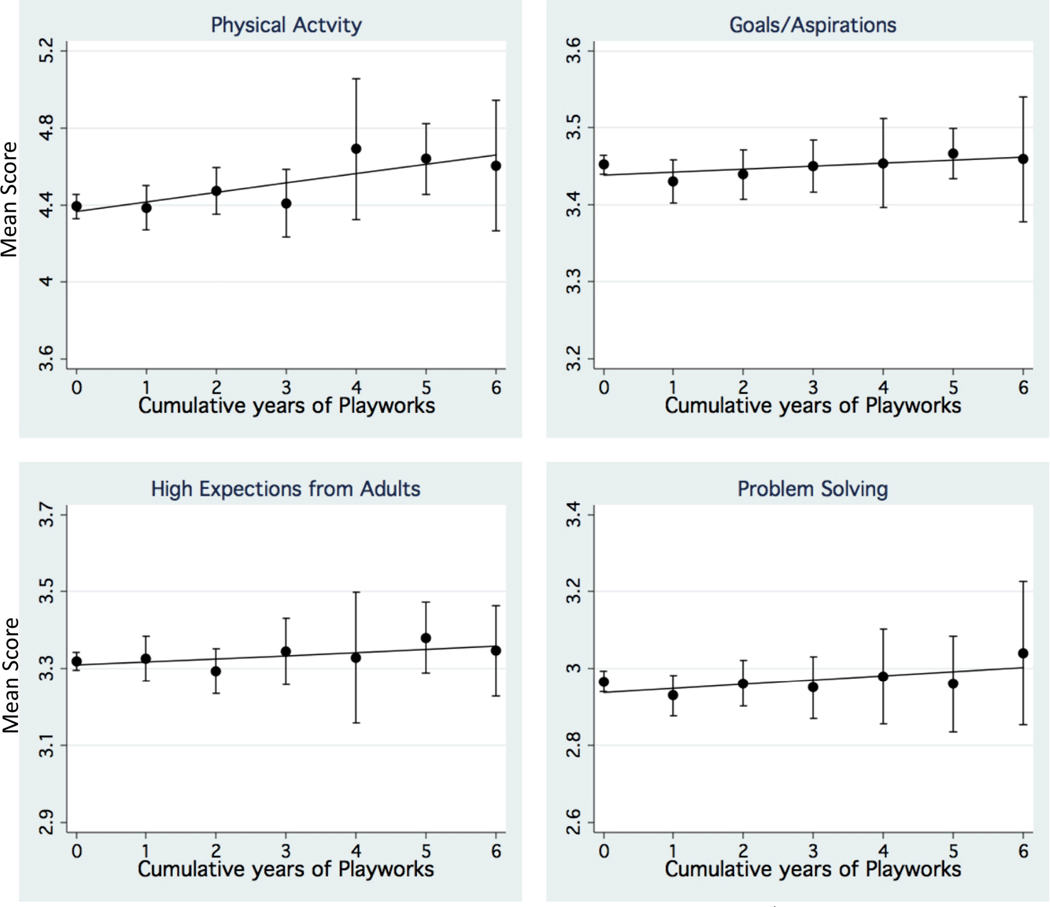
Overall, significant annual declines were seen in protective factors, including students' report of feeling safe (-0.03, 95% CI [-0.03, -0.01]), caring adults at school (-0.03 [-0.05, -0.02]), and problem solving skills (-0.03 [-0.04, -0.02]). Cumulative declines over 6 years were equivalent to a drop of 1 school-level SD. Each additional year of exposure to the program predicted greater meaningful participation (0.02 [0.001, 0.5]), problem-solving skills (0.03 [0.0001, 0.06]), and increased physical activity (0.06 [0.01, 0.10]); exposure throughout elementary school (6 years) increased scores by 1 school-level SD.
Low-income students reported a significant decline in protective factors since 2001. School partnerships with youth development programs promoting physical activity may ameliorate declines in emotional well-being and increase physical activity.
与积极青年发展相关的保护因素预测健康和教育成果。本研究探讨了低收入学生中这些保护因素和体育活动的趋势,并确定了一项基于学校的青年发展计划对这些趋势的影响。
本研究采用准实验时间序列设计,包括 2001 年至 2007 年来自 158 所低收入学校的数据。94 所学校通过结构化游戏接触到促进体育活动和青年发展的基于学校的计划;64 所学校作为对照。主要结果是在加利福尼亚州全州范围内进行的一项关于体育活动的调查(1-6 分制)和保护因素的测量结果,包括解决问题的能力、在学校的有意义参与和有爱心的成年人(1-4 分制),5 年级学生的分数(n=13109)。预测因子是时间(年份)和学校接触该计划的年数。
总体而言,保护因素呈显著逐年下降趋势,包括学生对安全感的报告(-0.03,95%置信区间[-0.03,-0.01])、学校的关爱成年人(-0.03[-0.05,-0.02])和解决问题的能力(-0.03[-0.04,-0.02])。6 年内的累积下降相当于学校水平标准差的下降 1 个。接触该计划的额外一年预测更大的有意义参与(0.02[0.001,0.5])、解决问题的能力(0.03[0.0001,0.06])和增加的体育活动(0.06[0.01,0.10]);在整个小学阶段(6 年)接触该计划可将分数提高 1 个学校水平标准差。
自 2001 年以来,低收入学生报告保护因素显著下降。与促进体育活动的青年发展计划建立学校伙伴关系可能会减轻情感健康的下降并增加体育活动。