Institute for Meteorology and Climate Research, Karlsruhe Institute of Technology, Karlsruhe, Germany.
Int J Biometeorol. 2012 Jul;56(4):669-80. doi: 10.1007/s00484-011-0468-8. Epub 2011 Jul 9.
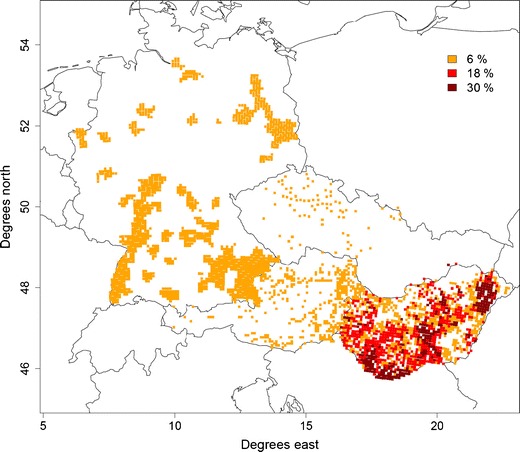
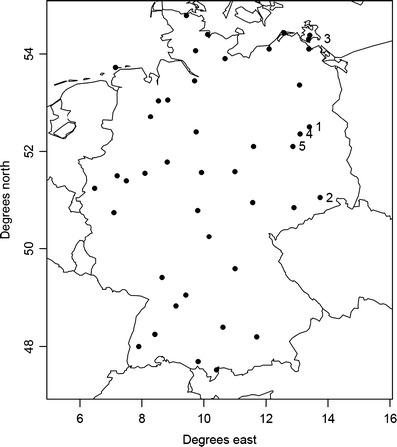
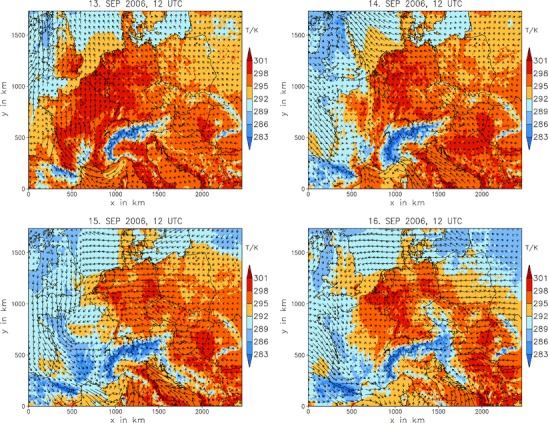
Common ragweed (Ambrosia artemisiifolia L.) is a highly allergenic plant that is spreading throughout Europe. Ragweed pollen can be transported over large distances by the wind. Even low pollen concentrations of less than 10 pollen m(-3) can lead to health problems in sensitive persons. Therefore, forecasting the airborne concentrations of ragweed pollen is becoming more and more important for public health. The question remains whether distant pollen sources need to be considered in reliable forecasts. We used the extended numerical weather prediction system COSMO-ART to simulate the release and transport of ragweed pollen in central Europe. A pollen episode (September 12-16, 2006) in north-eastern Germany was modeled in order to find out where the pollen originated. For this purpose, several different source regions were taken into account and their individual impact on the daily mean pollen concentration and the performance of the forecast were studied with the means of a 2 × 2 contingency table and skill scores. It was found that the majority of the pollen originated in local areas, but up to 20% of the total pollen load came from distant sources in Hungary. It is concluded that long-distance transport should not be neglected when predicting pollen concentrations.
普通豚草(Ambrosia artemisiifolia L.)是一种高度致敏的植物,正在欧洲各地蔓延。豚草花粉可以通过风远距离传播。即使花粉浓度低至每立方米不到 10 个花粉(10 pollen m(-3)),也会导致敏感人群出现健康问题。因此,预测豚草花粉的空气传播浓度对于公共健康变得越来越重要。问题仍然是在可靠的预测中是否需要考虑远距离花粉源。我们使用扩展的数值天气预报系统 COSMO-ART 来模拟中欧豚草花粉的释放和运输。模拟了 2006 年 9 月 12 日至 16 日在德国东北部的一次花粉爆发事件,以确定花粉的来源地。为此,考虑了几个不同的源区,并通过 2×2 列联表和技巧评分来研究它们对每日平均花粉浓度和预测性能的个别影响。结果发现,大部分花粉来源于当地地区,但总花粉负荷的 20%来自匈牙利的远距离源区。结论是,在预测花粉浓度时,不应忽视远距离传输。