Department of Biochemistry of Membranes, Centre for Biomembranes and Lipid Enzymology, Institute of Biomembranes, Utrecht University, Padualaan 8, 3584 CH Utrecht, The Netherlands.
J Membr Biol. 2011 Aug;242(3):137-43. doi: 10.1007/s00232-011-9384-4. Epub 2011 Jul 10.
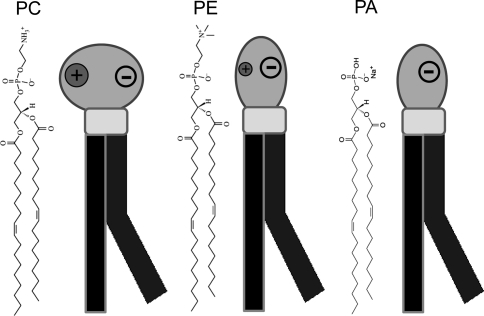
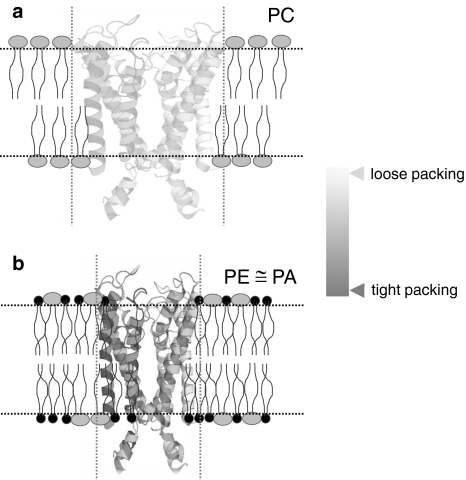
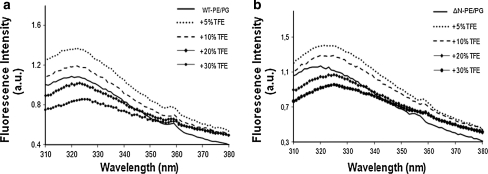
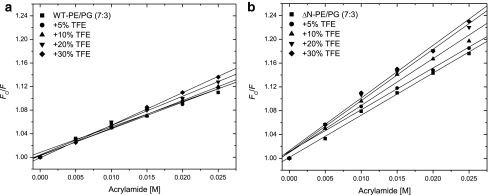
Phospholipid headgroups act as major determinants in proper folding of oligomeric membrane proteins. The K(+)-channel KcsA is the most popular model protein among these complexes. The presence of zwitterionic nonbilayer lipid phosphatidylethanolamine (PE) is crucial for efficient tetramerization and stabilization of KcsA in a lipid bilayer. In this study, the influence of PE on KcsA folding properties was analyzed by tryptophan fluorescence and acrylamide quenching experiments and compared with the effect of anionic phosphatidic acid (PA). The preliminary studies suggest that the small size and hydrogen bonding capability of the PE headgroup influences KcsA folding via a mechanism quite similar to that observed for anionic PA.
磷脂头部基团是寡聚膜蛋白正确折叠的主要决定因素。在这些复合物中,K(+)通道 KcsA 是最受欢迎的模型蛋白。带电荷的非双层脂质磷脂酰乙醇胺 (PE) 的存在对于 KcsA 在脂质双层中的有效四聚化和稳定至关重要。在这项研究中,通过色氨酸荧光和丙烯酰胺猝灭实验分析了 PE 对 KcsA 折叠性质的影响,并与阴离子磷脂酸 (PA) 的影响进行了比较。初步研究表明,PE 头部基团的小尺寸和氢键能力通过与观察到的阴离子 PA 非常相似的机制影响 KcsA 的折叠。