Department of Pathology and Immunology, Washington University School of Medicine, 660, S, Euclid Ave, St, Louis, MO 63110, USA.
BMC Med Genomics. 2011 Jul 11;4:57. doi: 10.1186/1755-8794-4-57.
Pilocytic Astrocytomas (PAs) are common low-grade central nervous system malignancies for which few recurrent and specific genetic alterations have been identified. In an effort to better understand the molecular biology underlying the pathogenesis of these pediatric brain tumors, we performed higher-order transcriptional network analysis of a large gene expression dataset to identify gene regulatory pathways that are specific to this tumor type, relative to other, more aggressive glial or histologically distinct brain tumours.
RNA derived from frozen human PA tumours was subjected to microarray-based gene expression profiling, using Affymetrix U133Plus2 GeneChip microarrays. This data set was compared to similar data sets previously generated from non-malignant human brain tissue and other brain tumour types, after appropriate normalization.
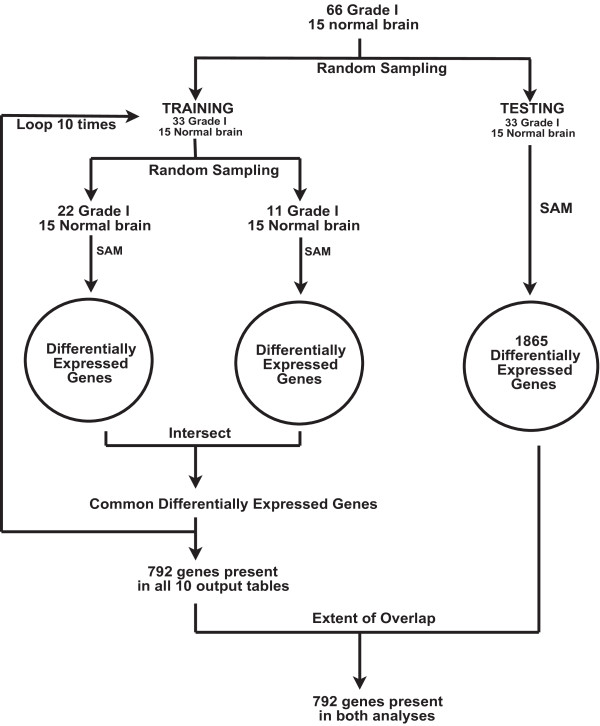
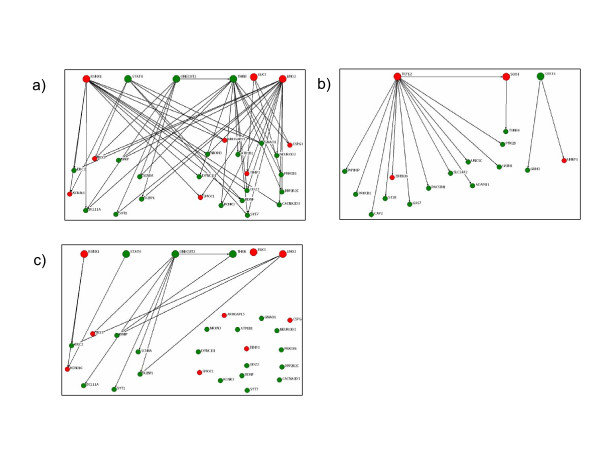
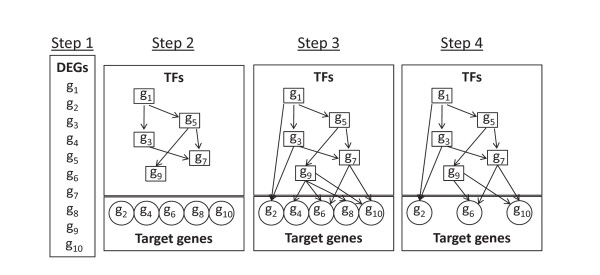
In this study, we examined gene expression in 66 PA tumors compared to 15 non-malignant cortical brain tissues, and identified 792 genes that demonstrated consistent differential expression between independent sets of PA and non-malignant specimens. From this entire 792 gene set, we used the previously described PAP tool to assemble a core transcriptional regulatory network composed of 6 transcription factor genes (TFs) and 24 target genes, for a total of 55 interactions. A similar analysis of oligodendroglioma and glioblastoma multiforme (GBM) gene expression data sets identified distinct, but overlapping, networks. Most importantly, comparison of each of the brain tumor type-specific networks revealed a network unique to PA that included repressed expression of ONECUT2, a gene frequently methylated in other tumor types, and 13 other uniquely predicted TF-gene interactions.
These results suggest specific transcriptional pathways that may operate to create the unique molecular phenotype of PA and thus opportunities for corresponding targeted therapeutic intervention. Moreover, this study also demonstrates how integration of gene expression data with TF-gene and TF-TF interaction data is a powerful approach to generating testable hypotheses to better understand cell-type specific genetic programs relevant to cancer.
毛细胞型星形细胞瘤(PA)是常见的低级别的中枢神经系统恶性肿瘤,其仅发现了少数复发性和特异性的基因改变。为了更好地了解这些儿科脑肿瘤发病机制的分子生物学,我们对大型基因表达数据集进行了更高级别的转录网络分析,以鉴定相对于其他侵袭性更强或组织学上不同的脑肿瘤类型,特定于这种肿瘤类型的基因调控途径。
来自冷冻的人类 PA 肿瘤的 RNA 经过基于微阵列的基因表达谱分析,使用 Affymetrix U133Plus2 GeneChip 微阵列。在适当的标准化后,将此数据集与先前从非恶性人类脑组织和其他脑肿瘤类型生成的类似数据集进行比较。
在这项研究中,我们比较了 66 个 PA 肿瘤和 15 个非恶性皮质脑组织的基因表达,鉴定了 792 个在独立的 PA 和非恶性标本之间表现出一致差异表达的基因。从整个 792 个基因集,我们使用先前描述的 PAP 工具组装了一个由 6 个转录因子基因(TF)和 24 个靶基因组成的核心转录调控网络,共有 55 个相互作用。对少突胶质细胞瘤和胶质母细胞瘤多形性(GBM)基因表达数据集的类似分析确定了独特但重叠的网络。最重要的是,比较每种脑肿瘤类型特异性网络揭示了 PA 特有的网络,该网络包括 ONECUT2 的抑制表达,ONECUT2 是其他肿瘤类型中经常甲基化的基因,以及 13 个其他独特预测的 TF-基因相互作用。
这些结果表明,可能存在特定的转录途径来创建 PA 的独特分子表型,从而为相应的靶向治疗干预提供机会。此外,这项研究还表明,如何将基因表达数据与 TF-基因和 TF-TF 相互作用数据集成是一种强大的方法,可以生成可测试的假设,以更好地理解与癌症相关的特定于细胞类型的遗传程序。