Graduate Program in Neuroscience, State University of New York at Stony Brook, Stony Brook, NY 11794, USA.
J Gen Physiol. 2011 Aug;138(2):179-94. doi: 10.1085/jgp.201110623. Epub 2011 Jul 11.
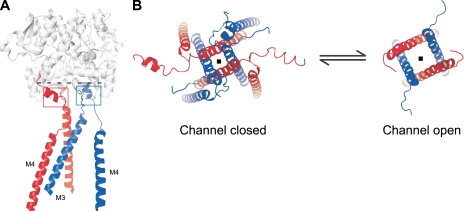
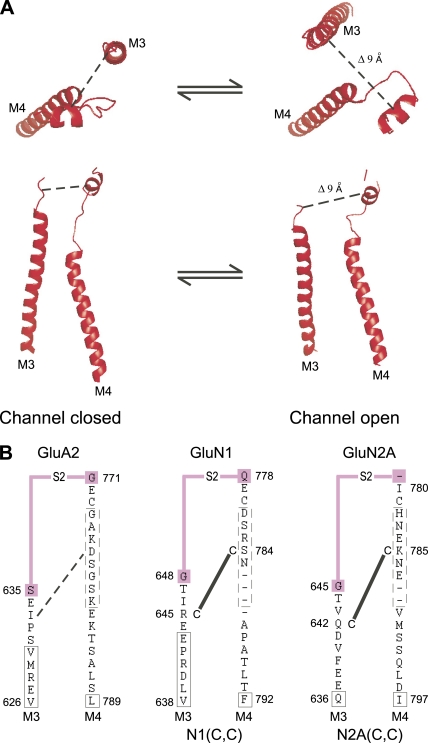
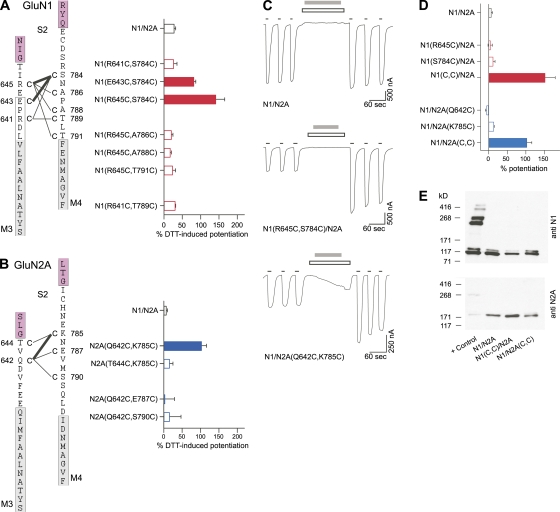
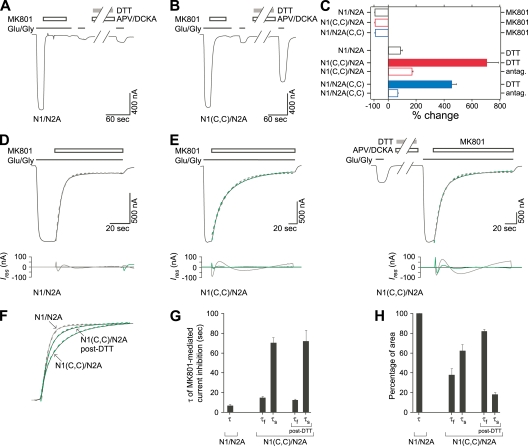
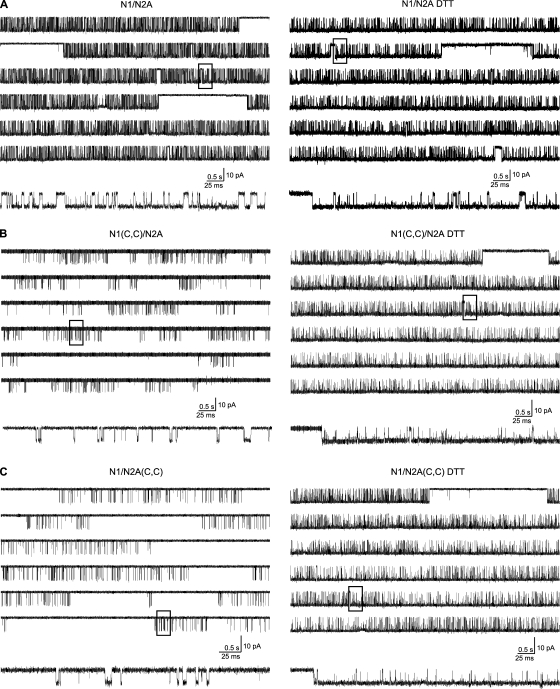
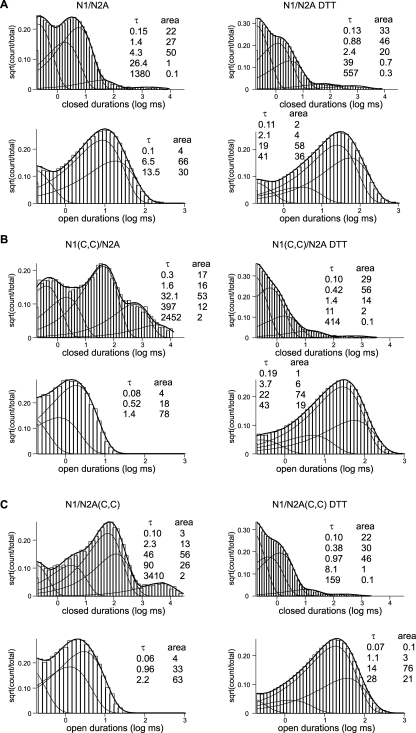
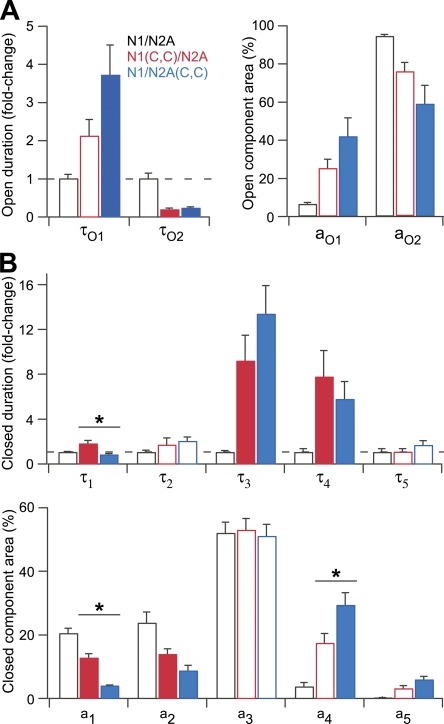
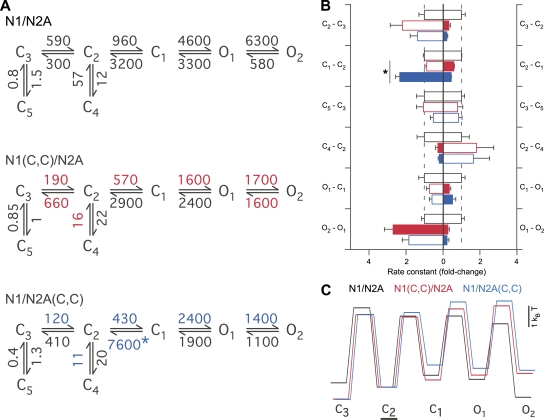
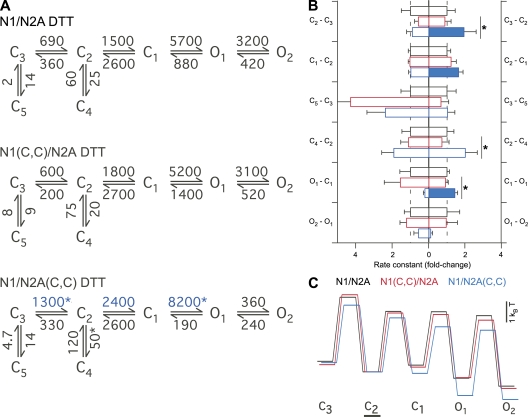
The defining functional feature of N-methyl-d-aspartate (NMDA) receptors is activation gating, the energetic coupling of ligand binding into opening of the associated ion channel pore. NMDA receptors are obligate heterotetramers typically composed of glycine-binding GluN1 and glutamate-binding GluN2 subunits that gate in a concerted fashion, requiring all four ligands to bind for subsequent opening of the channel pore. In an individual subunit, the extracellular ligand-binding domain, composed of discontinuous polypeptide segments S1 and S2, and the transmembrane channel-forming domain, composed of M1-M4 segments, are connected by three linkers: S1-M1, M3-S2, and S2-M4. To study subunit-specific events during pore opening in NMDA receptors, we impaired activation gating via intrasubunit disulfide bonds connecting the M3-S2 and S2-M4 in either the GluN1 or GluN2A subunit, thereby interfering with the movement of the M3 segment, the major pore-lining and channel-gating element. NMDA receptors with gating impairments in either the GluN1 or GluN2A subunit were dramatically resistant to channel opening, but when they did open, they showed only a single-conductance level indistinguishable from wild type. Importantly, the late gating steps comprising pore opening to its main long-duration open state were equivalently affected regardless of which subunit was constrained. Thus, the NMDA receptor ion channel undergoes a pore-opening mechanism in which the intrasubunit conformational dynamics at the level of the ligand-binding/transmembrane domain (TMD) linkers are tightly coupled across the four subunits. Our results further indicate that conformational freedom of the linkers between the ligand-binding and TMDs is critical to the activation gating process.
N-甲基-D-天冬氨酸(NMDA)受体的定义性功能特征是激活门控,即配体结合到相关离子通道孔打开的能量偶联。NMDA 受体是必需的异四聚体,通常由结合甘氨酸的 GluN1 和结合谷氨酸的 GluN2 亚基组成,以协调的方式门控,需要所有四个配体结合才能随后打开通道孔。在单个亚基中,由不连续多肽片段 S1 和 S2 组成的细胞外配体结合域,以及由 M1-M4 片段组成的跨膜通道形成域,通过三个接头连接:S1-M1、M3-S2 和 S2-M4。为了研究 NMDA 受体在孔打开过程中亚基特异性事件,我们通过连接 GluN1 或 GluN2A 亚基的 M3-S2 和 S2-M4 内的二硫键损害激活门控,从而干扰 M3 片段的运动,M3 片段是主要的孔衬和通道门控元件。在 GluN1 或 GluN2A 亚基中具有门控障碍的 NMDA 受体对通道打开具有显著抗性,但当它们打开时,它们仅显示出与野生型无法区分的单一电导水平。重要的是,无论哪个亚基受到限制,构成孔打开到其主要长持续时间开放状态的后期门控步骤都受到同等影响。因此,NMDA 受体离子通道经历一种孔打开机制,其中配体结合/跨膜域(TMD)接头处的亚基内构象动力学在四个亚基之间紧密偶联。我们的结果还表明,配体结合和 TMD 之间的接头的构象自由度对于激活门控过程至关重要。